Astronomers using ESO’s Very Large Telescope (VLT) have discovered a gas giant around a brown dwarf in the stellar system CD-35 2722. The discovery blurs the traditional lines between stars, planets and moons that make our own Solar System easy to describe.
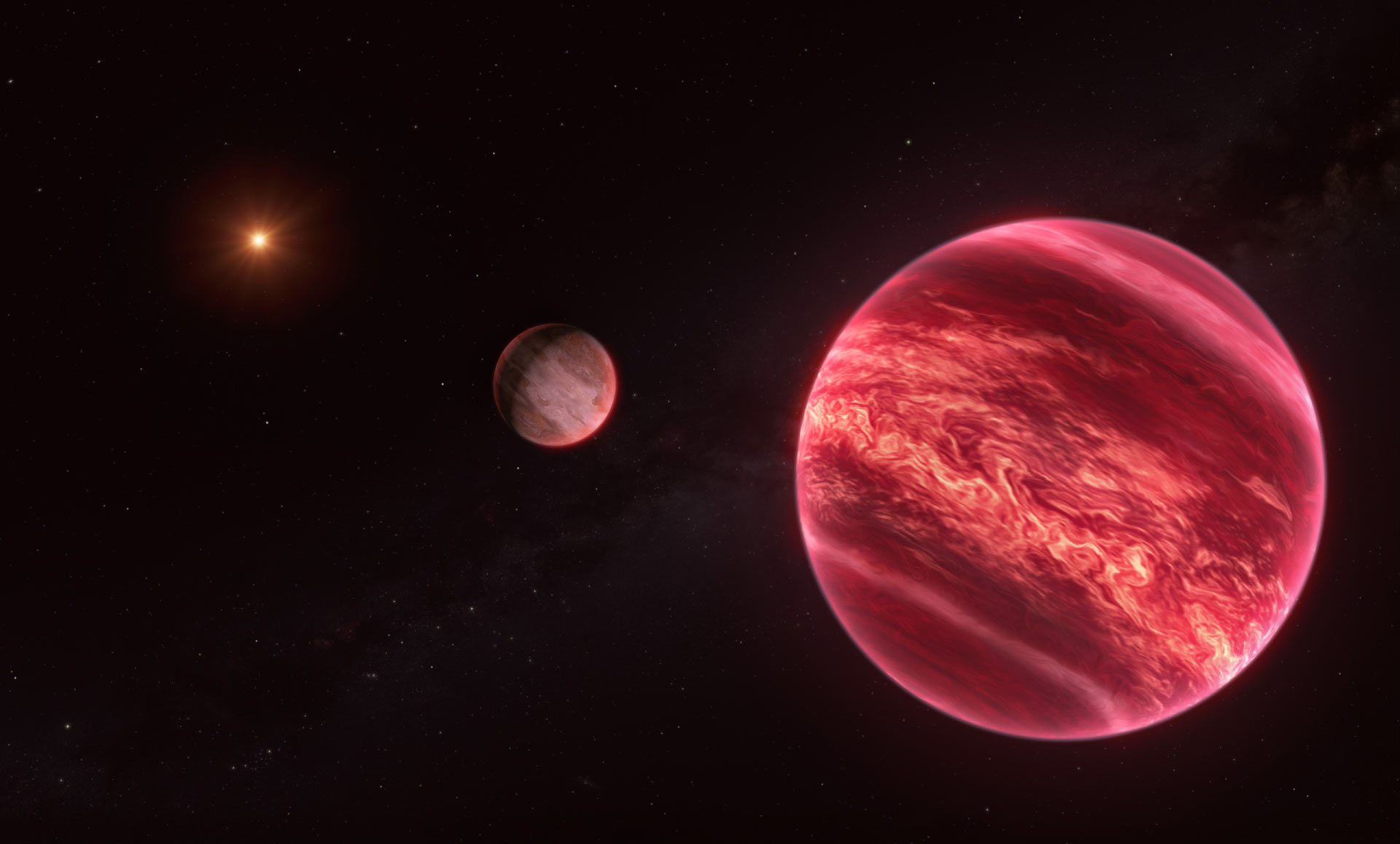
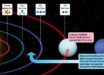
This illustration shows the stellar system CD-35 2722, with the newly found exomoon at the center; the star has about half the mass of our Sun, and it is orbited by a brown dwarf, the reddish-brown object seen here in the foreground (right). Image credit: ESO / M. Kornmesser.
CD-35 2722, also known as TIC 201426753, is a star located 73 light-years away from Earth in the constellation of Columba.
The star is orbited by a brown dwarf around 37 times Jupiter’s mass and the newly detected exomoon orbits that brown dwarf, rather than the star itself.
The exomoon has a minimum mass of about 0.9 Jupiter masses and an orbital period of around 170 days.
“This system is somewhat hard to define using solar-system-based words like ‘planet’ and ‘moon’,” said ESO astronomer Kevin Hoy.
“The exosatellite is clearly massive enough to be a planet, but it does not orbit a star, though it orbits an object that orbits a star.”
“Being the third wheel in this system makes us want to call it a moon, even if it is nothing like the small, rocky moons we have in our system.”
“The satellite we report is a giant gaseous body orbiting a highly massive companion, itself several times the mass of Jupiter,” said Universidad Diego Portales astronomer Alice Zurlo.
“We have a clear delineation between the planets and the Sun in the Solar System, so defining things like moons is simple.”
“In the CD-35 2722 system, where we are blurring the lines between stars, planets, and moons, the whole thing becomes more complicated to describe.”
The astronomers used the CRIRES+ instrument on VLT, applying the radial velocity method to detect subtle wobbles in the brown dwarf’s motion caused by the orbiting object.
“As exotic as it is, this system is truly unique and represents a breakthrough: the first plausible detection of an exosatellite,” Dr. Zurlo said.
The findings appear in the journal Nature.
_____
K. Hoy et al. 2026. Planetary-mass exosatellite detected around the substellar companion of a star. Nature 655, 865-869; doi: 10.1038/s41586-026-10751-w