An assemblage of more than 700 Ediacaran fossils from the end of the Ediacaran period indicates that key animal groups — including early relatives of vertebrates — were already diversifying millions of years earlier than long believed.
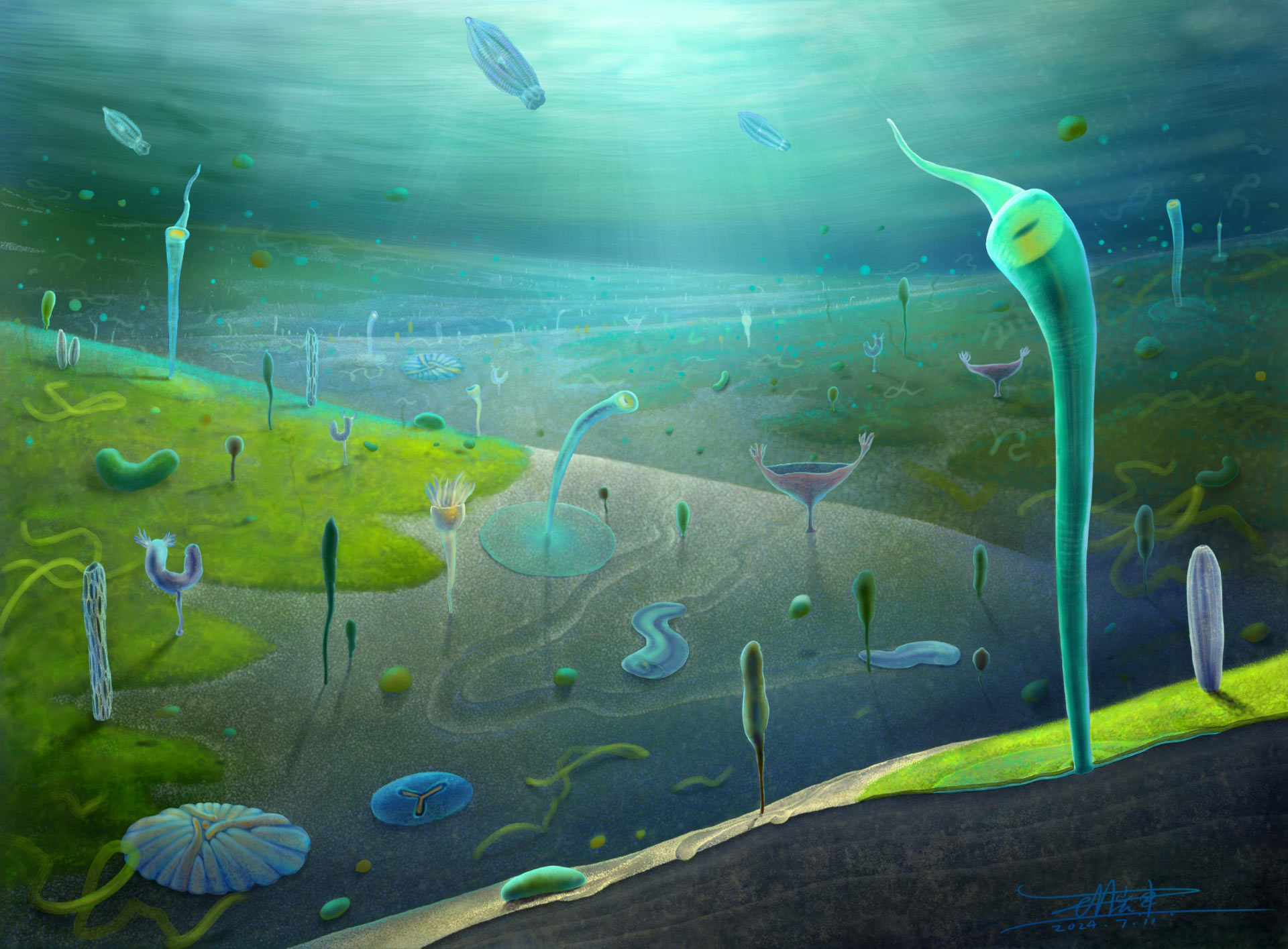
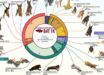
Reconstruction of the Jiangchuan Biota. Image credit: Xiaodong Wang.
The burst of animal diversification spanning the transition from the Ediacaran to the Cambrian periods stands as one of the most consequential turning points in Earth’s history.
Yet the fossil record offers only a fragmented view of that transformation: Ediacaran communities bear little resemblance to those of the Cambrian, leaving the pivotal moment when major animal groups emerged frustratingly out of reach.
“Our discovery closes a major gap in the earliest phases of animal diversification,” said Dr. Gaorong Li, a researcher at Oxford University.
“For the first time, we demonstrate that many complex animals, normally only found in the Cambrian, were present in the Ediacaran period, meaning that they evolved much earlier than previously demonstrated by fossil evidence.”
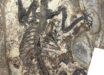
In the study, Dr. Li and colleagues examined more than 700 specimens from a recently-discovered fossil site in Yunnan, southwest China.
The fossil assemblage is between 554 and 539 million years old and is part of the Jiangchuan Biota.
Unlike most Ediacaran fossil sites, which preserve organisms mainly as impressions on sandstone surfaces, these fossils are preserved as carbonaceous films, a mode of preservation more typical of famous Cambrian sites such as the Burgess Shale in Canada.
“This discovery is extremely exciting because it reveals a transitional community: the weird world of the Ediacaran giving way to the Cambrian, the following time period where the animals are much easier to place in groups that are alive today,” said Oxford University’s Dr. Luke Parry.
“When we first saw these specimens, it was clear that this was something totally unique and unexpected.”
The assemblage contains the oldest known relatives of deuterostomes, the broader group that today includes vertebrates such as humans and fish.
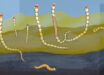
Among the specimens are also ancestors of modern starfish and their closest relatives, the acorn worms (the Ambulacraria).
They have a U-shaped body and were attached to the seafloor with a stalk, with a pair of tentacles on their head used to catch food.
“The presence of these ambulacrarians in the Ediacaran period is really exciting,” said Oxford University’s Dr. Frankie Dunn.
“We have already found fossils which are distant relatives of starfish and sea cucumbers and are looking for more.”
“The discovery of ambulacrarian fossils in the Jiangchuan Biota also means that the chordates — animals with a backbone — must also have existed at this time.”
Other ancestral groups among the fossils include worm-like bilaterian animals, some with complex feeding adaptations, alongside rare fossils interpreted as early comb jellies.
Many specimens show novel combinations of anatomical features that do not match any known Ediacaran or Cambrian species.
“Our results indicate that the apparent absence of these complex animal groups from other Ediacaran sites may reflect differences in preservation rather than true biological absence,” said Oxford University’s Dr. Ross Anderson.
“Carbonaceous compressions like those at Jiangchuan are rare in rocks of this age, meaning that similar communities may simply not have been preserved elsewhere.”
The discovery is described in a paper in the journal Science.
_____
Gaorong Li et al. 2026. The dawn of the Phanerozoic: A transitional fauna from the Late Ediacaran of Southwest China. Science 392 (6793): 63-68; doi: 10.1126/science.adu2291