Researchers at Guangzhou Medical University tracked nearly 88,000 people for over eight years, finding a significant link between daytime light exposure and reduced dementia rates.
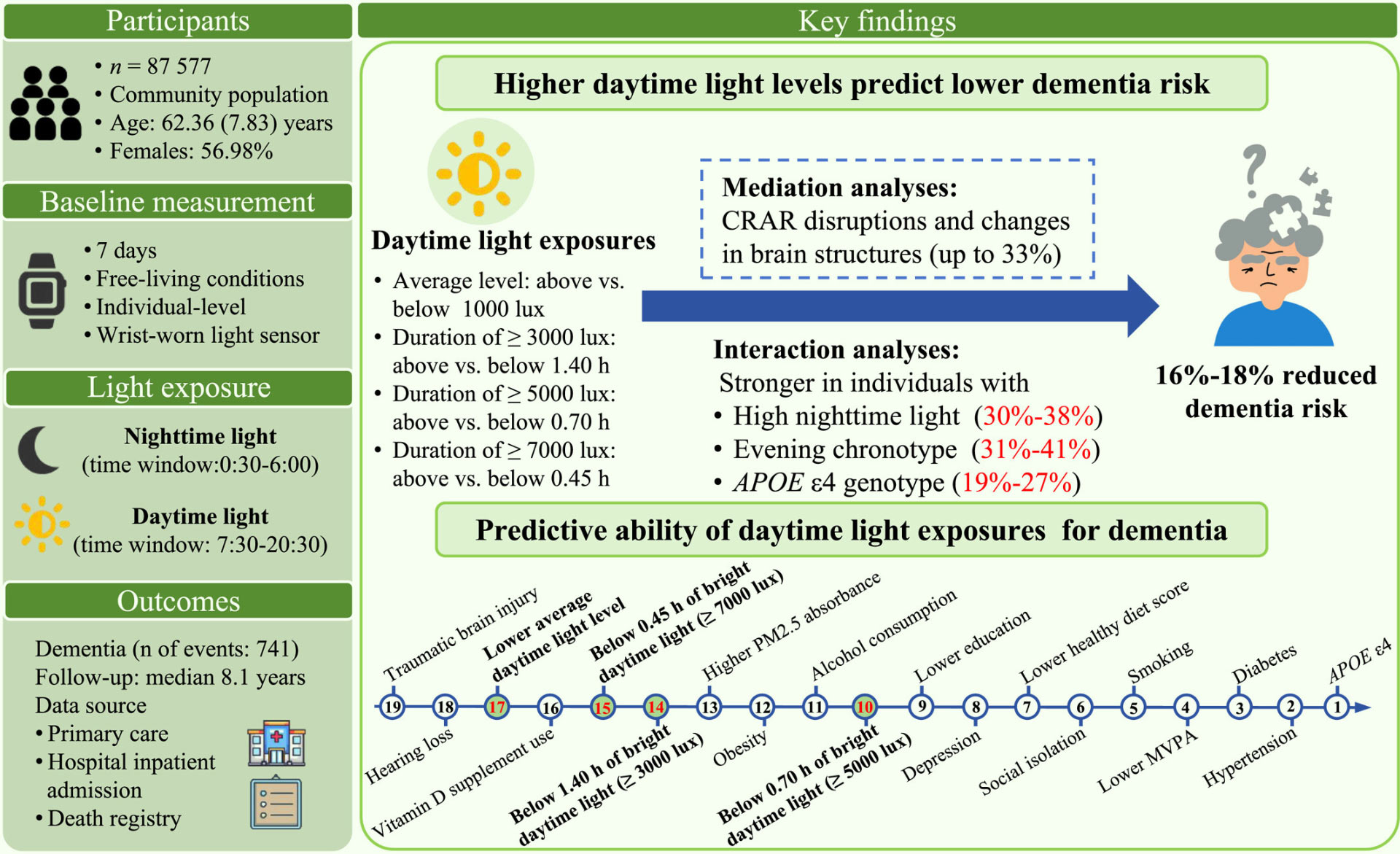
Zheng et al. uncovered a link between higher levels of daytime light exposure and a lower risk of dementia. Image credit: Zheng et al., doi: 10.1002/gps3.70039.
“Dementia, the most common neurodegenerative disease worldwide, is characterized by progressive cognitive decline and impairments in daily functioning,” said co-senior author Dr. Hongliang Feng and colleagues.
“As the global population ages, the rapidly increasing prevalence of dementia, coupled with limited effective treatments, presents a growing health and socioeconomic challenge.”
“Therefore, there is an urgent need to identify protective factors and establish effective prevention strategies.”
“The natural light-dark cycle, characterized by darkness at night and bright light during the day, is a fundamental environmental cue that entrains endogenous circadian rhythms.”
“This circadian entrainment regulates physiology, behavior and cognition.”
“Conversely, circadian disruptions are commonly found in persons with dementia and are associated with a higher risk of dementia in the general population.”
In the study, the authors tracked 87,577 adults from the UK Biobank over a median follow-up of 8.1 years.
They found that people who spent their days exposed to light levels above 1,000 lux — roughly the brightness of indirect outdoor daylight — had about a 16% lower risk of developing dementia compared with those exposed to dimmer conditions.
The benefit grew with intensity: participants who logged at least 42 minutes daily at 5,000 lux or brighter saw their risk drop by roughly 17%.
Crucially, the researchers measured light exposure not through self-reported surveys but through wrist-worn sensors worn continuously for seven days under real-world conditions.
“These findings position daytime light exposure as a novel, robust and measurable indicator of dementia risk,” the scientists said.
When ranked against 15 established dementia predictors using a machine learning model, insufficient bright daytime light outperformed factors including obesity, alcohol consumption, air pollution and traumatic brain injury.
The protective association was strongest in three groups: people who also experienced high nighttime light exposure, night owls, and carriers of the APOE ε4 gene variant, which is the most significant known genetic risk factor for Alzheimer’s disease.
In those groups, the dementia risk reduction reached as high as 41%.
The researchers suggest that daytime light may work in part by stabilizing the body’s circadian rhythms and preserving certain brain structures.
Nighttime light exposure, by contrast, showed no significant association with dementia risk.
“The findings could inform future research into light-based interventions and public health guidelines that recommend increased daytime light exposure as a low-cost strategy to support brain health, particularly in high-risk populations,” the scientists concluded.
Their paper appears in the journal General Psychiatry.
_____
Nana Zheng et al. 2026. Associations between wearable-device-measured daytime and nighttime light exposures and dementia risk: A prospective cohort study. General Psychiatry 39 (3): e70039; doi: 10.1002/gps3.70039