Paleontology News

Apr 10, 2013 by Enrico de Lazaro

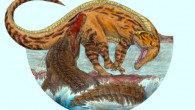
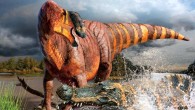
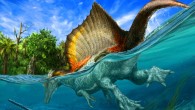
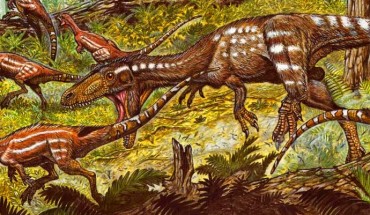
100M year old dinosaur tracks reported in the journal Chinese Science Bulletin suggest that some dinosaurs were strong swimmers. Carnivorous two-legged dinosaur swimming in a river, making claw marks as it touches bottom with its tiptoes (Nathan E. Rogers) “Humans have been around for about 200,000 years. Dinosaurs ruled for Earth for 160 million years,” said study co-author Scott Persons, a paleontologist with the University of Alberta. “From...

Apr 4, 2013 by News Staff

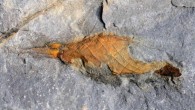
A new study published in the new peer-reviewed open access journal PeerJ sheds light on the origin of tadpole shrimps, a group commonly regarded as ‘living...

Apr 3, 2013 by Sergio Prostak

Chinese paleontologists led by Dr Tao He from the Zhejiang Museum of Natural History in Hangzhou have identified a new species of thalattosaur from a fossil...

Mar 29, 2013 by News Staff

A 246-million-year-old skull fossil found in Winterswijk, the Netherlands, sheds new light on the origin and phylogenetic development of placodonts, a...

Mar 22, 2013 by Enrico de Lazaro

University of Southampton paleontologists have described a completely new genus and species of small prehistoric flying reptile from a fossil discovered...

Mar 12, 2013 by Enrico de Lazaro

Paleontologists from the Australian National University have described a new species of ancient fish, after unearthing the largest fossilized lobe-finned...

Mar 11, 2013 by Sergio Prostak

Analysis of DNA extracted from a fossil tooth found in 1975 in a cave called Razboinichya in southern Siberia, Russia, confirms that the tooth belonged...

Mar 6, 2013 by Enrico de Lazaro

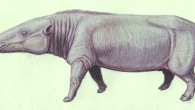
A group of paleontologists has announced the discovery of fossilized remains of an extinct giant camel that lived in what is now Canada about 3.5 million...

Mar 5, 2013 by Enrico de Lazaro

According to U.S. paleontologists, the discovery of 19 million year old crocodilian fossils in Panama sheds new light on the history of interchange and...

Mar 4, 2013 by Enrico de Lazaro

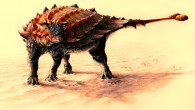
Paleontologists from the South Dakota School of Mines & Technology, the University of Tennessee and North Carolina State University, have found the...

Feb 28, 2013 by Enrico de Lazaro

An international team of paleontologists has solved some of the mysteries surrounding large spiral fossils of an ancient fish called Helicoprion. Outdated...

Feb 13, 2013 by Enrico de Lazaro

A study by Prof Paul Else of the University of Wollongong, Australia, suggests dinosaurs may have produced a kind of milk for their offspring. “But...

Feb 8, 2013 by Enrico de Lazaro

A small, insect-eating animal was the common ancestor of placental mammals, an international team of researchers has reported in the journal Science (full...

Feb 5, 2013 by Enrico de Lazaro

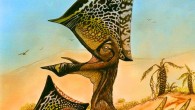
A team of scientists from Romania, the United Kingdom and Brazil has described a new species of extinct flying reptile from the time of the dinosaurs. This...

Feb 1, 2013 by Enrico de Lazaro

Tapeworm eggs found in 270-million-year-old fossilized shark feces provide the earliest known evidence of intestinal parasites in vertebrates. Left: a...

Jan 29, 2013 by Sergio Prostak

Sexual selection can be inferred from the fossil record, according to a new paleontological study appearing in the journal Trends in Ecology and Evolution. Sexual...

Jan 25, 2013 by Enrico de Lazaro

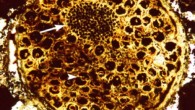
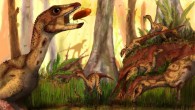
Paleontologist Derek Larson of the Royal Ontario Museum, who spent six years analyzing fossilized dinosaur teeth, has identified more than 20 species of...

Jan 25, 2013 by Enrico de Lazaro

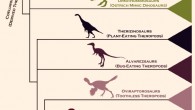
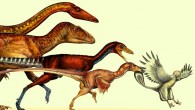
According to a team of paleontologists from Europe and China, the discovery of a new bird-like dinosaur from the Jurassic period challenges widely accepted...

Jan 24, 2013 by Natali Anderson

An international team of scientists has discovered a 2-million-year-old species of fox at the site of Malapa in the Cradle of Humankind World Heritage...

Jan 18, 2013 by Sergio Prostak

According to Dr Julien Benoit and his colleagues from the University of Science and Technology in Montpellier, France, an Eocene skull fossil discovered...