For the first time, researchers have extracted ancient human DNA directly from the walls of a cave. Although their results do not conclusively link ancient DNA preservation to the generation of cave art, they show that traces of human DNA can persist on cave walls for thousands of years.
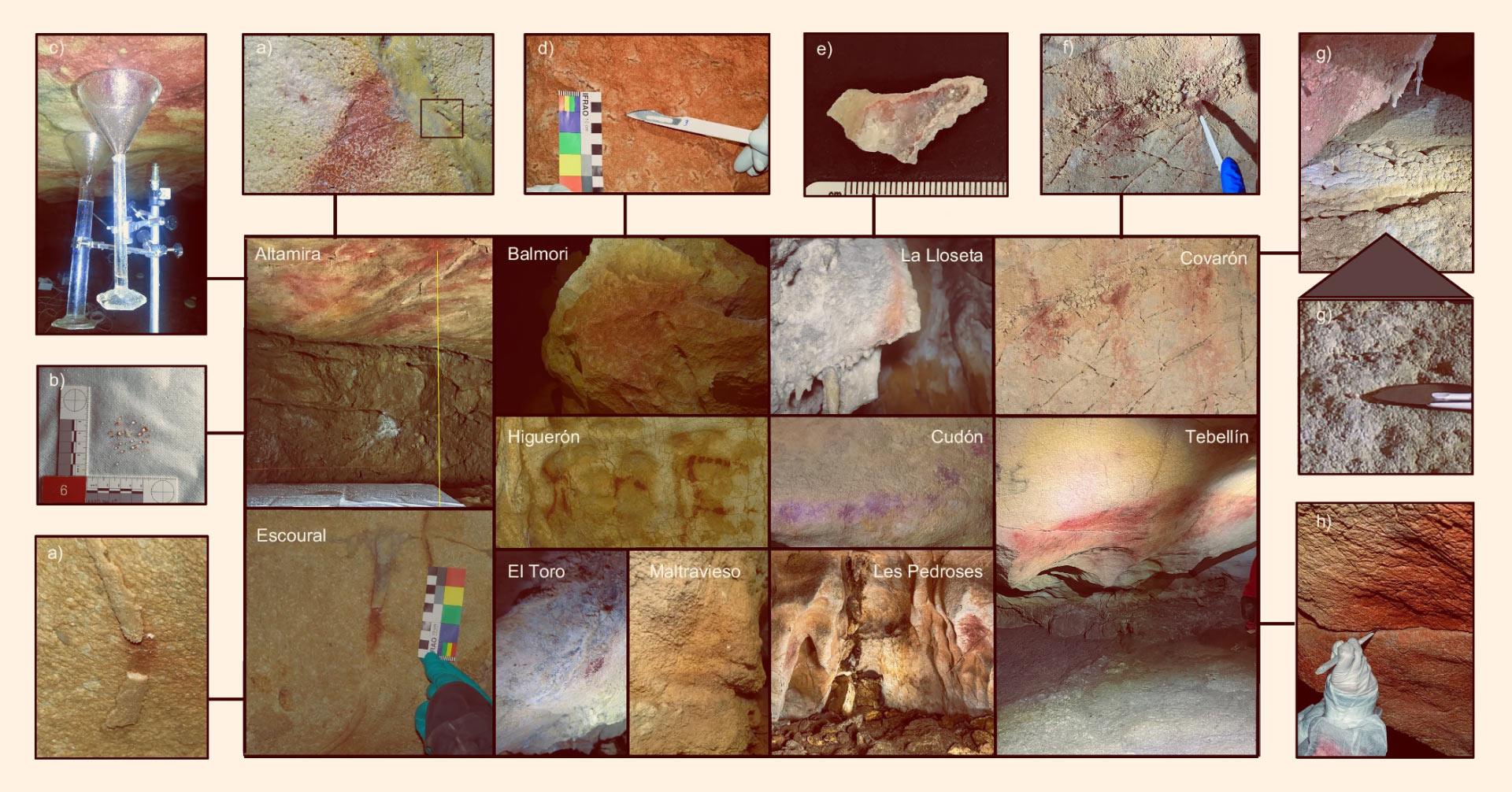
Representative rock art figures from each of the 11 archaeological sites analyzed by Bossoms Mesa et al. Image credit: Bossoms Mesa et al., 10.1038/s41467-026-74234-2.
A major challenge in the study of human prehistory is linking cultural artifacts in the archaeological record to the human groups who created them.
Ancient DNA research has helped bridge this gap through the analysis of human DNA from skeletal remains, sediments, and more recently, from artifacts themselves.
However, rock art, an important expression of human culture, remains beyond the reach of paleogenetics, as it usually lacks direct association with excavated cave floors.
As a result, ancient DNA analysis cannot currently contribute to debates about authorship, including whether Neanderthals, in addition to early modern humans, created rock art.
“We know that some of the art was applied to cave walls by blowing or rubbing pigment onto the surface,” said Dr. Hipólito Collado Giraldo, an archaeologist and rock art specialist from the Extremadura Government in Spain.
“Given the enormous sensitivity of current ancient DNA analysis techniques, we were eager to see if this type of contact could leave traces of DNA in the rock art, potentially allowing us to obtain genetic profiles from the makers of the art.”
Dr. Collado Giraldo and his colleagues from Germany, Spain and Portugal analyzed DNA preservation in pigment samples collected in and around 24 rock art panels from 11 caves across Spain and Portugal.
The paintings, most created with red ochre, included simple marks (from nine sites), dots, hand stencils (Maltravieso Cave, Spain) and figurative imagery (Cave of Altamira, Spain).
The researchers also tested unpainted sections of cave wall, sediment, animal bones and a bird-bone fragment thought to have been used as an airbrush for spraying pigment.
The strongest result came from Escoural Cave in Portugal, where a sample taken from a pigmented calcite crust yielded genetic material from one or more humans, with no trace of animal DNA.
An unpigmented wall sample from the same cave produced a similar result.
Because sediment and other environmental sources typically carry a broad mix of animal DNA, the scientists concluded that the human DNA at Escoural Cave most likely came from direct contact rather than from surrounding dirt or debris.
Three other unpigmented wall samples, from Escoural and from Covarón Cave in Asturias, Spain, contained a mixture of human and animal DNA, suggesting a less direct route, such as people carrying sediment on their hands or feet as they moved through the caves.
At Covarón, genetic analysis of two wall samples linked the DNA to a population of western hunter-gatherers who inhabited Europe roughly between 5,200 and 16,700 years ago, and indicated the DNA likely came from women. A separate wall sample from Escoural Cave pointed to a male source.
The authors were not able to determine precise ages for most of the recovered DNA, though patterns of chemical degradation and the archaeological history of the sites suggest the material is at least several thousand years old, and at Escoural, at least 4,000 to 5,000 years old.
Despite sampling extensively, they recovered usable ancient human DNA from only one of the 24 painted panels, and none from the bird-bone airbrush at Altamira, indicating that pigmented cave surfaces rarely preserve enough genetic material to detect after so much time has passed.
As a result, the study stops short of establishing who made the paintings, including whether the DNA found near the Escoural pigment came from the artists themselves or from unrelated human activity in the cave.
“Although we cannot directly connect the traces of ancient human DNA we have found to the creation of rock art, this is the first evidence for human DNA preservation on cave walls for thousands of years,” said Alba Bossoms Mesa, a doctoral researcher at the Max Planck Institute for Evolutionary Anthropology.
“It is exciting to think that we may have uncovered a new way to study prehistoric human presence”.
“This study fundamentally changes how we think about where ancient DNA can be found,” said Dr. Matthias Meyer, a paleogeneticist at the Max Planck Institute for Evolutionary Anthropology.
“We were surprised to see that ancient DNA can be recovered not only from pigmented samples, but also from cave walls that show no visible evidence of past human activity.”
“The preservation of human DNA on cave walls is highly variable,” Bossoms Mesa said.
“But when it does survive, it tells a powerful story. And while these first results are promising, I think our priority now should be to refine the methods and to understand under what conditions we can expect a higher success rate”.
“This is just the beginning. We now know that cave walls are genetic archives of past human presence,” Dr. Meyer said.
“The next step is to test more sites, art styles and techniques, especially hand stencils and figurative art in caves with good molecular preservation, as far as minimally invasive sampling allows.”
“With further work, it may become possible to reveal the makers of at least some pieces of cave art — and to put faces, or at least genetic identities, to the artists who created them.”
A paper on the results was published June 23 in the journal Nature Communications.
_____
A. Bossoms Mesa et al. 2026. Investigating ancient human DNA preservation on cave walls and in rock art. Nat Commun 17, 5561; doi: 10.1038/s41467-026-74234-2