Researchers at Binghamton University have applied a 70-year-old theory of information to the viral word game Wordle, revealing how a carefully chosen first guess can dramatically improve a player’s chances of solving the puzzle.
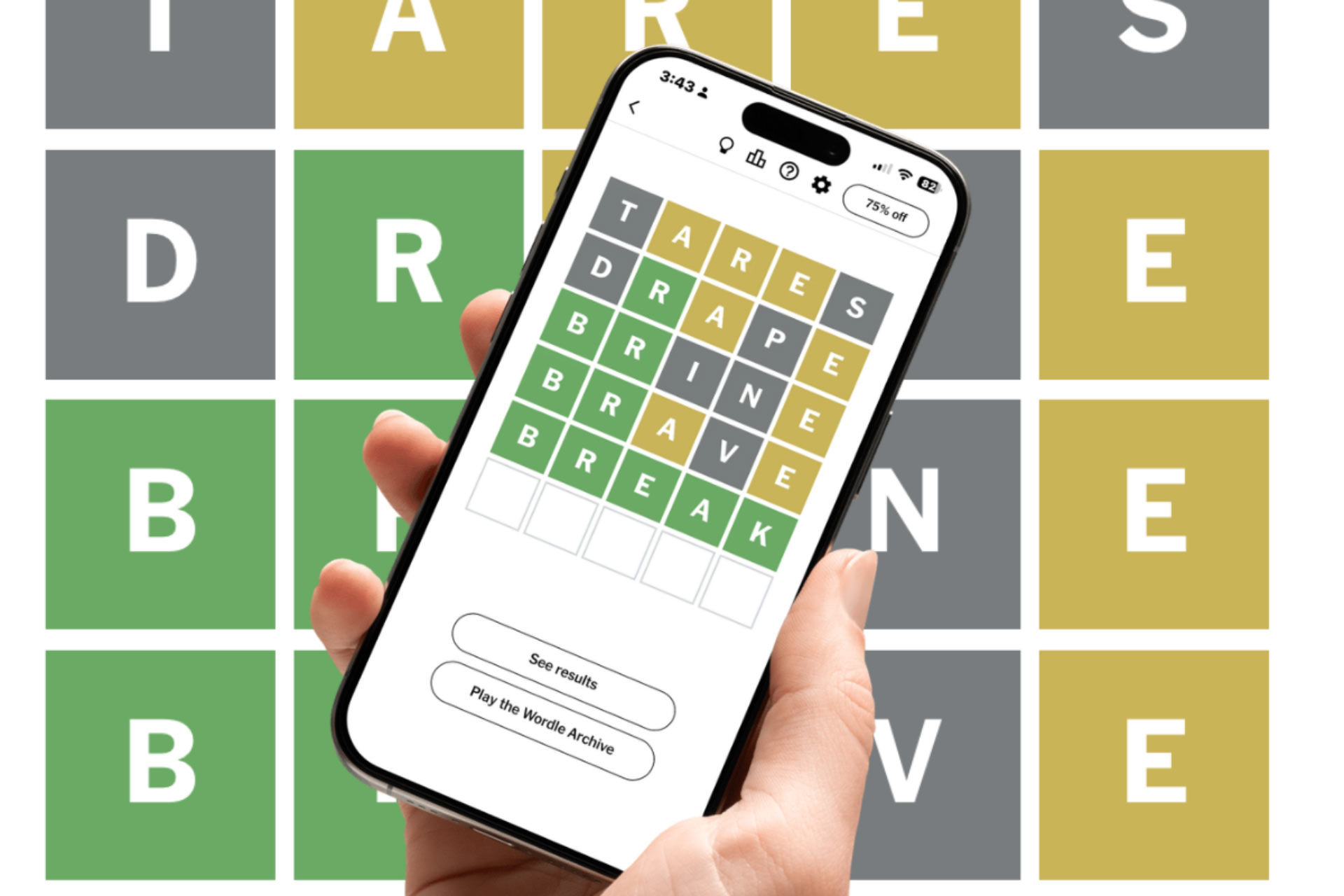
Wordle, a popular word-guessing game, challenges players to identify a five-letter secret word through iterative guesses and feedback on letter placement. The players must figure out the secret word within six guesses. After each guess, the letters will be color-coded based on different criteria. Optimizing the choice of guesses is critical for maximizing success within the limited attempts allowed. Image credit: Aladaileh et al., doi: 10.63562/2577-8439.1146.
Wordle is a popular online single player game developed by Josh Wordle, where players attempt to identify a secret word by making five-letter word guesses.
The game is won if the player can guess the secret word in six guesses or less; otherwise, the game is lost.
Following each guess, players receive feedback indicating which letters are absent from the word (highlighted as gray), which letters are present but incorrectly positioned (highlighted as yellow), and which letters are both correct and in the proper position (highlighted as green).
Using this information, players refine their guesses by eliminating incorrect options and selecting new possibilities for subsequent attempts.
“Beyond being well-known as a simple word-guessing game, Wordle can be looked at as a dynamic feedback system in which each guess will provide information that will affect the subsequent guesses,” said senior author Dr. Congyu ‘Peter’ Wu and colleagues.
“Through this continuous feedback, the state of the game develops as players learn from clues and eliminate possibilities, which reduces the uncertainty with each round.”
“This uncertainty is quantified using entropy; as feedback narrows down the possible solutions, the entropy (uncertainty) of the game state decreases, moving the solution from disordered state initially to more organized state.”
“In this way, information theory offers a clear framework for analyzing how the decision-making process works and adapts with each guess in Wordle.”
The authors applied Shannon entropy — a mathematical measure of uncertainty — to determine which guesses provide the most information.
Rather than focusing solely on guessing the most likely answer from the get-go, their method prioritizes guessing words that provide as much information as possible to reduce the pool of possible words.
“Let’s say you’re at a certain guess,” Dr. Wu said.
“The previous guesses will eliminate a whole bunch of options, and based on the remaining options, guessing some words will send you into a trajectory where information gain is speedier.
“A subtle but important insight from the paper is that a guess doesn’t have to be the most likely answer; it simply has to be informative,” added co-author Donald Stephens, a doctoral student at Binghamton University.
“By applying Shannon entropy, the objective shifts to maximizing the expected reduction in uncertainty rather than the probability of being right.”
“In practice, this approach can lead to solving the puzzle in fewer guesses.”
The team’s method might seem more random, but it is more likely to lead to a successful guess by the end of the game.
To use the method in real time, a player would need to run a script/program on the side.
The player would enter the color-coded feedback that the game provides, and the program would spit out the next best guess to attempt to provide more information.
The researchers tested their strategy against a more traditional approach based on guessing common letters (e.g., A, E, R).
In simulations, their approach solved 99% of Wordle puzzles, while the traditional method solved just 90%.
“The experimental results demonstrate that entropy-based word selection improves performance compared to a heuristic approach based on selecting words by letter distribution, providing a systematic framework for decision-making in Wordle,” the scientists said.
Their paper was published in April 2026 in the Northeast Journal of Complex Systems.
_____
Talal Aladaileh et al. 2026. Solving Wordle Using Information Theory. Northeast Journal of Complex Systems 8 (1): 6; doi: 10.63562/2577-8439.1146