Scientists at the University of Waterloo and Kyushu University have developed the first method to create redundant, encrypted copies of qubits — a milestone toward practical quantum cloud services and secure quantum infrastructure.
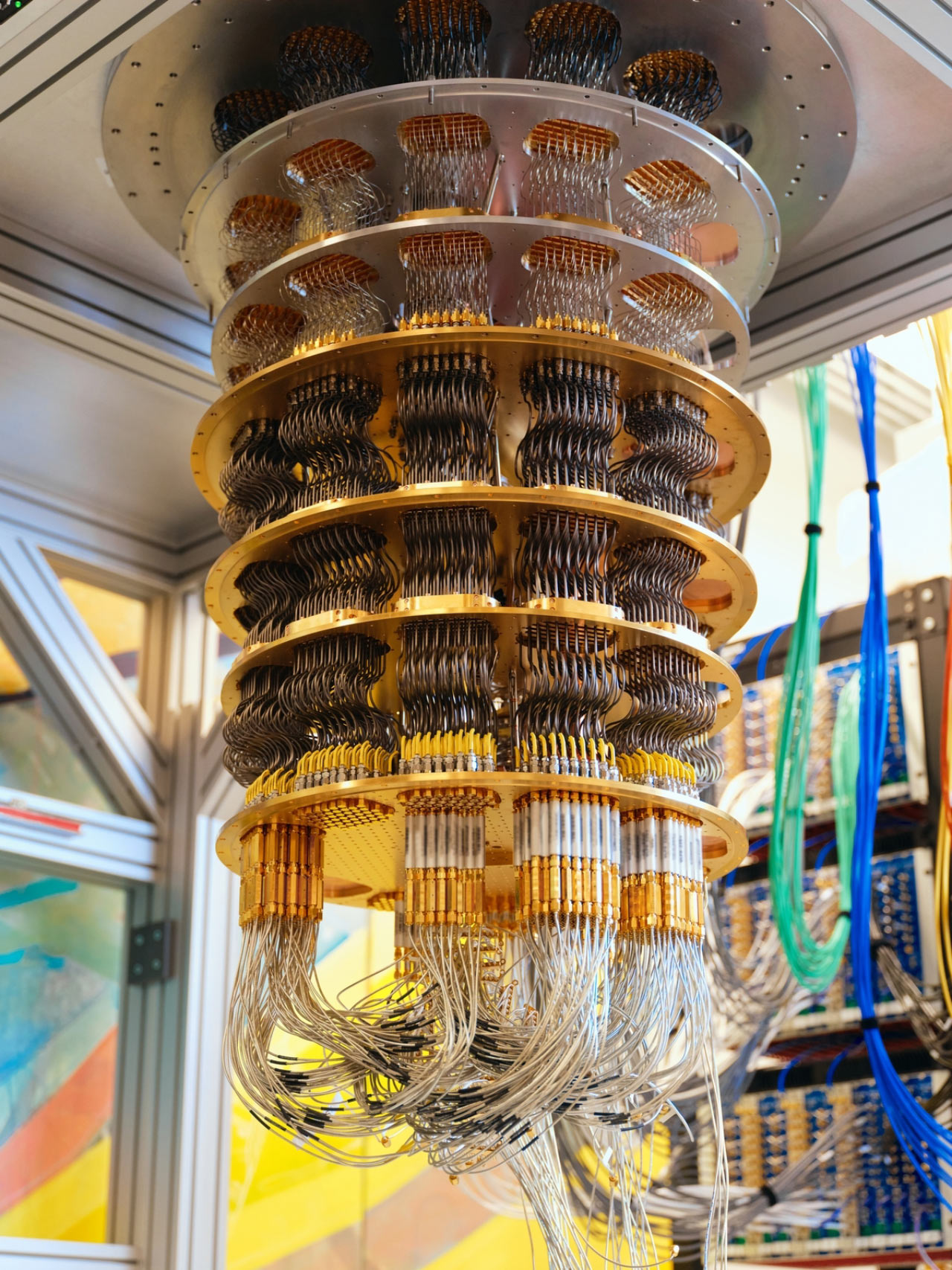
Google’s quantum computer. Image credit: Google.
In quantum mechanics, the no-cloning theorem says it is impossible to make an identical copy of an unknown quantum state.
University of Waterloo’s Dr. Achim Kempf and Kyushu University’s Dr. Koji Yamaguchi stress that this basic rule still holds.
What they show instead is a method that produces many encrypted versions of a single quantum bit, or qubit.
“This breakthrough will enable quantum cloud storage, like a quantum Dropbox, a quantum Google Drive or a quantum STACKIT, that safely and securely stores the same quantum information on multiple servers, as a redundant and encrypted backup,” Dr. Kempf said.
“It’s an important step in enabling the buildup of quantum computing infrastructure.”
“Quantum computing has tremendous potential, particularly for solving very hard problems, but it also poses unique challenges.”
“One of the most challenging issues facing quantum computing is called the no-cloning theorem, which states that quantum information cannot be copied, at least not directly.”
“This is because of the delicate way in which quantum information is stored.”
According to the researcher, quantum information works a bit like splitting a password.
“If you have the first half of the password and a friend has the second half, neither of you can use it alone — but if you put your two halves together, you acquire the valuable password,” Dr. Kempf said.
“In a similar sense, qubits are special because they can share information in a way that grows as you combine them.”
“A single qubit doesn’t hold much on its own, but when qubits are linked together, they can store a huge amount of information that only appears when they’re connected.”
“This unique ability to hold shared information across multiple qubits is called quantum entanglement.”
“100 qubits can share information in 2100 ways simultaneously. This allows them to share so much entangled information that all of today’s classical computers could not store it.”
“For all the potential of quantum computing, however, the no-cloning theorem limits how it can be applied.”
“This is because, unlike in classical computing, where the copying of information — for sharing and for backups — is a very commonly used tool, there is no simple copy and paste in quantum computing.”
“We have found a workaround for the no-cloning theorem of quantum information,” Dr. Yamaguchi said.
“It turns out that if we encrypt the quantum information as we copy it, we can make as many copies as we like.”
“This method is able to bypass the no-cloning theorem because after one picks and decrypts one of the encrypted copies, the decryption key automatically expires, that is the decryption key is a one-time-use key.”
“But even a one-time key enables important applications, such as redundant and encrypted quantum cloud services.”
The team’s work will appear in the journal Physical Review Letters.
_____
Koji Yamaguchi & Achim Kempf. 2026. Encrypted Qubits can be Cloned. Physical Review Letters, in press; arXiv: 2501.02757