A team of researchers working at the National Evolutionary Synthesis Center has found that some insects such as crickets and katydids evolved their supersensitive hearing long before their predators came to be.

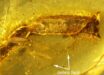
50 million-year-old fossil cricket (Dena Smith)
A new study of 50 million year-old cricket and katydid fossils, published in the January 2012 issue of Journal of Paleontology, helps trace the evolution of the insect ear.
“Insects hear with help from unusual ears. Grasshoppers have ears on their abdomens. Lacewings have ears on their wings. The ears of the tachinid fly are tucked under the chin. Insects have ears on pretty much every part of their body except on their head proper,” said Dr. Roy Plotnick of the University of Illinois, a co-author on the study.
Insects have evolved ears at least 17 times in different lineages. Dr. Plotnick and his co-author Dr. Dena Smith of the University of Colorado are trying to figure out when different insects got their ears, and whether predators may have played a role.

Fossil cricket ear: it appears as a light-colored oval on the front leg (Roy Plotnick)
Modern insects use their ears to tune in to each other’s chirps, trills and peeps. Many species can also pick up sounds beyond the range of human hearing, such as the high-pitched sonar of night-hunting bats. Crickets, moths and other flying insects have ultrasound-sensitive hearing and can hear bats coming, diving or swerving in midflight to avoid being eaten.
“The big evolutionary trigger for the appearance of hearing in many insects is thought to be the appearance of bats. Prior to the evolution of bats we would expect to find ears in relatively few insects, but after that we should see ears in more insect groups,” Dr. Plotnick said.
For this study, the researchers examined fossils from a Green River site in Colorado, focusing on crickets and katydids, which have ears on their front legs, just below their knees. They scoured more than 500 museum drawers of Green River fossils for crickets and katydids with intact front legs, looking for evidence of ears. “You can just make them out with the naked eye,” Dr. Plotnick explained. “They look like the eye of a needle.”
In crickets and katydids living today, the ear is a tiny oval cavity with a thin membrane stretched over it that vibrates in response to sound, much like our own eardrum.
The fossil ears measured half a millimeter in length, and were virtually identical in size, shape, and position to their modern counterparts.
The findings suggest that this group of insects evolved their supersensitive hearing long before bat predators came to be.
“Their bat-detecting abilities may have simply become apparent later. The next step is to look for ears in other insect groups,” concluded Dr. Smith.