Children who were already obese in early childhood face roughly a one-in-two chance of being obese at 13; for those who were merely overweight, the risk is about one in ten, according to a study of 124,470 Norwegian children.
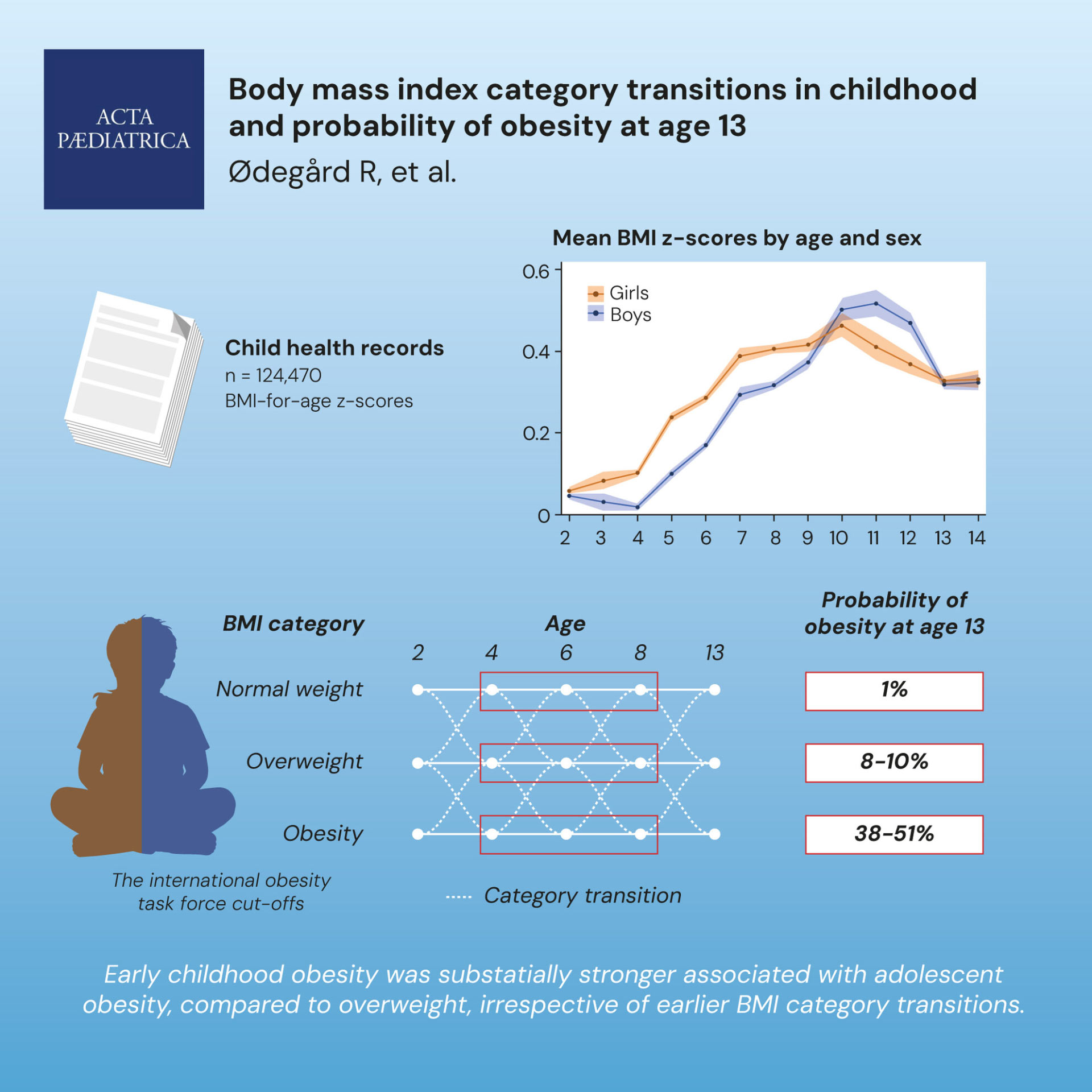
Early childhood obesity was strongly associated with adolescent obesity, whereas overweight was associated with a substantially lower risk of progression, even among children whose BMI had recently increased from normal weight. Image credit: Ødegård et al., doi: 10.1111/apa.70715.
“If we want to improve public health and reduce the prevalence of obesity among 13-year-olds, we need to do two things at the same time: (i) provide treatment for those at the very highest level of risk; and (ii) implement effective preventive measures that reach everyone,” said lead author Professor Rønnaug Astri Ødegård from the Norwegian University of Science and Technology and Trondheim University Hospital.
The researchers analyzed 360,957 routine height and weight measurements recorded at child health visits at ages 2, 4, 6, 8 and 13 in the cities of Trondheim and Bergen. The records span children measured between 1991 and 2017.
They sorted children into normal weight, overweight and obesity using international cutoffs. They then estimated how earlier categories related to obesity at 13.
The predicted probability of obesity at 13 was low for children of normal weight, between 0.4% and 2% depending on the age assessed.
For children with overweight at ages 4, 6 or 8, it was 8% to 10%.
For children with obesity at those ages, it ranged from 38%, when obesity was seen at age 4, to 51%, when it was seen at age 8.
Of children with overweight or obesity at age 6, around 44% had normal weight by 13. Half of the children who were obese by 13 had been in the normal-weight range at age 6.
Prior research has linked rapid increases in body mass index in the preschool years to later obesity. In this study, though, the risk of adolescent obesity varied little with a child’s earlier transitions.
Among children with overweight at 6, the chance of obesity at 13 was 9% to 12% whether they had been normal weight, overweight or obese at 4.
The risk was not elevated even among children whose body mass index (BMI) had recently crossed from normal weight into overweight.
Children who had obesity and later moved down to overweight had no higher risk of adolescent obesity than children who had never been obese, which illustrates the potential benefit of effective treatment.
“Some parents receive a phone call from the school nurse after their child has been weighed in year 3, informing them that their child is overweight,” said co-author Dr. Waaler Bjørnelv, a researcher at the Norwegian University of Science and Technology and the University of Oslo.
“But we need to question whether this is the best use of resources when it comes to preventing obesity among 13-year-olds.”
“The point is to make it easier for all children and families to make healthy choices,” Professor Ødegård added.
“Among children who do not already have obesity, it is difficult to predict who will develop it later. That is why preventive measures need to reach a broad population.”
The study will be published in the December 2026 issue of the journal Acta Paediatrica.
_____
R. Ødegård et al. 2026. Body Mass Index Category Transitions in Childhood and Probability of Obesity at Age 13. Acta Paediatrica 115 (12): 2906-2915; doi: 10.1111/apa.70715