Tethyshadros insularis, an island-dwelling duck-billed dinosaur that lived 81 million years ago in what is now Italy, did not have a comb of tooth-like spikes at the tip of its snout, according to a new analysis; instead, those structures were part of a dense network of blood vessels and nerves that fed a large, bird-like beak.
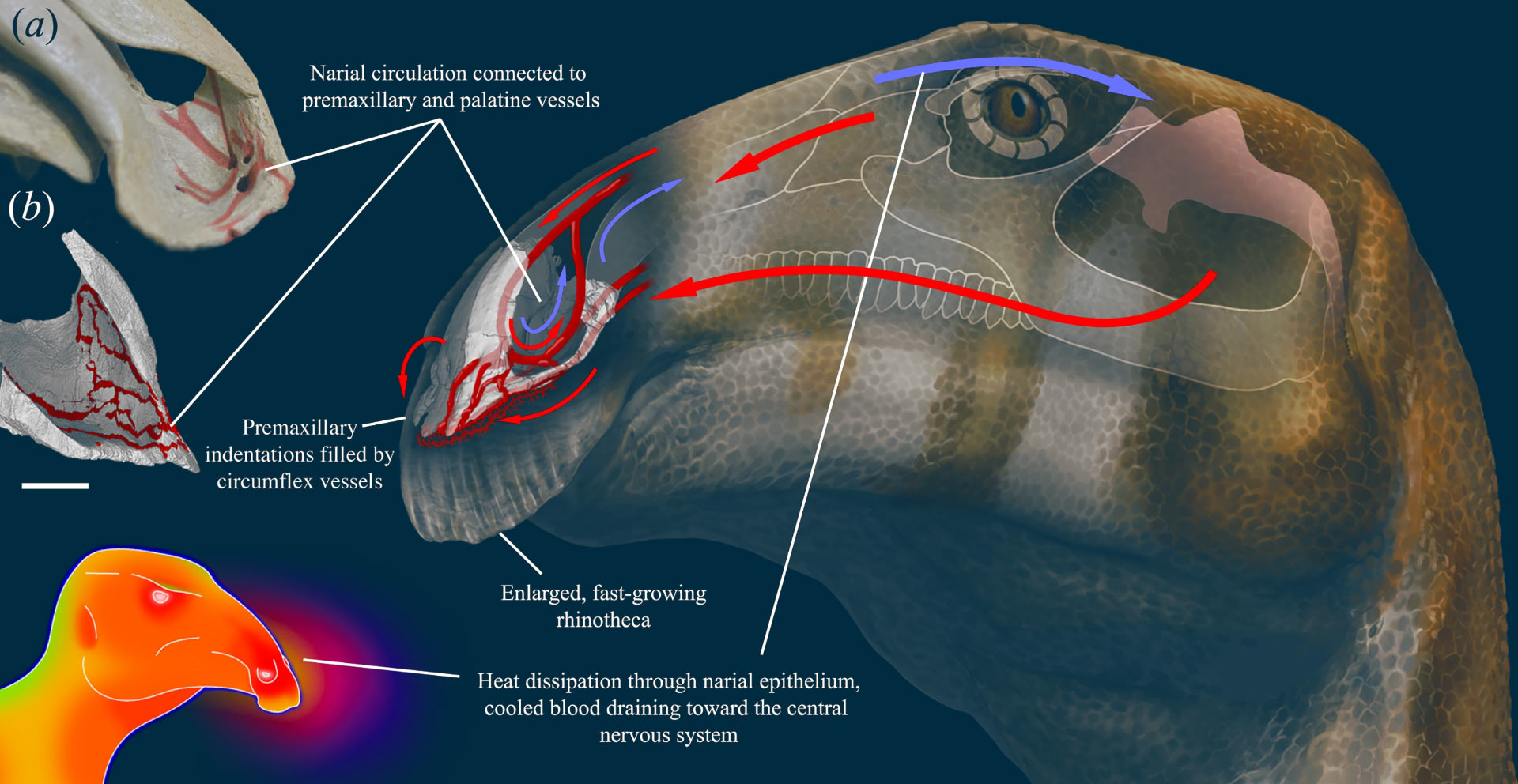
The inferred beak-nares thermal exchange system in Tethyshadros insularis, with arterial/warm blood (red) nourishing the hypertrophied rhinotheca and passing through the naris, where venous/cooled return (blue) drains towards the neurocranium: (a-b) highlight of osteological correlates for the narial premaxillary circulation in (a) Gobihadros mongoliensis and (b) Tethyshadros insularis. Scale bar – 20 mm. Image credit: Muscioni et al., doi: 10.1098/rsos.260392 / Davide Bonadonna.
“Bird beaks are among the most complex and versatile oral structures in tetrapods,” said Dr. Alfio Alessandro Chiarenza of University College London and colleagues.
“They consist of a cornified structure at the edentulous terminal portion of the rostrum.”
“Across more than 10,000 bird species, beaks show extreme variation in shape reflecting how birds feed, interact and move through their environments.”
“These structures also play key roles in preening, manipulation, thermoregulation, vocal production and even locomotion.”
“Beaks were not restricted to theropods, and multiple lineages of ornithischian dinosaurs evolved specialized beaks or beak-like structures often in tandem with toothed jaws,” they added.
“Duck-billed hadrosauroid dinosaurs represent a clear example of this condition, with anterior edentulous beaks and posterior specialized tooth batteries for efficient mastication.”
“However, the physiological role of the hadrosauroid beak, its in vivo appearance and its paleoecological relevance have been somewhat overlooked.”
In the research, the paleontologists focused on Tethyshadros insularis, one of the best-preserved dinosaurs of its group in Europe.
When the animal was first described, forward-facing, rod-like projections along the edge of its upper jaw were taken as evidence of an unusual, comb-like toothed beak. The idea also shaped popular artistic reconstructions.
Using micro-computed tomography, the authors examined the upper and lower jaw bones at the front of the snout in three Tethyshadros insularis individuals, including the holotype specimen.
The scans let them trace canals and openings inside the bone that once carried blood vessels and nerves.
They suggest that the ‘spikes’ and the porous bone around them are osteological correlates of an exceptionally developed neurovascular network.
The reconstruction links circulation around the nostril, the palate and the beak’s base, along with a previously unrecognized sinus at the midline of the upper jaw.
Large vessels looped along the cutting edge and probably supported a keratin sheath, the rhamphotheca, that likely exceeded the underlying bone in both size and complexity.
This is the first detailed description of such structures in ornithopods, the group that includes duck-billed dinosaurs.
The team compared the pattern with modern birds and turtles and found the closest match in birds.
They also found similar arrangements around the nails and hooves of large mammals such as horses, cattle and elephants.
“The best-documented potential functional analogue is found in the vascular organization of ungual phalanges, both in large ornithischians and in extant large mammals bearing hooves or hoof-like structures,” they said.
“In large, extensively studied domestic ungulate mammals such as Equus and Bos, complex vascular networks branch both internally and superficially across the keratin-bearing regions of ungual phalanges.”
The researchers suggest Tethyshadros insularis’ beak did several jobs.
Deep wear scratches on the teeth of one large specimen, some wider than 150 micrometers, point to a diet of very abrasive material.
The dinosaur likely swallowed coarse grit, probably limestone particles from the carbonate soils of its coastal habitat, along with its plants.
The beak was the primary cropping tool and heavy wear would have required rapid growth, comparable to the ever-growing incisors of rodents.
A depression inside the premaxilla, probably holding a blood sinus or a cluster of sensory nerve cells, may have let the beak register mechanical stress, similar to structures found in alligators and some whales.
“Together with tactile papillae, the hadrosauroid beak could therefore have functioned as a highly proprioceptive organ, functionally analogous to that of birds,” the scientists said.
Tethyshadros insularis lived in a warm, low-latitude environment and was comparatively large.
Because it is inferred to have been warm-blooded, it probably relied on focused cooling of the head.
Blood flowing through the beak and nostrils could shed heat, a strategy seen in birds such as the toco toucan, whose bill dissipates substantial body heat. This would be especially useful in animals without crests, sails or other obvious radiators.
“Taken together, these findings support a re-evaluation of the hadrosauroid beak as a large, dynamic, vascularized, sensory and thermoregulatory organ, functionally and evolutionarily comparable in complexity to the avian bill,” the paleontologists concluded.
“The emergence of this multifunctional beak-nares complex may represent a key innovation that facilitated dietary versatility, environmental responsiveness and ultimately the ecological expansion and body-size escalation that characterize later diverging hadrosaurids.”
Their paper was published November 11 in the journal Royal Society Open Science.
_____
Marco Muscioni et al. 2026. The bird-like complexity of hadrosauroid beaks. R. Soc. Open Sci 13 (11): 260392; doi: 10.1098/rsos.260392