Astronomers have watched a star slightly less massive than the Sun spiral into a bloated supergiant and merge with it, in a first-of-its-kind observation in the Andromeda galaxy. The newly single star, nicknamed Bao and formally known as AT 2025abao, may be ‘rejuvenated’ by the collision.
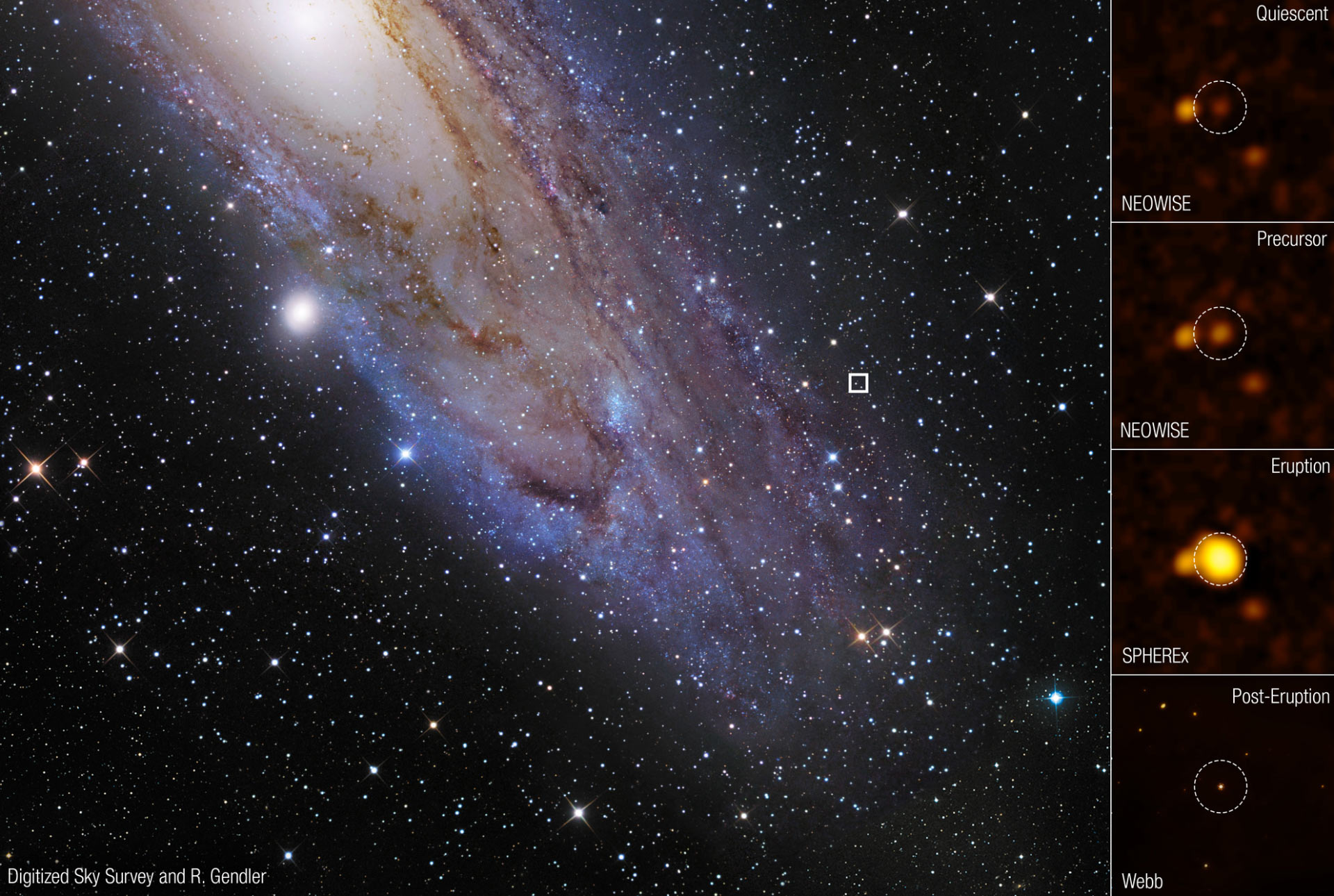
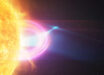
Webb allowed astronomers to fully reconstruct what happened before, during, and after the AT 2025abao merger in the Andromeda galaxy. Image credit: NASA / ESA / CSA / STScI / Viraj Karambelkar, Columbia / Kishalay De, Columbia / Alyssa Pagan, STScI / DSS / Robert Gendler.
The AT 2025abao system was first spotted in 2023 in the data from NASA’s NEOWISE mission.
It erupted in October 2025, and the NASA/ESA/CSA James Webb Space Telescope observed it just 47 days after the peak.
“Stellar mergers are very, very difficult to observe in real time because they are hard to predict,” said Dr. Viraj Karambelkar, an astronomer at Columbia University.
“However, we noticed something unusual was going on in 2023 and continued to monitor the system to see what it would do.”
“Then, in 2025, it erupted! Webb observed Bao only 47 days after the stars’ eruption peaked, the earliest ever follow-up of an event like this.”
“The telescope’s data helped us characterize what the system looked like before, during, and immediately after the merger, which is absolutely mind-blowing.”
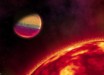
Modeling suggests the primary star, Big Bao, was seven times the Sun’s mass, 350 times its radius and 18,000 times brighter. Its companion, Little Bao, weighed about 0.7 solar masses.
After the smaller star touched the giant’s surface, the two merged in only seven orbits, or about seven years. Binary mergers of smaller stars typically take thousands of orbits.
The AT 2025abao eruption also expelled around 0.1-0.2 solar masses of material.
The observations suggest that standard models may not capture all the ways energy is redistributed during common-envelope evolution.
Future observations will be needed to confirm conclusively that the two stars merged.
“There’s going to be a large influx of similar discoveries just ahead,” Dr. Karambelkar said.
The findings appear today in the journal Nature.
_____
V. Karambelkar et al. 2026. An inspiral of a star inside a common envelope with its giant companion. Nature 659, 628-633; doi: 10.1038/s41586-026-11221-z