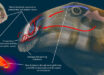
Earth’s rise from a hot, oxygen-free world to a planet that can support complex life may have been driven partly by the mountains, according to a new study.

Hadean Earth. Image credit: Alec Brenner.
‟Changes that occurred deep in the Earth ultimately gave rise to much taller mountains over time, which may have made our planet habitable by providing the nutrients needed for life to form and flourish,” said Dr. Matthijs Smit, a researcher at the University of British Columbia.
“Nutrients such as phosphorous are essential ingredients for life on our planet, but prior to three billion years ago, these elements were locked in the Earth’s crust and the oceans were quite nutrient-starved. All this changed when tall mountains started to develop.”
Dr. Smit and his colleagues examined the pressures recorded in metamorphic rocks, which formed when crust was buried deep inside ancient mountain belts.
Those pressures act as a ‘ruler’ for how thick the crust, and therefore how tall the mountains, could grow.
The researchers found that before about 2.7 billion years ago, rocks were buried to depths of roughly 30 to 35 km.
By around 2.2 billion years ago, burial depths had grown to about 55 to 60 km, enough to support mountains perhaps 5 km high.
Then, between roughly 800 and 700 million years ago, rocks began to be buried as deep as 90 km, similar to the roots beneath today’s Himalaya and Tibet, supporting an additional 4 km of elevation.
Those two growth spurts broadly coincide with the Great Oxidation Event and the Neoproterozoic Oxidation Event, along with increases in nutrient delivery to the oceans and shifts in how microbes processed sulfur.
‟The first growth spurt may have led to the emergence of land on a large scale for the first time, while the second growth spurt thrust mountain ranges to enormous heights,” said Dr. Douwe van Hinsbergen, a researcher at Utrecht University.
‟Given such profound effects, mountains may well have played a far greater role in the creation of a habitable planet than previously assumed.”
The scientists propose that higher peaks accelerated erosion and chemical weathering, flushing nutrients such as phosphorus into the seas, boosting productivity and helping oxygenate the atmosphere.
Both oxidation events were followed by the ‘Snowball Earth’ glaciations and, later, the diversification of complex life.
The mountain-building changes were likely driven by the gradual cooling of Earth’s mantle, which altered how tectonic plates collide.
The findings suggest that a planet’s interior evolution could be a key ingredient in whether its surface becomes habitable, a point of interest for scientists assessing which distant worlds might support life.
‟It’s likely not a coincidence that life on Earth developed and diversified approximately during the same period that the two growth spurts occurred,” said Dr. Ellen Kooijman, a researcher at the Swedish Museum of Natural History.
‟It’s exciting to think that mountain belts were once non-existent and that their development over the past three billion years may have driven the environmental and biological change that shaped our planet.”
The study was published this month in the journal Science Advances.
_____
Matthijs A. Smit et al. 2026. Raising mountains for a habitable Earth. Science Advances 12 (46); doi: 10.1126/sciadv.aei2764