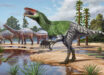
The Devonian period, which occurred 419 to 358 million years ago, prior to the evolution of life on land, is known for a series of catastrophic mass extinction events, during which it’s estimated nearly 70% of all life on Earth went extinct. New research shows that the evolution of tree roots likely flooded past oceans with excess nutrients, causing massive algae growth; these destructive algae blooms would have depleted most of the oceans’ oxygen, triggering mass extinctions.

An artist’s impression of Devonian forest. Image credit: Eduard Riou / Rursus.
The Devonian period was a watershed moment in Earth history, with substantial changes in the biologic, ecologic, and atmospheric composition.
The expansion and radiation of land plants occurred on an unprecedented scale during this period.
Coincident with this emergent terrestrial biosphere, the Devonian hosted numerous marine extinction events, including the Late Devonian mass extinction (also known as the Frasnian-Famennian extinction), one of the ‘big five’ with the loss of about 40% of marine families and 60% of genera.
Additionally, the Devonian saw a pronounced decrease in atmospheric carbon dioxide to near contemporary levels.
Despite these key biological innovations and planetary transitions, much is still unknown about the specific feedbacks within the Devonian ecosphere.
It has been theorized that two seemingly separate events, marine extinctions and plant evolution and expansion, were intricately linked in the Devonian.
Specifically, it has been proposed that plant evolution and root development occurred so rapidly and on such a massive scale that nutrient export from the land to the ancient oceans would have drastically increased.
This scenario is seen in modern systems where anthropogenically sourced nutrient export has vastly increased the nutrient load into areas such as the Gulf of Mexico and the Great Lakes, leading to large-scale algal blooms that ultimately deplete the oxygen in the water column.
This effect, known as eutrophication, magnified on a global scale, would have been catastrophic to ancient oceans, fueling algal blooms that would have depleted most of the ocean’s oxygen.
The key to linking mass extinctions and the expansion and radiation of land plants lies in identifying a nutrient flux elevated above background levels, linking that nutrient flux to either indirect or direct evidence of the presence of deeply rooting land plants and finally showing that this phenomenon occurred in multiple locations and times.
“Our theory is based upon a combination of new and existing evidence,” said Professor Gabriel Filippelli, a researcher in the Department of Earth Sciences at Indiana University.
Professor Filippelli and his colleagues were able to do precisely that by utilizing geochemical records from ancient lake deposits in Greenland, northern Scotland, and Orkney.
Utilizing lake records, they detected elevated values of the nutrient phosphorus in five distinct locations during the height of plant evolution and expansion in the Devonian period.
In each case, elevated values of nutrient input were coincident with evidence of the presence of early trees in the form of fossilized spores and, in some cases, fossilized stems of the earliest deeply rooting tree, Archaeopteris.
In two cases, that evidence coincided with a Devonian marine extinction event, including the Late Devonian mass extinction.
Additionally, the study linked the periodic wet/dry climate cycles known to exist in the region during the Devonian with specific episodes of plant colonization.
While elevated nutrient export was noted during both wet and dry climate cycles, the most significant export events occurred during wet cycles, suggesting that plant expansion was episodic and tied to climate cyclicity.
The episodic nature of plant expansion could help explain why there are at least six significant marine extinctions in the Devonian.
“These new insights into the catastrophic results of natural events in the ancient world may serve as a warning about the consequences of similar conditions arising from human activity today,” Professor Fillipelli said.
The study was published this week in the Geological Society of America Bulletin.
_____
Matthew S. Smart et al. Enhanced terrestrial nutrient release during the Devonian emergence and expansion of forests: Evidence from lacustrine phosphorus and geochemical records. GSA Bulletin, published online November 9, 2022; doi: 10.1130/B36384.1