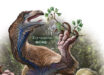
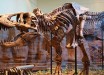
A semi-complete skull of an adult Edmontosaurus at Montana State’s Museum of the Rockies preserves a fleeting moment from the Late Cretaceous: a tyrannosaur biting into a duck-billed dinosaur’s face.
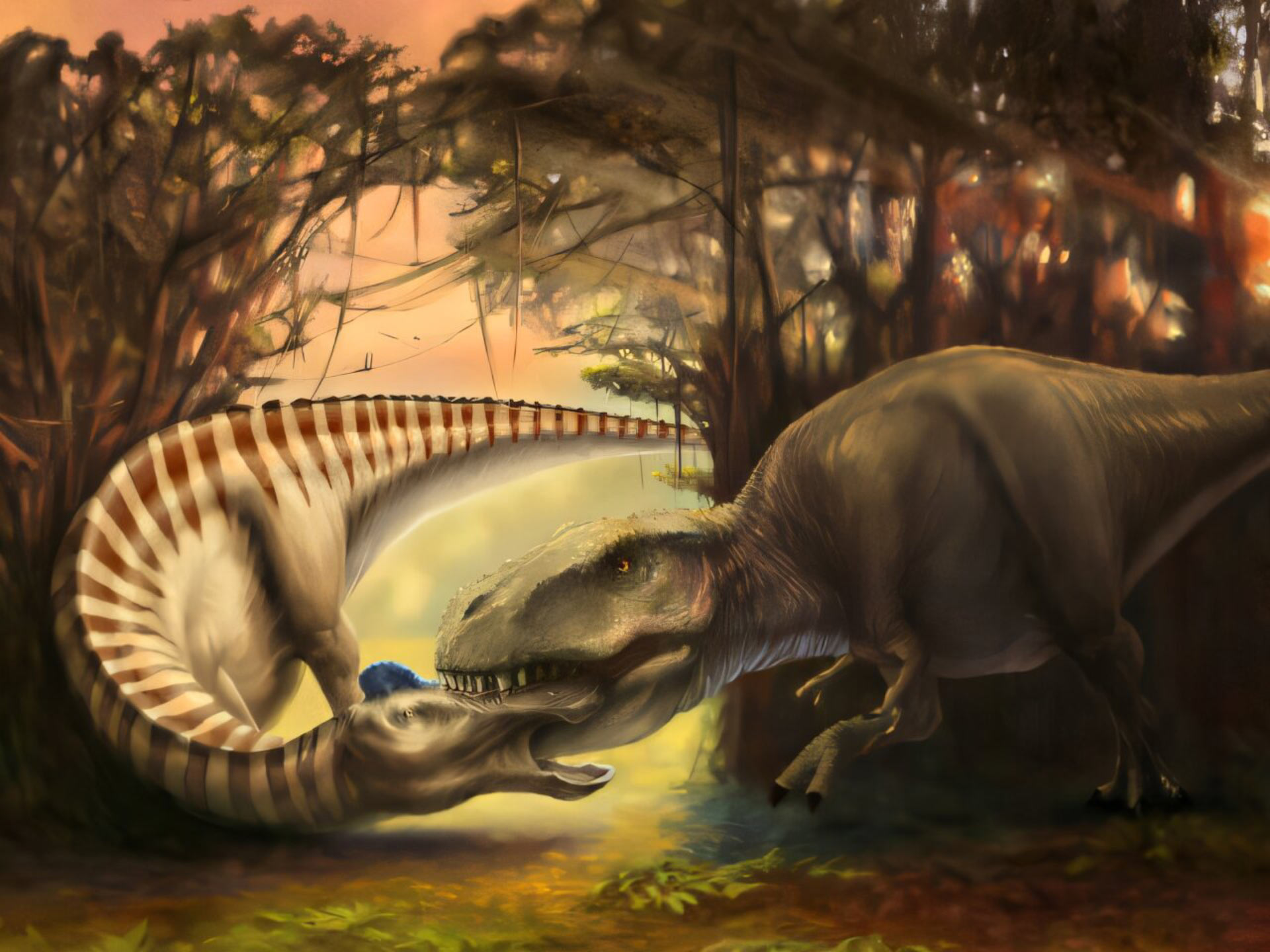
A Tyrannosaurus attacking an adult Edmontosaurus. Image credit: Jenn Hall.
The damaged Edmontosaurus skull was found in 2005 in the Hell Creek Formation of eastern Montana.
The fossil is now housed in the paleontology collection at Museum of the Rockies, and it contains a telling detail: lodged inside its face is the tooth of a tyrannosaur.
“Although bite marks on bones are relatively common, finding an embedded tooth is extremely rare,” said University of Alberta doctoral student Taia Wyenberg-Henzler.
“The great thing about an embedded tooth, particularly in a skull, is it gives you the identity of not only who was bitten but also who did the biting.”
“This allowed us to paint a picture of what happened to this Edmontosaurus, kind of like Cretaceous crime scene investigators.”
Comparing the embedded tooth to all the carnivorous inhabitants in the Hell Creek Formation revealed that it most closely matched with the teeth of Tyrannosaurus. CT scans of the skull, helped provide greater detail.
“A fossil like this is extra exciting because it captures a behavior: a tyrannosaur biting into this duckbill’s face,” said Museum of the Rockies’ curator of paleontology John Scannella.
“The skull shows no signs of healing around the tyrannosaur tooth, so it may have already been dead when it was bitten, or it may be dead because it was bitten.”
“Looking at the way the tooth is embedded in the nose of the Edmontosaurus suggests that it met its attacker face-to-face, something that usually happens to an animal that was killed by a predator,” Wyenberg-Henzler said.
“The amount of force necessary for a tooth to have become broken off in bone also points to the use of deadly force.”
“For me, this paints a terrifying picture of the last moments of this Edmontosaurus.”
“The feeding habits of Tyrannosaurus, one of the largest meat-eating animals to ever walk the Earth, have been the subject of study and debate for decades,” Dr. Scannella said.
“The tooth inside this Edmontosaurus skull provides a further glimpse into Tyrannosaurus behavior.”
The findings were published online in the journal PeerJ.
_____
T.C.A. Wyenberg-Henzler & J.B. Scannella. 2026. Behavioral implications of an embedded tyrannosaurid tooth and associated tooth marks on an articulated skull of Edmontosaurus from the Hell Creek Formation, Montana. PeerJ 14: e20796; doi: 10.7717/peerj.20796