Using NASA’s Goldstone Solar System Radar and NSF’s Green Bank Telescope, astronomers from the University of California, Los Angeles, confirmed that the icy surface of Jupiter’s moon Europa scatters radio energy in an unusually strong and complex way not seen on rocky worlds.
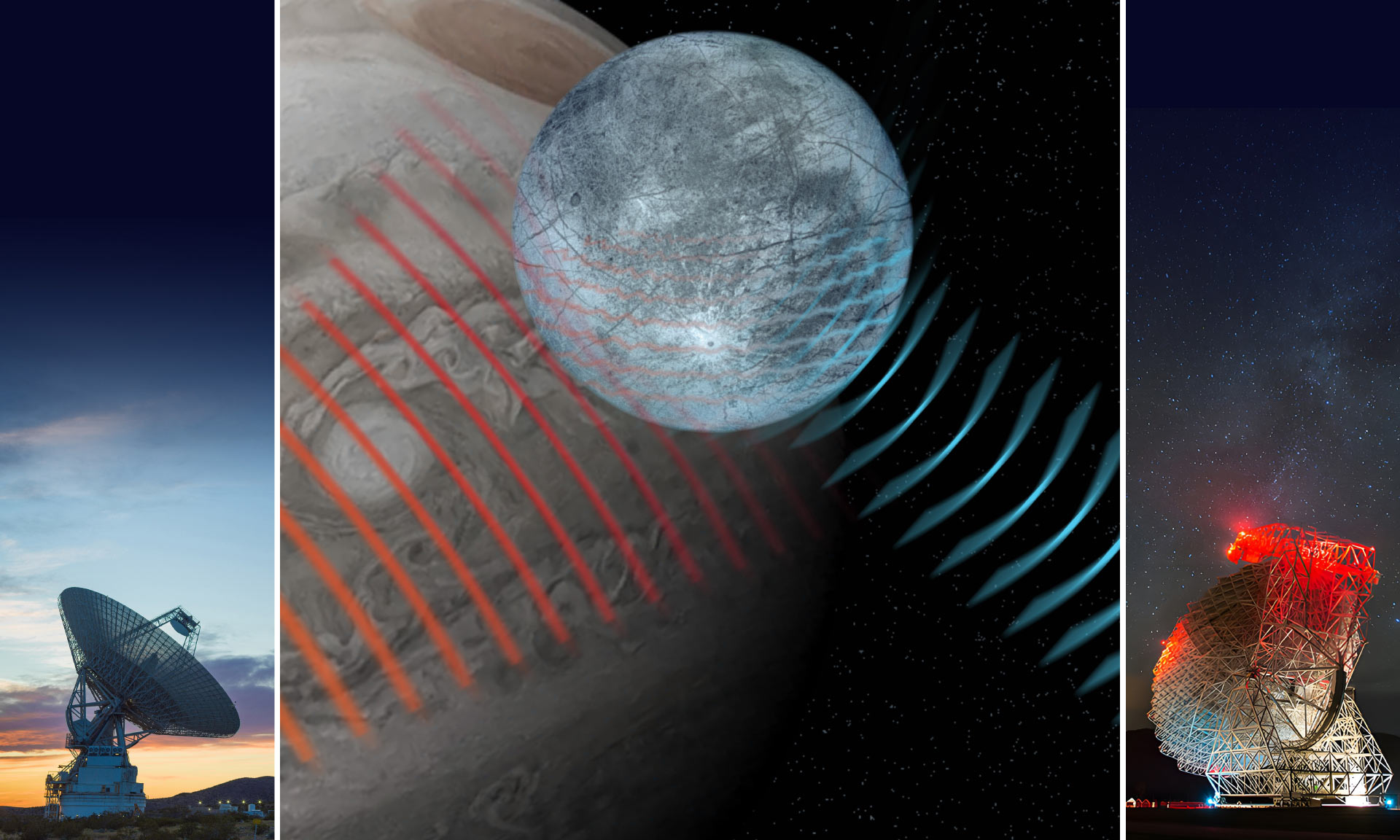
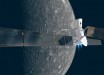
This artist’s impression shows radar waves from NASA’s Goldstone Solar System Radar pinging Europa; the radar waves penetrate Europa’s icy surface before bouncing back to be collected by NSF’s Green Bank Telescope on Earth. Image credit: NSF / AUI / NSF’s NRAO / P.Vosteen.
Three of Jupiter’s Galilean satellites — Europa, Ganymede, and Callisto — are of particular scientific interest due to their icy shells and suspected subsurface oceans.
However, the radar properties of the icy satellites have not been measured since observations from 1987 to 1991.
Because radio waves can penetrate pure ice to considerable depths, radar observations provide a powerful means of characterizing the subsurface properties of the icy shells of these satellites, offering key insights into planetary evolution.
“Radar delves below what is easily seen, because radio waves can penetrate into the ice, and carry information about its internal structure and purity,” said Tunhui (Tina) Xie, a graduate student at the University of California, Los Angeles.
In order to address a longstanding gap in the radar studies, Xie and her colleague, Professor Jean-Luc Margot, observed Europa using the Goldstone Solar System Radar and the Green Bank Telescope from 2011 to 2024.
These observations show that Europa’s radar albedo — measure of how bright it appears to radar — is much higher than that of typical planets and asteroids.
The returning radar signal is dominated by the same circular polarization as the transmitted beam, a hallmark of multiple scattering inside clean, porous ice.
These properties strongly support an explanation known as the coherent backscatter opposition effect, in which radio waves bounce around within the ice before returning back to the telescope, dramatically boosting the echo.
Because the researchers observed Europa in a bistatic configuration — with the Goldstone radar transmitting and both Goldstone and the Green Bank Telescope receiving — they could also test how the coherent backscatter effect changes with the angle between transmitter, moon, and receiver.
They found that Europa’s radar brightness stayed roughly constant even when the angle increased, implying that the bright backscatter ‘peak’ must be broader than the range of angles they sampled, placing a limit on the depth that the radio waves diffused before being absorbed.
This depth limit offers a new constraint on how transparent Europa’s ice is, and will help scientists interpret upcoming ice‑penetrating radar data from spacecraft now en route to study this moon in more detail.
“Future planetary science and space flight missions, like NASA’s Europa Clipper, could benefit from this type of radar science,” said Dr. Will Armentrout, a researcher with NSF’s National Radio Astronomy Observatory who supports radar projects.
“As the Green Bank Telescope’s radar capabilities evolve, with new technologies currently under development, we’re looking forward to providing even more radar capabilities for the scientific community.”
The authors will present their results today at the 248th meeting of the American Astronomical Society (AAS) in Pasadena, California.
_____
Tunhui Xie & Jean-Luc Margot. 2026. Radar observations of Europa in 2011-2024: New insights into radar scattering properties. AAS 248, abstract # 481