The main-belt asteroid Donaldjohanson, a heavily cratered fragment born from a catastrophic breakup 155 million years ago, appears to wobble through space while preserving clues to the migration of water-rich worlds in the early Solar System, according to a new analysis of images and data from NASA’s Lucy spacecraft.
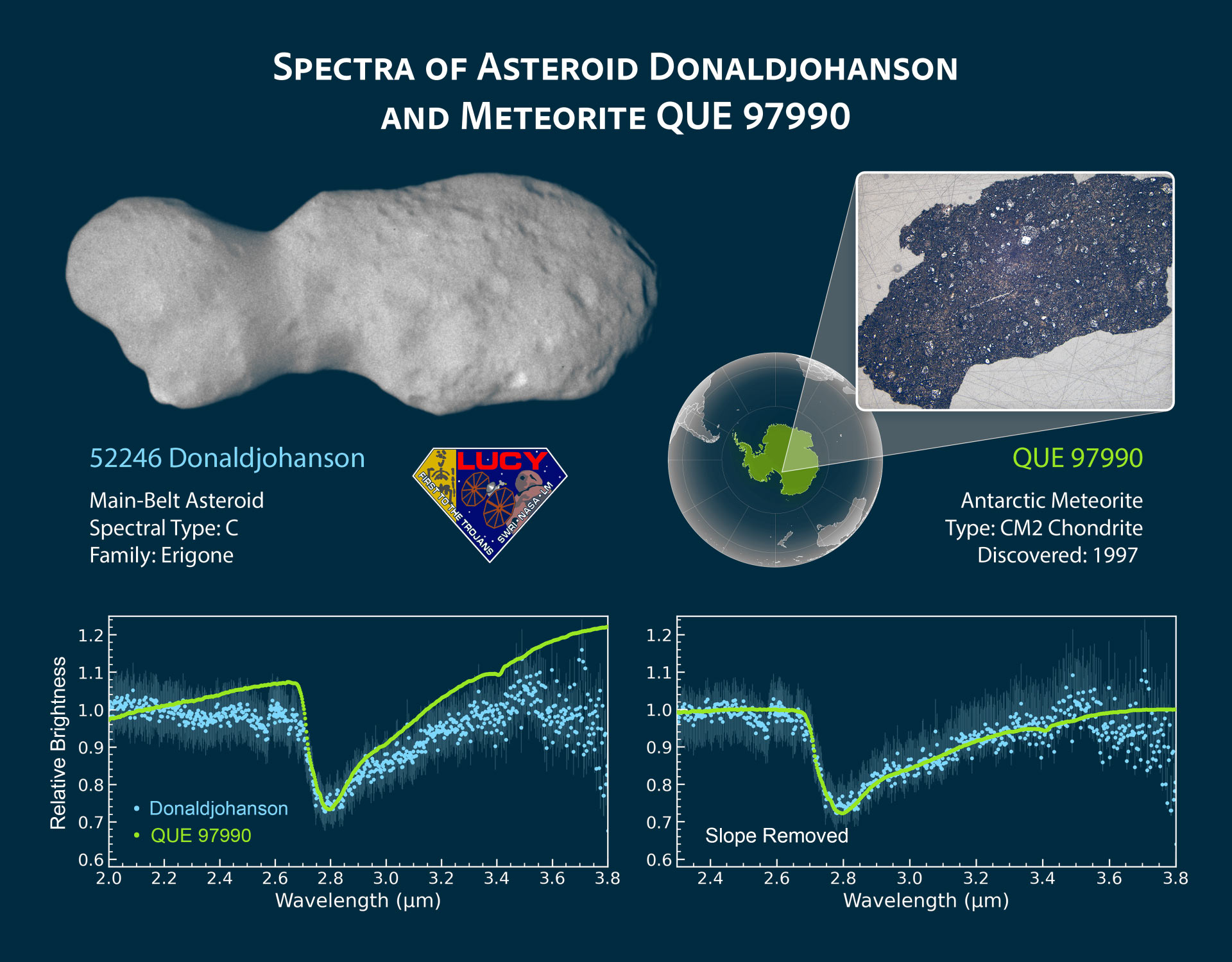
The asteroid Donaldjohanson is composed of two heavily cratered lobes, connected by a smoother neck, with overall dimensions 8.8 km by 4.4 km by 3.1 km. Image credit: NASA / Goddard / SwRI / Dan Gallagher.
As part of a 12-year mission to visit eight asteroids, the Lucy spacecraft flew past Donaldjohanson on April 20, 2025.
Rather than rolling through space in a steady pattern, the asteroid turns on two axes, rotating end-over-end once every 10.5 Earth days while wobbling around its horizontal axis then once every 26.5 days.
“This is just one of many surprising things learned since NASA’s Lucy spacecraft flew by Donaldjohanson on April 20, 2025,” said Lucy deputy principal investigator Dr. Simone Marchi, a researcher at the Southwest Research Institute.
Images of Donaldjohanson taken during the flyby show that the asteroid consists of two cratered lobes connected by a relatively smooth neck.
The density of craters is consistent with the age of the Erigone asteroid family, a group of asteroids that were produced by a catastrophic collision that broke up a larger parent body.
“Lucy images confirmed its elongated shape, initially suggested by Earth-based telescope observations,” Dr. Marchi said.
“The flyby revealed that the small asteroid, half a mile in diameter, resembles a peanut, with a two-lobed structure connected by a narrower neck.”
Lucy also detected iron-rich clay minerals, formed long ago from the presence of liquid water.
These findings indicate that the asteroid likely formed from fragments of a larger, carbon- and water-rich asteroid that broke apart 155 million years ago.
Lucy’s encounter with Donaldjohanson is considered a test run for its primary mission to explore the Trojan asteroids, two swarms of ancient objects that lead and trail Jupiter as it orbits the Sun.
Scientists think these populations of space rocks have been preserved since they formed in the early history of the Solar System.
“It’s helpful for scientists to compare Donaldjohanson with asteroids like Bennu and Ryugu, which are seemingly similar asteroids, because every subtle difference is another clue to our origin story,” Dr. Marchi said
“Once we start learning more about the Trojans, a completely different population of space rocks with very different histories, our understanding of solar system formation is destined to be challenged.”
The findings were published June 18 in the journal Science.
_____
Simone Marchi et al. 2026. The Lucy flyby of (52246) Donaldjohanson: A bilobed asteroid with tumbling rotation. Science 392 (6804): 1287-1291; doi: 10.1126/science.aec0503