A new study published in the Geophysical Research Letters suggests the dark material on the surface of Europa – the sixth-closest moon of the planet Jupiter and the smallest of its four Galilean satellites – is likely sodium chloride from a subsurface ocean, discolored by exposure to radiation.

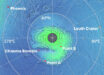
The surface of Europa looms large in this newly-reprocessed color view; image scale is 1.6 km per pixel; north on Europa is at right. Image credit: NASA / JPL-Caltech / SETI Institute.
For decades, planetary researchers have wondered about the nature of the dark material that coats long, linear fractures and other relatively young geological features on the surface of Europa.
Its association with young terrains suggests the material has erupted from within the icy moon, but with limited data available, the material’s chemical composition has remained elusive.
“If it’s just salt from the ocean below, that would be a simple and elegant solution for what the dark, mysterious material is,” said study lead author Dr Kevin Hand of NASA’s Jet Propulsion Laboratory in Pasadena.
One certainty is that Europa is bathed in radiation created by Jupiter’s powerful magnetic field. Electrons and ions slam into the moon’s surface with the intensity of a particle accelerator.
To identify the dark material, Dr Hand and his co-author, Dr Robert Carlson of NASA’s Jet Propulsion Laboratory, created a simulated patch of Europa’s surface in a laboratory test apparatus for testing possible candidate substances.
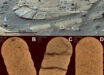
They tested samples of sodium chloride (common salt) along with mixtures of salt and water, in their vacuum chamber at Europa’s chilly surface temperature of minus 280 degrees Fahrenheit (minus 173 Celsius). They then bombarded the salty samples with an electron beam to simulate the intense radiation on the moon’s surface.
After a few tens of hours of exposure to this harsh environment, which corresponds to as long as a century on Europa, the salt samples, which were initially white just like table salt, turned a yellowish-brown color similar to features on the icy moon.
The scientists found the color of these samples, as measured in their spectra, showed a strong resemblance to the color within fractures on Europa that were imaged by NASA’s Galileo orbiter.
_____
K.P. Hand & R.W. Carlson. Europa’s surface color suggests an ocean rich with sodium chloride. Geophysical Research Letters, published online April 21, 2015; doi: 10.1002/2015GL063559