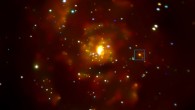
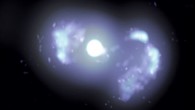
The NASA/ESA Hubble Space Telescope shot this image of the supernova remnant DEM L249.
This Hubble image shows DEM L249, a remnant of Type Ia supernova...
The Type Ia supernova remnant (SNR) G344.7-0.1 resides about 19,600 light-years away in the constellation of Scorpius.
This composite image shows SNR G344.7-0.1...
Using spectral data from the Sloan Digital Sky Survey (SDSS), the Chandra Source Catalog 2.0, and the Chandra COSMOS Legacy survey, astronomers have found...
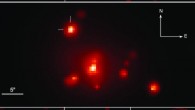
By combining gravitational lensing with the capabilities of NASA’s Chandra X-ray Observatory, astronomers have detected two X-ray-emitting objects —...
Astronomers using NASA’s Chandra X-ray Observatory and Neil Gehrels Swift Observatory have detected a set of eight X-ray rings around a low-mass black...
Using NASA’s Chandra X-ray Observatory and the MeerKAT radio telescope in South Africa, an astronomer from the University of Massachusetts, Amherst has...
Astronomers using NASA’s Chandra X-ray Observatory have detected stable titanium, along with chromium and iron, blasting out from the center of the supernova...
As part of the Clusters Hiding in Plain Sight (CHiPS) survey, astronomers have discovered three new galaxy cluster candidates and confirmed two of them:...
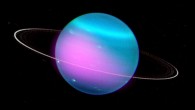
Uranus, the seventh planet from the Sun, and its ring system appear to mainly produce X-ray emission by scattering solar X-rays, but some may also come...
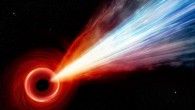
The source of the 160,000-light-year-long jet of particles is PSO J352.4034-15.3373 (PJ352-15 for short), a rapidly growing supermassive black hole, or...
Supernova 1987A (SN 1987A) was first observed on February 23, 1987 in a nearby dwarf galaxy, the Large Magellanic Cloud, some 164,000 light-years away....
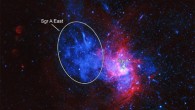
Sagittarius A East (Sgr A East), a supernova remnant located strikingly close to the central supermassive black hole of our Milky Way Galaxy, resulted...
Astronomers using NASA’s Chandra X-ray Observatory have studied Swift J1818.0-1607, a new magnetar (a type of neutron star with an extremely powerful...
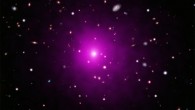
Astronomers using NASA’s Chandra X-ray Observatory are searching for signs of a recoiling black hole in the core of A2261-BCG, the most massive and brightest...
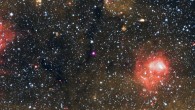
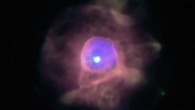
Astronomers using NASA’s Chandra X-ray Observatory have spotted a bubble of ultrahot gas at the center of a planetary nebula called IC 4593.
This composite...
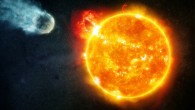
Barnard’s star, a 10-billion-year-old red dwarf just 6 light-years from Earth, is still very active and potentially destructive for the atmospheres of...
In 2017, astronomers detected a gravitational-wave signal, designated GW170817, from the merger of two neutron stars. And since the detection, they have...
Astronomers using NASA’s Chandra X-ray Observatory have detected an extragalactic candidate planet circling a binary system in Messier 51 (also known...
Around five years ago, NASA’s Fermi Gamma-ray Space Telescope detected high-energy gamma rays coming from TXS 0128+554, an elliptical galaxy located...