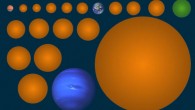
A team of geobiologists and astronomers from the United States and Germany has identified 24 extrasolar planets that may have conditions more suitable...
Other stars could have as many as seven Earth-like planets in the absence of farther out giant planets, according to a new study led by the University...
A duo of U.S. planetary scientists has calculated that water in the subsurface ocean of Jupiter’s icy moon Europa could have been formed by breakdown...
New estimate suggests that 18% of Sun-like (G-type) stars could have a planet the size of Earth orbiting in their conservative habitable zone.
There may...
Astronomers using data from NASA’s Kepler space telescope have discovered two new planets in the Kepler-160 planetary system. One of the new planets...
A new study shows that pockets of brine can form and persist from the equator to high latitudes on the Martian surface for a few percent of the year for...
Giant elliptical galaxies are not as likely as previously thought to be cradles of complex life, according to a paper published in the Monthly Notices...
Astronomers using data from NASA’s Kepler Space Telescope have discovered an Earth-sized planet in the habitable zone of a low-mass star called Kepler-1649.
An...
Astronomers using the CARMENES spectrograph at Calar Alto Observatory in Spain have discovered a super-Earth exoplanet orbiting an M-dwarf star in the...
Using data gathered by NASA’s Kepler space telescope, a team of astronomers in Canada has discovered 17 new exoplanets, including an Earth-sized world....
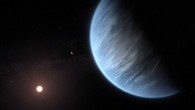
A team of astronomers from the Institute of Astronomy at the University of Cambridge, UK, has found K2-18b, a planet of almost nine Earth masses in orbit...
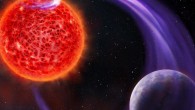
Using the Low Frequency Array (LOFAR) radio telescope, astronomers have observed radio waves that carry the distinct signatures of extraterrestrial aurorae,...
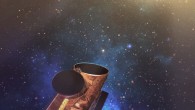
The Habitable Exoplanet Observatory (HabEx) would use a telescope with a mirror larger than Hubble’s, and would employ origami techniques to utilize...