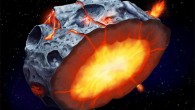
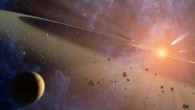
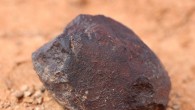
Metallic asteroids are the cooled cores of disrupted planetesimals. They originated early in the history of our Solar System when planets were beginning...
ALH-77005, a Martian rock found in Antarctica, contains numerous mineralized ‘biosignatures,’ including coccoidal, filamentous structures and organic...
A team of planetary scientists at the Australian National University found that our planet is made of the same elements as the Sun but has less of the...
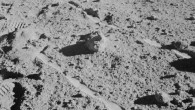
A lunar rock sample collected by Apollo 14 astronauts in 1971 contains traces of minerals with a chemical composition common to Earth and very unusual...
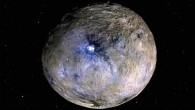
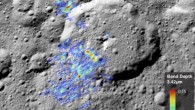
The surface of the dwarf planet Ceres may contain several times the concentration of carbon than is present in the most carbon-rich, primitive meteorites...
An international team of researchers from the United States, Taiwan and France provides new evidence that phosphates — a key element in the building...
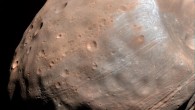
The Martian moons Phobos and Deimos have been suggested to be captured asteroids based on the similarities between the dark, red, nearly featureless spectra...
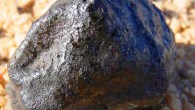
Northwest Africa (NWA) 11119, a stone meteorite found in December 2016 in Mauritania, is the world’s oldest igneous meteorite, according to new research.
An...
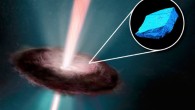
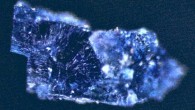
By examining microscopic ice-blue crystals of mineral hibonite trapped inside a carbonaceous chondrite meteorite, an international team of scientists was...
A new analysis of data collected by NASA’s Dawn orbiter suggests that organic molecules may exist in surprisingly high concentrations on the surface...
A team of researchers from the United States, UK and Japan has found liquid water and a mix of complex organic compounds in 4.5-billion-year-old salt crystals...
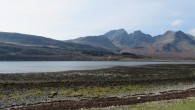
A team of geologists has found 60 million-year-old ejecta from a previously unknown meteorite impact on the Isle of Skye, northwest Scotland. This is the...
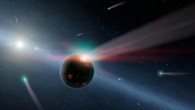
According to a paper published in the journal Meteoritics & Planetary Science, Earth’s atmosphere is a better shield from meteoroids than scientists...
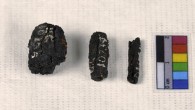
The production of iron from its ore only started in the 2nd millennium BC, but a number of iron artifacts from the preceding Bronze Age are known to exist....
New research, reported in the journal Nature, changes scientists’ understanding of how terrestrial planets attain their physical and chemical characteristics.
A...
New research from Monash University and the University of Queensland has added a new dimension to understanding life on the Red Planet with the discovery...
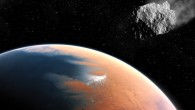
Mars experienced a single colossal impact during its first 130 million years, the equivalent to the largest body in the today’s asteroid belt slamming...
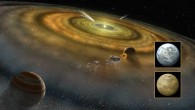
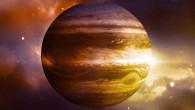
The gas giant Jupiter is not only the most massive planet in our Solar System, but it’s also the oldest, according to an international team of planetary...