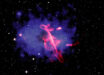
Using ESO’s Very Large Telescope (VLT), astronomers have captured a breathtaking shock wave around the white dwarf star 1RXS J052832.5+283824 (RXJ0528+2838 for short) — a phenomenon that doesn’t fit existing models and could reshape our understanding of stellar evolution.
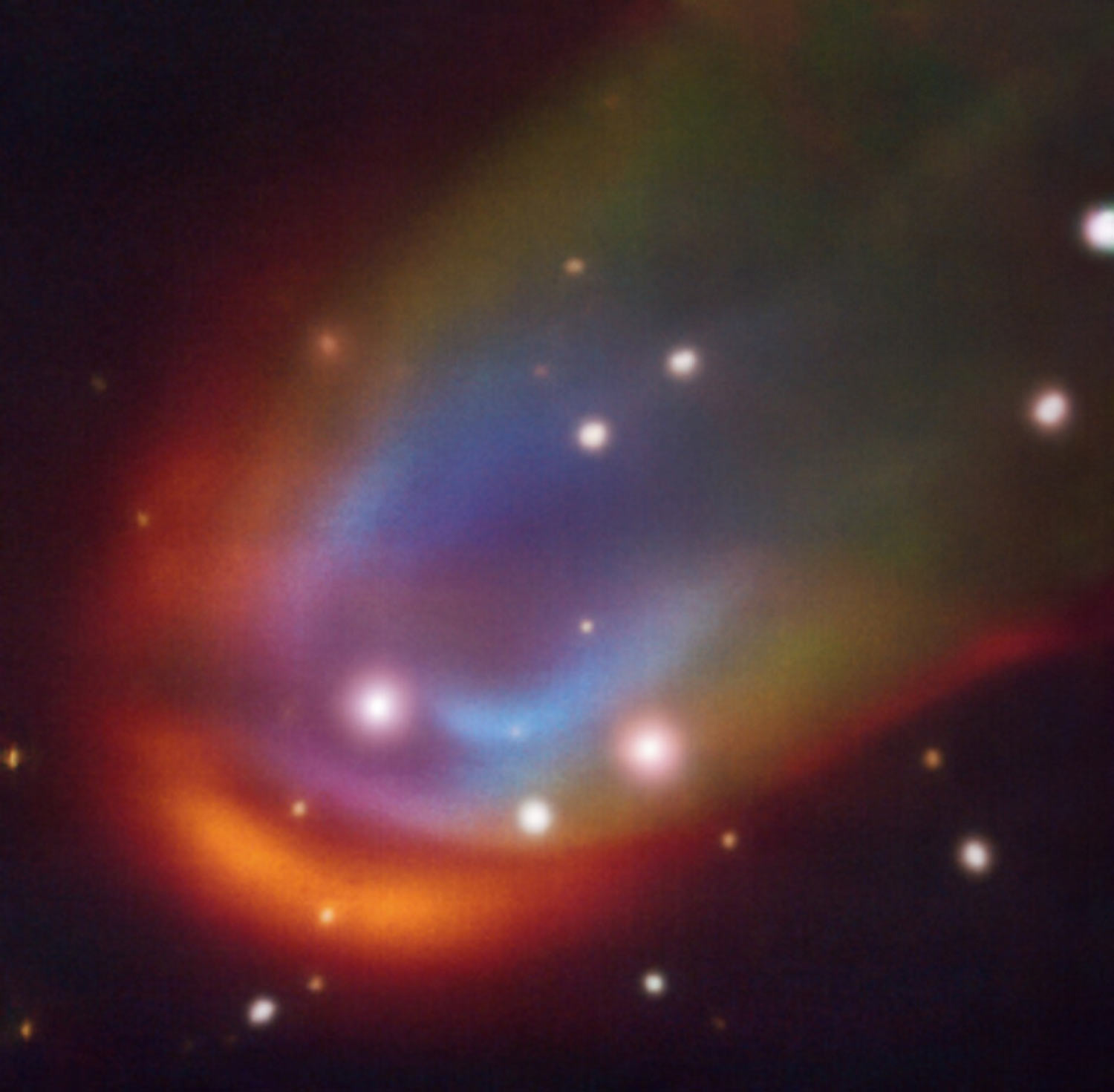
This image, taken with the MUSE instrument on ESO’s Very Large Telescope, shows a shock wave around RXJ0528+2838. Image credit: ESO / Iłkiewicz et al.
RXJ0528+2838 is located approximately 730 light-years away in the constellation of Auriga.
Like the Sun and other stars, this white dwarf rotates around the center of the Milky Way.
“As it moves, it interacts with the gas that permeates the space between stars, creating a type of shock wave called a bow shock, a curved arc of material, similar to the wave that builds up in front of a ship,” said Dr. Noel Castro Segura, an astronomer at the University of Warwick.
“These bow shocks are usually created by material outflowing from the central star, but in the case of RXJ0528+2838, none of the known mechanisms can fully explain the observations.”
RXJ0528+2838 has a Sun-like companion orbiting it. In such binary systems, the material from the companion star is transferred to the white dwarf, often forming a disk around it.
While the disk fuels the white dwarf, some of the material also gets ejected into space, creating powerful outflows.
But RXJ0528+2838 shows no signs of a disk, making the origin of the outflow and resulting nebula around the star a mystery.
“The surprise that a supposedly quiet, diskless system could drive such a spectacular nebula was one of those rare ‘wow’ moments,” said Dr. Simone Scaringi, an astronomer at Durham University.
The astronomers first spotted a strange nebulosity around RXJ0528+2838 on images from the Isaac Newton Telescope in Spain.
Noticing its unusual shape, they observed it in more detail with the MUSE instrument on VLT.
The shape and size of the bow shock imply that the white dwarf has been expelling a powerful outflow for at least 1,000 years.
Scientists don’t know exactly how a white dwarf without a disk can power such a long-lasting outflow — but they do have a guess.
RXJ0528+2838 is known to host a strong magnetic field, which has been confirmed by the MUSE data.
This field channels the material stolen from the companion star directly onto the white dwarf, without forming a disk around it.
“Our finding shows that even without a disk, these systems can drive powerful outflows, revealing a mechanism we do not yet understand.
“This discovery challenges the standard picture of how matter moves and interacts in these extreme binary systems,” said Dr. Krystian Iłkiewicz, a postdoctoral researcher at the Nicolaus Copernicus Astronomical Center.
“The results hint at a hidden energy source, likely the strong magnetic field, but this ‘mystery engine’ still needs to be investigated.”
The data show that the current magnetic field is only strong enough to power a bow shock lasting for a few hundred years, so it only partly explains what the astronomers are seeing.
“We found something never seen before and, more importantly, entirely unexpected,” Dr. Scaringi said.
The discovery is described in a paper published today in the journal Nature Astronomy.
_____
K. Iłkiewicz et al. A persistent bow shock in a diskless magnetized accreting white dwarf. Nat Astron, published online January 12, 2026; doi: 10.1038/s41550-025-02748-8