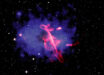
On January 22, 2026, the NASA/ESA Hubble Space Telescope observed the interstellar comet 3I/ATLAS nearly perfectly aligned with the Sun-Earth axis, revealing unprecedented jet structures and an extended anti-tail.
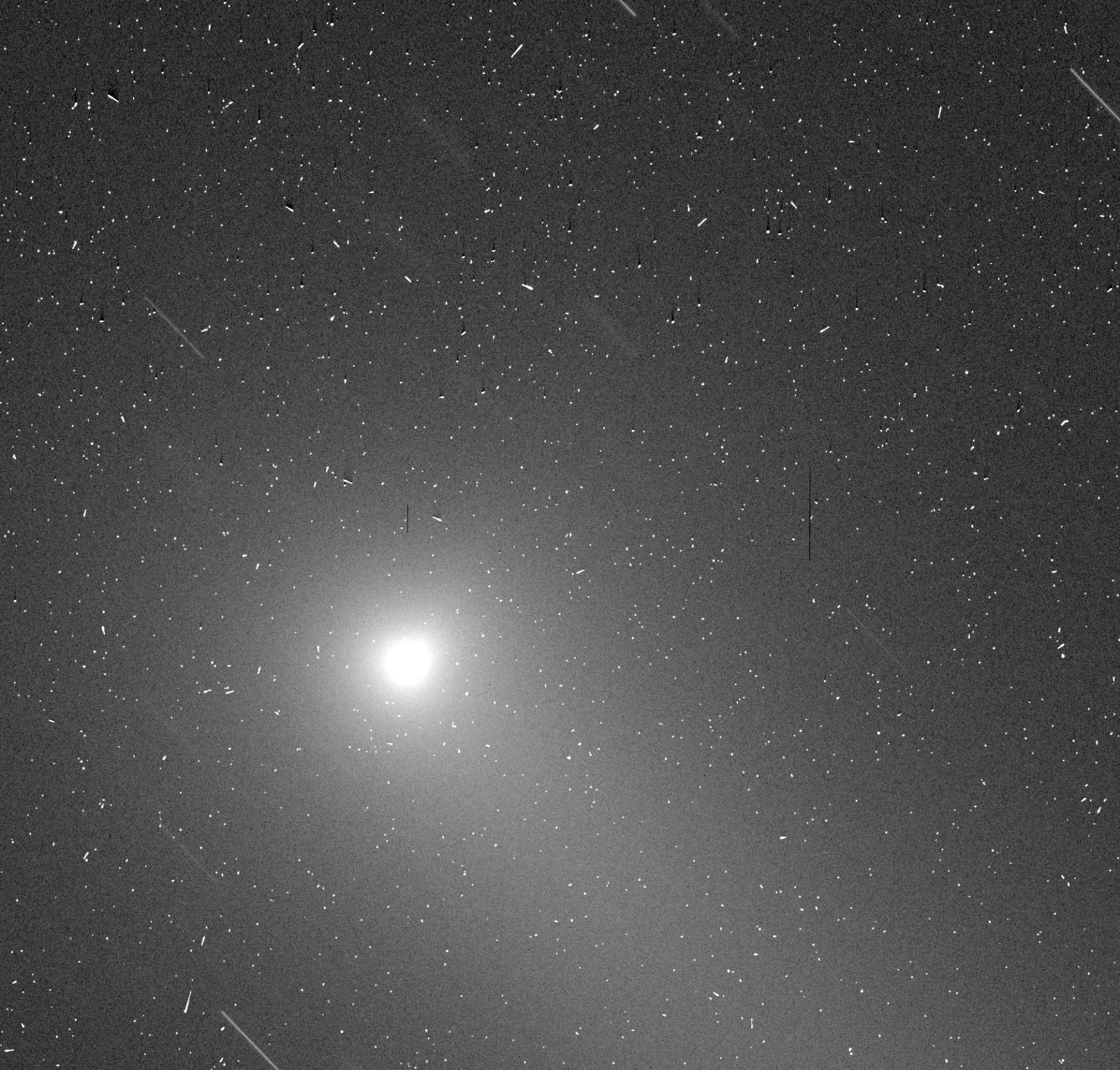
This image of the interstellar comet 3I/ATLAS was captured by Hubble’s WFC3 instrument on January 22, 2026, at 13:10 UTC. Image credit: NASA / ESA / Hubble / Man-To Hui, Shanghai Astronomical Observatory.
“Interstellar objects provide unique opportunities for studying materials from other stellar systems,” Harvard University’s Professor Abraham Loeb and Dr. Mauro Barbieri of the INAF-Padova Observatory wrote in a recent paper in the Research Notes of the American Astronomical Society.
“Unfortunately for that purpose, 1I/Oumuamua did not display traces of gas or dust around it and 2I/Borisov was only observed at phase angles relative to the Sun-Earth axis of over 16 degrees and never near opposition.”
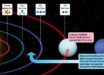
On January 22, 2026, the interstellar object 3I/ATLAS aligned to within an exceptionally small angle of 0.69 degrees with the Earth-Sun axis.
During that moment, our planet passed almost directly between the Sun and the comet.
“This rare alignment resulted in a brightness surge whose magnitude and growth rate are dictated by the composition and structure of the particles shed by jets of 3I/ATLAS,” Professor Loeb explained in a statement.
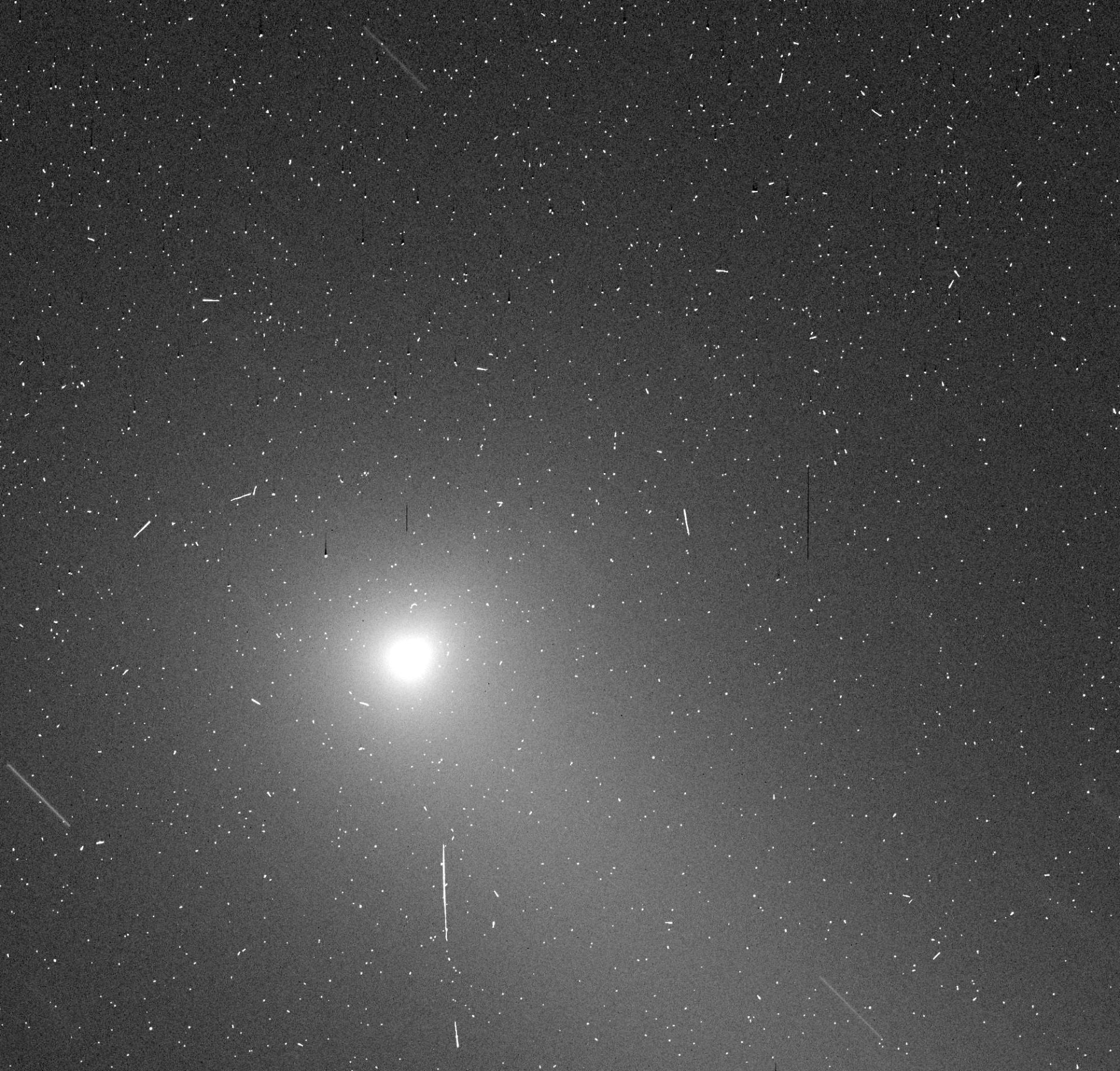
This image of the interstellar comet 3I/ATLAS was captured by Hubble’s WFC3 instrument on January 22, 2026, at 13:40 UTC. Image credit: NASA / ESA / Hubble / Man-To Hui, Shanghai Astronomical Observatory.
Shanghai Astronomical Observatory astronomer Man-To Hui used Hubble to observe 3I/ATLAS under the ‘conditions that may not repeat for decades.’
The images of the interstellar object were obtained with Hubble’s Wide Field Camera 3 (WFC3) instrument.
“When the Hubble images from the January 22, 2026 alignment were processed by my collaborator Toni Scarmato, the residuals showed the system of 4 jets, including a prominent anti-tail directed nearly towards the Sun and Earth, supplemented by three mini-jets,” Professor Loeb wrote.
“The mini-jets are equally separated from each other by an angle of 120 degrees, and one of them is faint, possibly because it is hidden in an unfavorable orientation relative to Earth.”