New microwave measurements from NASA’s Juno spacecraft reveal Europa’s ice shell may stretch nearly 29 km (18 miles) deep, reshaping planetary scientists’ understanding of how the icy moon’s hidden ocean might exchange life-giving chemicals with the surface.
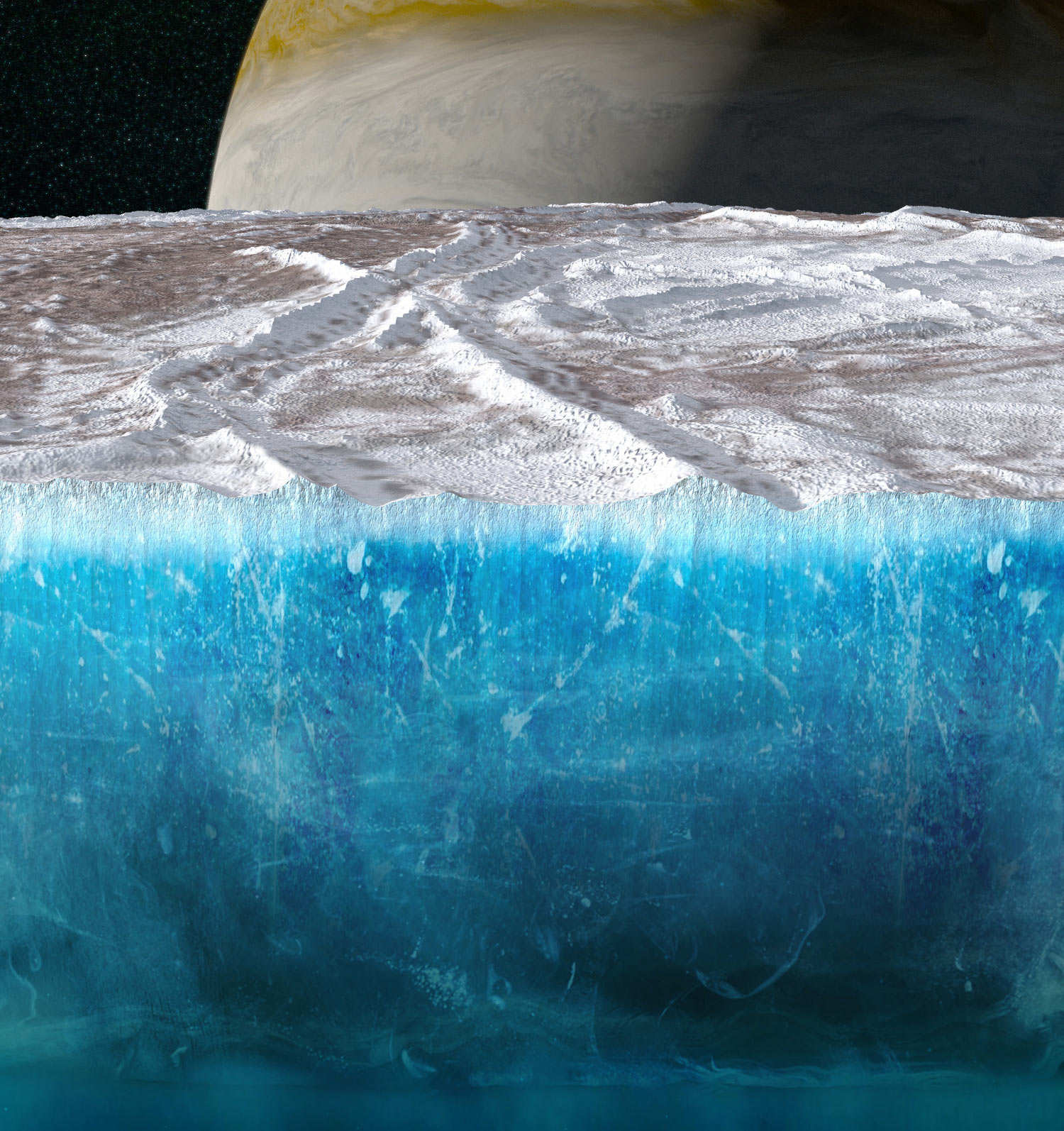
This artist’s concept depicts a cutaway view showing Europa’s ice shell. Image credit: NASA / JPL-Caltech / SwRI / Koji Kuramura / Gerald Eichstädt.
Europa has been a high priority target for planetary scientists for more than four decades.
Whether this icy moon of Jupiter is habitable has been debated for years.
Interest in its habitability substantially increased when measurements by NASA’s Galileo spacecraft indicated the presence of an electrically conductive (salty) water ocean beneath the ice crust and fractures in the surface ice.
On September 29, 2022, NASA’s Juno spacecraft flew past Europa at an altitude of 360 km (220 miles).
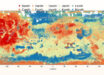
During the flyby, Juno’s microwave radiometer (MWR), which was designed to observe Jupiter’s deep atmosphere, provided measurements of the brightness temperatures at various depths of Europa’s ice-shell crust.
Using the MWR data, Juno project scientist Steve Levin and his colleagues determined that the shell averages about 29 km thick.
“The 29-km estimate relates to the cold, rigid, conductive outer-layer of a pure water ice shell,” Dr. Levin said.
“If an inner, slightly warmer convective layer also exists, which is possible, the total ice shell thickness would be even greater.”
“If the ice shell contains a modest amount of dissolved salt, as suggested by some models, then our estimate of the shell thickness would be reduced by about 5 km (3 miles).”
“The thick shell, as suggested by the MWR data, implies a longer route that oxygen and nutrients would have to travel to connect Europa’s surface with its subsurface ocean.”
“Understanding this process may be relevant to future studies of Europa’s habitability.”
The MWR data also provide new insights into the makeup of the ice just below Europa’s surface.
The instrument revealed the presence of ‘scatterers’ — irregularities in the near-surface ice such as cracks, pores, and voids that scatter the instrument’s microwaves reflecting off the ice.
These scatterers are estimated to be no bigger than a few inches in diameter and appear to extend to depths of hundreds of feet below Europa’s surface.
The small size and shallow depth of these features, as modeled in this study, suggest they are unlikely to be a significant pathway for oxygen and nutrients to travel from Europa’s surface to its salty ocean.
“How thick the ice shell is and the existence of cracks or pores within the ice shell are part of the complex puzzle for understanding Europa’s potential habitability,” said Juno’s principal investigator Dr. Scott Bolton, a researcher at the Southwest Research Institute.
“They provide critical context for NASA’s Europa Clipper and ESA’s Juice spacecraft — both of which are on their way to the Jovian system.”
“Europa Clipper will arrive there in 2030, while Juice will arrive the year after.”
The team’s new results were published on December 17, 2025 in the journal Nature Astronomy.
_____
S.M. Levin et al. 2026. Europa’s ice thickness and subsurface structure characterized by the Juno microwave radiometer. Nat Astron 10, 84-91; doi: 10.1038/s41550-025-02718-0