For several years, astronomers have been puzzling over a peculiar population of objects discovered by the NASA/ESA/CSA James Webb Space Telescope — faint, red objects from the early Universe dubbed ‘little red dots.’ Using Webb’s NIRCam and NIRSpec instruments, University of Texas at Austin astronomer Vasily Kokorev and his colleagues have now obtained the deepest spectrum ever taken of a little red dot. The data supports the interpretation that the object, called GLIMPSE-17775, is a supermassive black hole wrapped in a thick, dense cocoon of partially ionized gas, a model known as the BH* (black hole star) scenario.
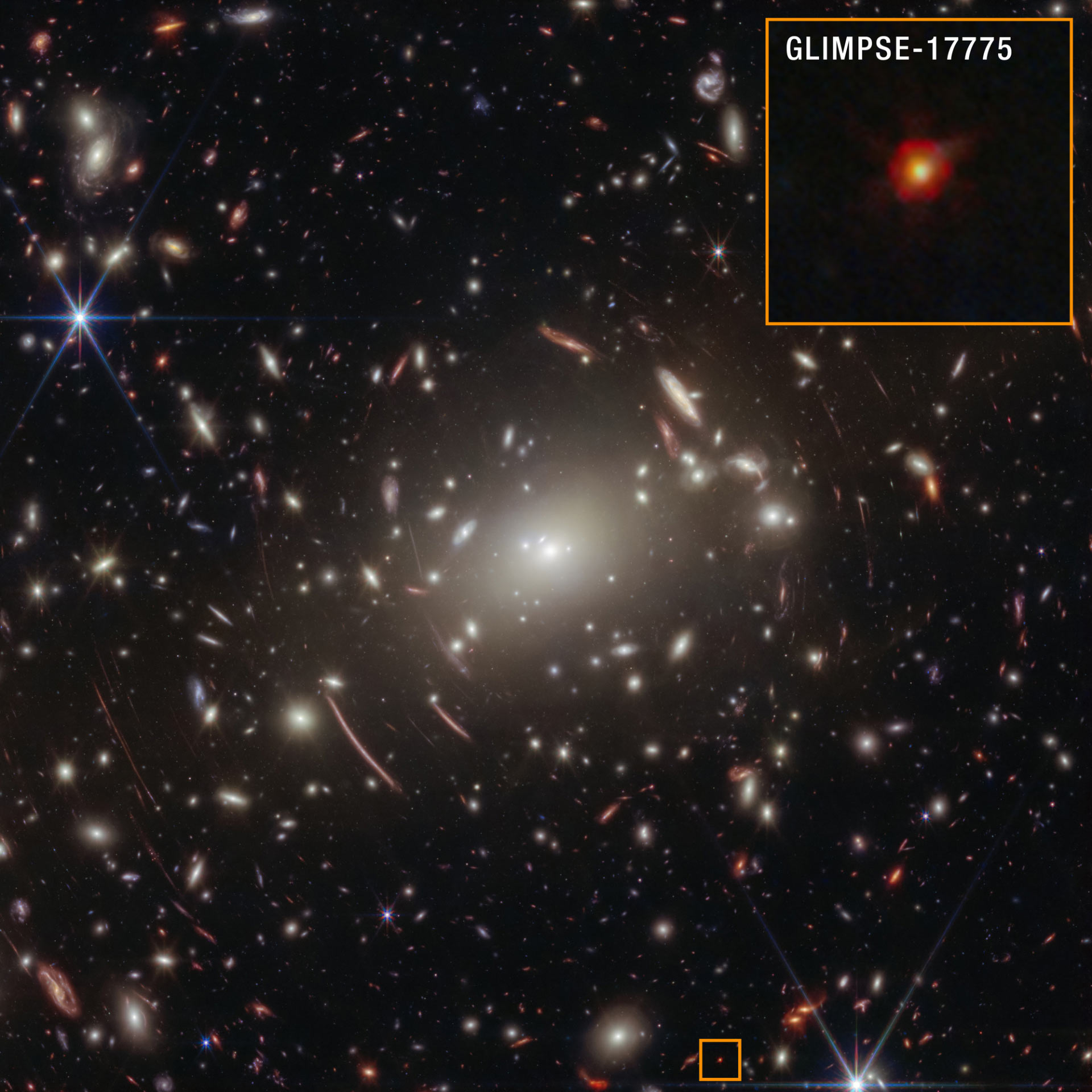
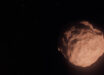
This Webb image shows the little red dot GLIMPSE-17775, which is located behind the galaxy cluster Abell S1063. Image credit: NASA / ESA / CSA / Vasily Kokorev, UT Austin / Alyssa Pagan, STScI.
“I think part of the scientific community is converging on a singular picture — that little red dots can be explained by black hole star models,” Dr. Kokorev said.
“But none of the previous little red dots have all of the pieces of evidence in the same place.”
“With GLIMPSE-17775 we can test these models because of how deep and amazing this source’s spectrum is.”
GLIMPSE-17775 has a cosmological redshift of 3.5, meaning it existed about 1.8 billion years after the Big Bang.
The object came into view almost serendipitously, caught up in Webb’s observations of the galaxy cluster Abell S1063, which was being observed to search for Population III stars and faint early galaxies.
The little red dot lies behind the cluster and gets a significant brightness boost from gravitational lensing.
“When we saw the spectrum for the first time, it was like having all the pieces of a puzzle scattered on the floor,” Dr. Kokorev said.
“We picked up each piece of the puzzle, measured the lines, and started combining the different pieces into a mosaic.”
“Maybe a few pieces looked like nothing at first, but then a couple of them came together, and we realized that there was something there.”
The spectroscopic data collected by Webb contains multiple lines of evidence that support the interpretation that little red dot GLIMPSE-17775 is a black hole star: a rapidly accreting, or growing, black hole enveloped in a dense gas cocoon, which is reprocessing the light emitted from near the black hole and producing the features seen in the spectrum.
“Everything fits, nothing is broken, and I think that makes the puzzle that is our Universe even better,” Dr. Kokorev said.
“Looking ahead, I’m eager to dive deeper and learn about what is powering the central engines of little red dots.”
“While we think it’s a black hole, there are some other interesting theories being proposed, which is exciting.”
“Maybe in a year or two, we’ll have the final answer to what powers these source.”
The team’s results appear in the Astrophysical Journal.
_____
Vasily Kokorev et al. 2026. The Deepest GLIMPSE of a Dense Gas Cocoon Enshrouding a Little Red Dot. ApJ 1004, 153; doi: 10.3847/1538-4357/ae4ed7