New images from the NASA/ESA/CSA James Webb Space Telescope reveal two young stars surrounded by planet-forming disks, Tau 042021 (left) and Oph 163131 (right), offering a rare edge-on glimpse into how worlds like our own may take shape.
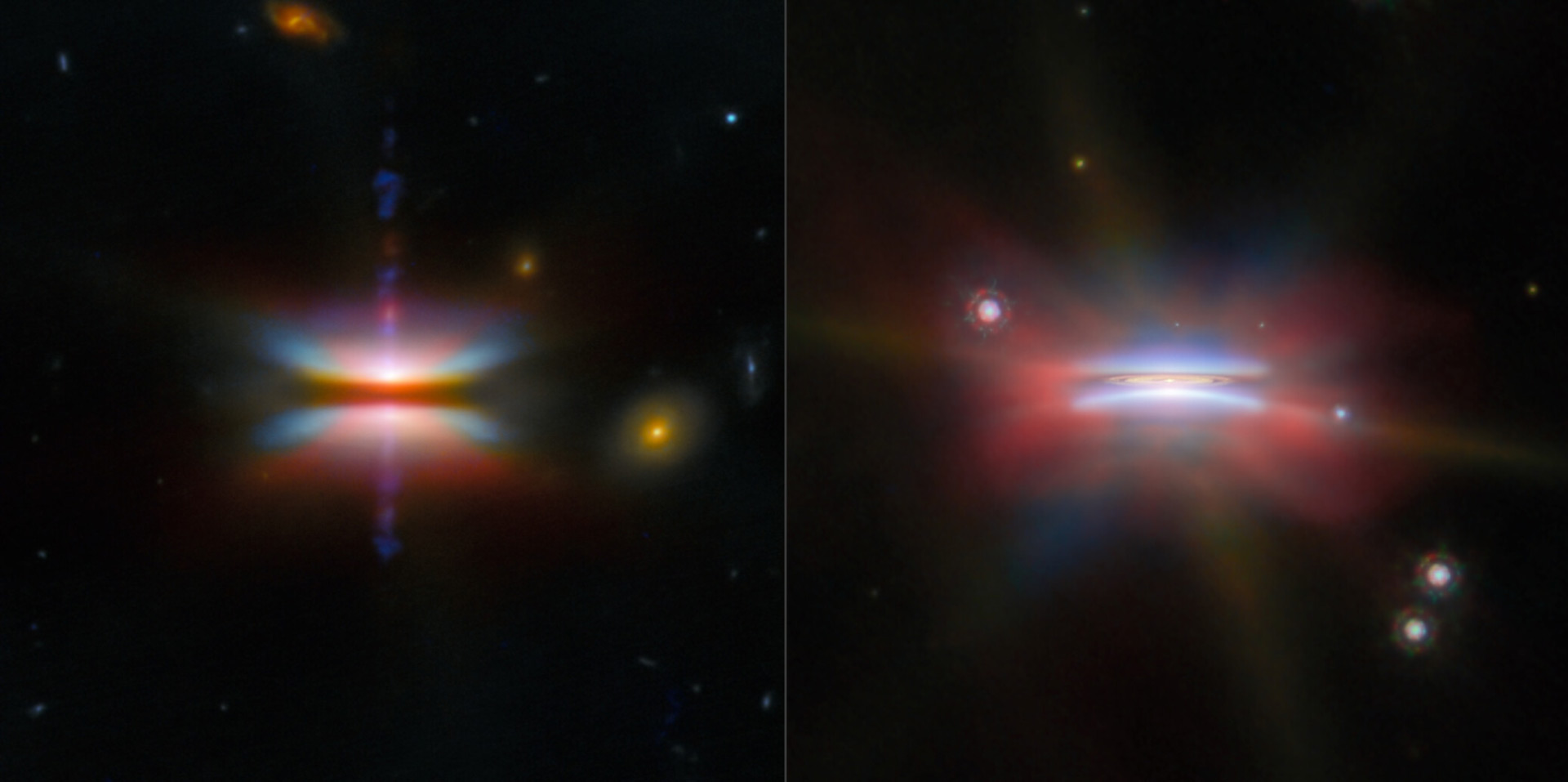
These composite images show protoplanetary disks Tau 042021 (left) and Oph 163131 (right). Image credit: NASA / ESA / CSA / Webb / Hubble / ALMA / ESO / NAOJ / NRAO / G. Duchêne / M. Villenave.
“Protoplanetary disks appear around stars that have recently been born,” the Webb astronomers said in a statement.
“When a clump of gas inside a larger molecular cloud collapses to form a star, unused gas and dust is left orbiting the star in a thick disk.”
“Over time, this dust too collides and collapses, slowly forming planetesimals which can, in turn, develop into planets.”
“The planetesimals which can’t make the jump to being a fully-fledged planet are left behind as asteroids and comets orbiting the star.”
“Gas that isn’t consumed by this process is blown away by the new star’s radiation over the course of tens of millions of years, ending the protoplanetary disk.”
“This is how our own Solar System formed in the distant past, creating the asteroids, comets, gas giants and terrestrial planets we know today.”
“By observing other protoplanetary disks at a much earlier age, we can work out how this process worked for our own Solar System, and how the different kinds of planets we see across the galaxy could have formed.”
The new images of protoplanetary disks Tau 042021 and Oph 163131, otherwise known as 2MASS J04202144+2813491 and 2MASS J16313124-2426281, were captured using Webb’s NIRCam and MIRI instruments.
Tau 042021 is located around 450 light-years away in the constellation of Taurus, while Oph 163131 lies about 480 light-years away in the constellation of Ophiuchus.
“The unique feature these two objects have in common is that, as we see them from our vantage point with Webb, they are oriented with the edge of the disk facing us,” the astronomers said.
“This means that the bright light from the young star in the center is mostly blocked, and we see the fine dust that has risen out of the disk as a nebula above and below the disk, lit by reflected light from the star.”
“Not only is this a beautiful sight, producing these images that resemble rainbow-colored spinning tops in space, it’s essential for studying how these planet-forming disks are composed.”
“The distribution of dust in the disk, both within it and above or below it, strongly affects where and how planets can form.”