Pohlsepia mazonensis, a cephalopod species first described in 2000 from a 300-million-year-old specimen and featured in the Guinness Book of Records as the world’s oldest octopus, has been reclassified as a distant relative of nautiluses, reshaping paleontologists’ timeline for when octopuses first evolved.
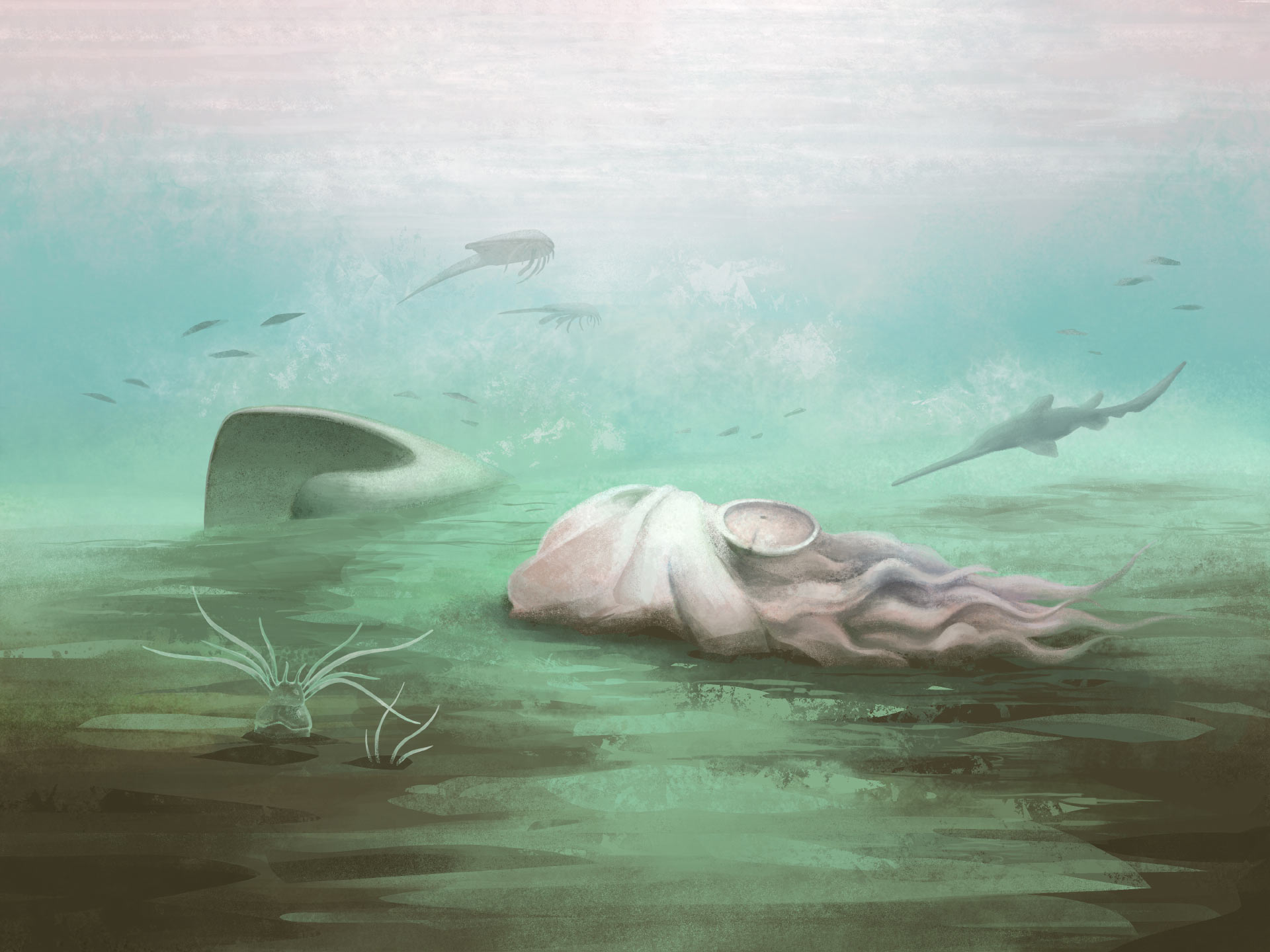
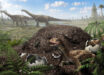
Reconstruction of a Paleocadmus decaying in the Mazon Creek marine basin; the separated shell is visible in the background; other Mazon Creek fauna are visible, such as the polychaete Esconites zelus (foreground) and Bandringa rayi, an elasmobranch shark (back left). Image credit: Franz Anthony.
“Described in 2000 from a solitary siderite concretion, Pohlsepia mazonensis fundamentally challenged our understanding of cephalopod evolution when it was interpreted as the oldest known octopus, predating previous estimates by over 150 million years,” said Dr. Thomas Clements, a paleontologist at the University of Leicester and the University of Reading, and his colleagues.
“This charismatic but contentious fossil from the Late Carboniferous Mazon Creek Lagerstätte (311-306 million years ago) was described as possessing a distinctive ‘sac-like’ fused head and mantle, symmetrical fins, paired eyespots and arm crown with both arms and specialized tentacles, while at the same time lacking any evidence of an internal or external shell.”
In the new study, the authors reexamined this enigmatic fossil, alongside multiple new specimens.
Using a suite of advanced analytical techniques, they found a previously undetected radula, the toothed tongue found in most mollusks.
The shape of the radula suggests Pohlsepia mazonensis belongs to the shelled nautiloids.
The organism had decayed significantly before fossilization, obscuring its true identity for decades.
“We conclude that Pohlsepia mazonensis is certainly Paleocadmus sp. and based on the morphological evidence, we determine that this cephalopod is synonymous with, and by order of precedence should be referred to as, Paleocadmus pohli,” the researchers said.
The team’s reinterpretation resolves a long-standing puzzle in octopus evolution and reveals the oldest preserved nautiloid soft tissue ever found.
“Our synchrotron micro-X-ray fluorescence elemental mapping analysis of Pohlsepia mazonensis identified a previously unknown radula obscured by the concretionary matrix,” the scientists said.
“The presence and morphology of the radular elements indicates that Pohlsepia mazonensis does not represent a crown octobrachian but, in fact, represents the oldest known fossil soft tissue nautiloid.”
“The reclassification of this enigmatic cephalopod refutes a Paleozoic origin for octobrachians, lending further support to a Mid/Late Mesozoic origin for crown Octopoda, and further diminishing support for the dubious coleoid affinity of the controversial Cambrian soft-bodied fossil Nectocaris pteryx.”
“Our findings highlight the interpretive difficulties when assessing the exceptional, yet occasionally ambiguous, soft tissue preservation seen in Mazon Creek Lagerstätte — emphasizing the need for rigorous re-evaluation when investigating enigmatic concretionary soft-bodied fossil material.”
The team’s paper was published today in the Proceedings of the Royal Society B.
_____
Thomas Clements et al. 2026. Synchrotron data reveal nautiloid characters in Pohlsepia mazonensis, refuting a Palaeozoic origin for octobrachians. Proc Biol Sci 293 (2068): 20252369; doi: 10.1098/rspb.2025.2369