A new analysis of isotopic signatures across planets and meteorite parent bodies suggests our home world formed entirely from inner solar system material, challenging long-standing theories of distant origins.
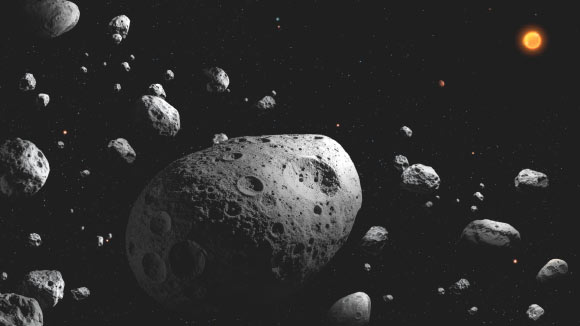
An artist’s impression of the asteroid 2025 MN45. Image credit: NSF-DOE Vera C. Rubin Observatory / NOIRLab / SLAC / AURA / P. Marenfeld.
“Our calculations make it clear: the building material of the Earth originates from a single material reservoir,” said ETH Zurich planetary scientist Dr. Paolo Sossi.
“We were truly astonished to find that the Earth is composed entirely of material from the inner Solar System distinct from any combination of existing meteorites,” added Dr. Dan Bower, also from ETH Zurich.
For their study, the researchers used data on ten different isotopic systems from meteorites, and analyzed them using a specialized statistical method.
“Our studies are actually data science experiments,” Dr. Sossi said.
“We carried out statistical calculations that are rarely used in geochemistry, even though they are a powerful tool.”
The analysis reveals that Earth is composed entirely of non-carbonaceous material.
No evidence was found for the previously suspected exchange between the outer and inner solar system reservoirs.
Therefore, our planet grew within a relatively static system, incorporating smaller neighboring bodies as it accreted.
This also implies that most volatile elements, such as water, were already present in the inner Solar System.
But why are there two distinct material reservoirs in our Solar System?
Scientists think that the split occurred during the planetary system’s formation, driven by the rapid growth and immense size of Jupiter.
The gas giant’s gravity carved a gap in the protoplanetary disk orbiting the young Sun.
Such disks — vast, ring-shaped structures of gas and dust — are the birthplaces of planets.
By opening this gap, Jupiter largely prevented material from the outer Solar System from drifting inward.
However, the degree to which this barrier remained permeable has, until now, been unclear.
In the current study, Dr. Sossi and Dr. Bower demonstrated that almost no material from beyond Jupiter flowed towards Earth.
“Our calculations are very robust and rely solely on the data itself, not on physical assumptions, as these are not yet fully understood,” Dr. Bower said.
“The analysis also shows that Earth’s material composition is similar to that of Vesta and Mars.”
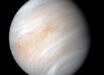
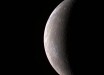
The researchers also suspect that Venus and Mercury lie on the same line.
“Based on our analysis, we can theoretically predict the composition of these two planets,” Dr. Sossi said.
“However, we cannot verify this analytically, as no rock samples from Mercury and Venus, which are the two innermost planets in the Solar System, are currently available to us.”
“Our results shed new light on the formation history of our Earth and the other rocky planets.”
The findings appear in the journal Nature Astronomy.
_____
P.A. Sossi & D.J. Bower. Homogeneous accretion of the Earth in the inner Solar System. Nat Astron, published online March 27, 2026; doi: 10.1038/s41550-026-02824-7