Astronomy News

Mar 13, 2017 by News Staff

An international team of astrophysicists from the United States, Ireland and Finland has come up with the formula for the formation of the first supermassive black holes in the Universe. The massive black hole shown at left in this drawing is able to rapidly grow as intense radiation from a galaxy nearby shuts down star formation in its host galaxy. Image credit: John Wise, Georgia Tech. Supermassive black holes live at the center of very large galaxies,...

Mar 13, 2017 by Natali Anderson

This image snapped by the NASA/ESA Hubble Space Telescope reveals a detailed view of part of the disc of NGC 1448, one of the nearest luminous galaxies...

Mar 12, 2017 by News Staff

Fast radio bursts (FRBs) — powerful radio flashes lasting just milliseconds, with mysterious origins that continue to be a matter of debate —...

Mar 9, 2017 by News Staff

New observations using the Atacama Large Millimeter/submillimeter Array (ALMA) have demonstrated that A2744_YD4 — the youngest and most remote galaxy...

Mar 6, 2017 by Enrico de Lazaro

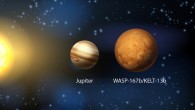
Using NASA’s Kepler spacecraft on its K2 mission, astronomers have discovered five new planets around other stars, including two extraordinary companions...

Mar 6, 2017 by Natali Anderson

The NASA/ESA Hubble Space Telescope has captured this vivid image of Westerlund 1, a young super star cluster. This image, taken with Hubble’s Wide Field...

Mar 2, 2017 by News Staff

For the first time, researchers have measured rapidly varying temperatures in hot gas flowing from the vicinity of a black hole. Artist impression illustrating...

Mar 2, 2017 by News Staff

A team of astrophysicists led by Yale Professor Priyamvada Natarajan has unveiled the most detailed maps to date of dark matter, offering a detailed case...

Mar 1, 2017 by News Staff

There may be a large number of undetected giant planet-like bodies in the neighborhood of our Sun, according to a Carnegie-led team of astronomers from...

Mar 1, 2017 by News Staff

A new image from ESO’s Very Large Telescope (VLT) gives a detailed view of NGC 1055, an edge-on spiral galaxy. This VLT image shows the spiral galaxy...

Feb 28, 2017 by News Staff

According to a team of astronomers at the University of Sheffield, UK, stars are ripped apart by supermassive black holes 100 times more often than previously...

Feb 27, 2017 by News Staff

Evidence of planetary debris surrounding a white dwarf and its substellar companion has been found by a University College London-led international team...

Feb 27, 2017 by News Staff

The NASA/ESA Hubble Space Telescope has delivered a stunning snapshot of the strange giant galaxy UGC 12591. This image, taken with the Wide Field Camera...

Feb 26, 2017 by News Staff

ESO’s Very Large Telescope (VLT) has produced this beautiful image of the spiral galaxy NGC 4981. This VLT image shows the spiral galaxy NGC 4981. The...

Feb 25, 2017 by News Staff

This new image of the remnant of core-collapse Supernova 1987A (SN 1987A) was taken by the NASA/ESA Hubble Space Telescope in January 2017. This Hubble...

Feb 24, 2017 by News Staff

ESA’s XMM-Newton mission has spotted a pulsar — a rapidly rotating, magnetized neutron star that sweeps regular pulses of radiation in two symmetrical...

Feb 22, 2017 by News Staff

NASA’s Fermi telescope has detected a strong gamma-ray signal coming from the core of the Andromeda galaxy (also known as Messier 31) that could indicate...

Feb 22, 2017 by News Staff

A system of seven exoplanets — three in their star’s habitable zone — has been found by an international team of astronomers. This artist’s...

Feb 21, 2017 by News Staff

A University of Cambridge-led team of astronomers, using chemical elements as a proxy for stellar DNA, has assembled an evolutionary family tree of stars...

Feb 20, 2017 by News Staff

This image shows the first measurements of the so-called Sunyaev-Zel’dovich effect (SZE) from the Atacama Large Millimeter/submillimeter Array. Astronomers...