Paleoanthropologists have identified a trove of Denisovan fossils from a cave in China’s Yunnan province, extending the known range of the elusive human relative and providing the first-ever direct evidence of what its forearm bones looked like.

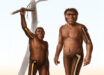
An artist’s concept of a Penghu Denisovan walking under the bright Sun during the Pleistocene of Taiwan. Image credit: Cheng-Han Sun.
“Denisovans are a genetically identified archaic hominin group believed to have been widely distributed across Asia,” said senior author Dr. Qiaomei Fu, a researcher with the Institute of Vertebrate Paleontology and Paleoanthropology at the Chinese Academy of Sciences, and colleagues.
“However, due to the limited number of fossil remains, especially postcranial bones, a distribution gap has long existed in Southwest China.”
“Therefore, little is known about the physical traits that allowed Denisovans to adapt to different environments.”
In a new study, the researchers screened more than 60,000 bone fragments from Bianfu Cave in Yunnan province, China.
Using techniques called zooarchaeology by mass spectrometry and proteomic sequencing analysis, they confirmed that five of these specimens belonged to Denisovans.
The finds include two skull fragments, a piece of a radius, or forearm bone, and two teeth, dating to roughly 190,000 to 70,000 years ago.
According to the team, Bianfu Cave now becomes the richest Denisovan site outside of Siberia.
Among the new specimens, the forearm fragment is especially significant.
It is the first Denisovan radius ever identified, offering researchers their first direct look at Denisovan limb anatomy beyond a single finger bone and rib recovered from other sites.
Its proportions showed a mix of traits — a robust head and neck resembling Neanderthals, paired with an overall shape and cross-sectional geometry closer to modern humans — suggesting Denisovans may have had a distinctive combination of physical adaptations.
The skull fragments, meanwhile, were notably thick, resembling patterns seen in Homo heidelbergensis and other archaic populations across East Asia.
“Bianfu Cave lies along an important migration corridor linking the Qinghai-Tibet Plateau with East Asia, South Asia and Southeast Asia,” the scientists said.
“It thus fills a critical geographic gap in the known distribution of Denisovans and reveals their presence across a vast range from Siberia and northeastern China in the north, through the Qinghai-Tibet Plateau in the center, to the Taiwan Strait in the southeast, and now the Yunnan-Guizhou Plateau in the southwest.”
The results appear this week in the journal Nature.
_____
H. Rao et al. Ancient proteins identify various Denisovan remains from Southwest China. Nature, published September 9, 2026; doi: 10.1038/s41586-026-10976-9