By tracing magnetic signals preserved in 3.5-billion-year-old rocks in Western Australia, geoscientists have found the oldest direct evidence yet that parts of the planet’s outer shell were shifting across the globe, pushing the origins of plate motion deep into Earth’s early history.

Hadean Earth. Image credit: Alec Brenner.
“There has been a huge range of ages suggested for timing,” said Dr. Alec Brenner, a researcher at Yale University.
“With this study, we’re able to say 3.5 billion years ago, we can see plates moving around on the Earth surface.”
In the study, Dr. Brenner and colleagues focused some of the oldest well-preserved rocks in the world, the Pilbara Craton in Western Australia, which contains formations from the Archean Eon when the Earth was hosting early microbial life and under heavy bombardment by astronomical objects.
“The Pilbara area contains evidence of some of the earliest known life, stromatolites and microbialite rocks deposited by single-celled organisms such as cyanobacteria,” they said.
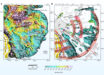
The researchers analyzed more than 900 rock samples collected from more than 100 sites scattered across an area called the North Pole Dome.
They extracted cylindrical samples or cores using an electric drill with a hollow bit and diamond teeth, kept cool by a hand-pump garden sprayer.
Afterwards the position of the sample was precisely recorded with an instrument inserted into the hole containing a compass and goniometer (device for measuring angles).
The scientists then sliced the cores into sections like cookies and placed them in a magnetometer, a machine that can measure magnetic signals 100,000 times more faint than a compass needle.
The samples were repeatedly measured while being heated to progressively hotter temperatures up to 590 degrees Celsius until the magnetite minerals lost their magnetization.
“We took a really big gamble. Demagnetizing thousands of cores takes years. And boy, did it pay off! These results were beyond our beyond our wildest dreams,” Dr. Brenner said.
In ferromagnetic minerals, the orientation of the electrons serves like a compass needle pointing towards the magnetic pole.
The electron orientation also provides hints about the position on the 3D globe relative to the magnetic pole when the rock formed — thus providing an indication of latitude.
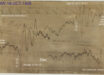
By analyzing a series of rocks spanning 30 million years just after 3.5 billion years ago, the authors found that part of the East Pilbara Formation shifted in latitude from 53 degrees to 77 degrees — a drift of tens of cm annually over several million years — and rotated clockwise by more than 90 degrees.
Because the magnetic pole occasional reverses, it remains uncertain whether this motion occurred in the northern or southern hemisphere.
Within about 10 million years, the motion slowed and followed by a period of little motion.
To compare this motion with Archaean sites elsewhere, the team examined a contemporary site in South Africa, the Barberton Greenstone Belt.
Previous paleomagnetic studies showed that the latter was located near the equator and nearly stationary during the same time interval. Apparently the two distant regions had different patterns of drift.
In the modern world, the North American and Eurasian plates now are moving away from each other by about 2.5 cm per year.
It remains an open question about when and how the Earth took on its current form of plate tectonics, which geophysicists call an active lid.
Various theories posit that the early Earth had a stagnant lid (a single unbroken global plate), a sluggish lid (slowly moving plates), or episodic lid (plates moving sporadically).
The new study rules out a stagnant lid but cannot distinguish which model of plate movement was most likely.
“We’re seeing motion of tectonic plates, which requires that there were boundaries between those plates and that the lithosphere wasn’t some big, unbroken shell across the globe, as a lot of people have argued before,” Dr. Brenner said.
“Instead, it was segmented into different pieces that could move with respect to each other.”
Dr. Brenner and co-authors also discovered the oldest-known case of a geomagnetic reversal — a phenomenon in which the magnetic field of the planet occasionally flipped. After a reversal, a compass needle would point south instead of north.
This phenomenon is believed to be governed by the dynamo action involving the convection of molten iron in the Earth core that produces electrical currents and magnetic fields. The last reversal occurred about 780,000 years ago.
“The new evidence suggests that 3.5 billion years ago, reversals occurred less frequently than in more recent history,” said Harvard University’s Professor Roger Fu.
“It’s not by itself conclusive, but it suggests that maybe the dynamo was in a slightly different regime than today.”
The findings were published March 19 in the journal Science.
_____
Alec R. Brenner et al. 2026. Paleomagnetic detection of relative plate motions and an infrequently reversing core dynamo at 3.5 Ga. Science 391 (6791): 1278-1282; doi: 10.1126/science.adw9250