For years glaciologists puzzled over strange plume-like structures hidden deep within the Greenland Ice Sheet. Now a new study by scientists from the University of Bergen, NASA’s Goddard Space Flight Center and the University of Oxford suggests that these enigmatic features are caused by thermal convection, a process usually linked to the Earth’s mantle.
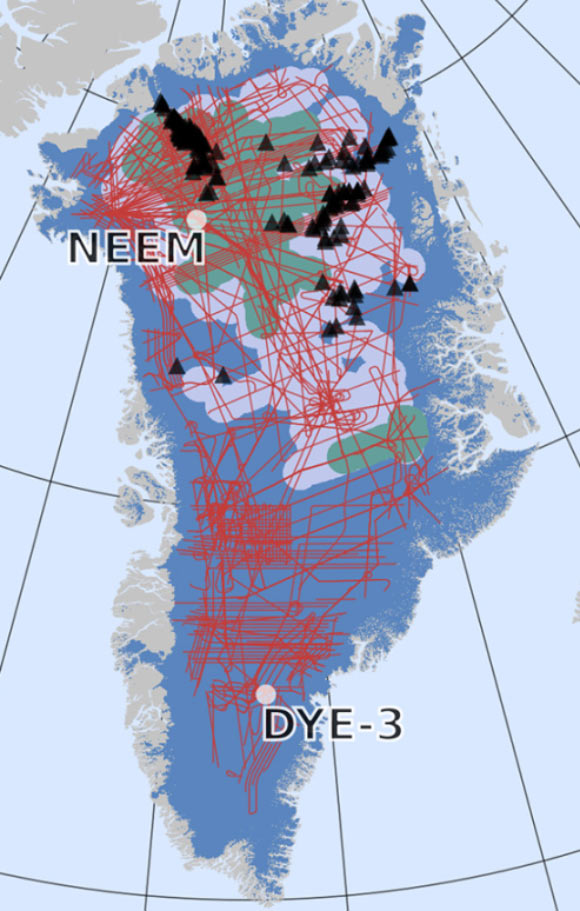
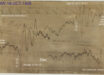
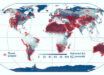
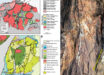
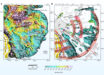
Location of large plume-like structures (triangles) hidden deep within the Greenland Ice Sheet. Image credit: Leysinger Vieli et al., doi: 10.1038/s41467-018-07083-3 / Law et al., doi: 10.5194/tc-20-1071-2026.
“We typically think of ice as a solid material, so the discovery that parts of the Greenland Ice Sheet actually undergo thermal convection, resembling a boiling pot of pasta, is as wild as it is fascinating,” said University of Bergen’s Professor Andreas Born, co-author of the study.
“Finding that thermal convection can happen within an ice sheet goes slightly against our intuition and expectations,” said lead author Dr. Robert Law, also from the University of Bergen.
“Ice is at least a million times softer than the Earth’s mantle, though, so the physics just work out. It’s like an exciting freak of nature.”
“Our discovery could be key to reducing uncertainties in models of future ice sheet mass balance and sea-level rise,” Professor Born added.
Although the deep ice could be around ten times softer than commonly assumed, this does not necessarily mean it will melt faster.
“Improving our understanding of ice physics is a really major way to be more certain about the future, but on its own, softer ice does not necessarily mean that the ice will melt faster or that sea level rise will be higher. We need further studies to fully isolate that,” Dr. Law said.
The findings do not predict disaster on Greenland or elsewhere, but they do highlight how complex and dynamic Greenland is.
“Greenland and its nature is truly special,” Dr. Law said.
“The ice sheet there is over one thousand years old, and it’s the only ice sheet on Earth to have a culture and permanent population at its margins.”
“The more we learn about the hidden processes inside the ice, the better prepared we’ll be for the changes coming to coastlines around the world.”
The results appear this month in The Cryosphere.
_____
R. Law et al. 2026. Exploring the conditions conducive to convection within the Greenland Ice Sheet. The Cryosphere 20: 1071-1086; doi: 10.5194/tc-20-1071-2026