By combining seismic, gravity and topographic data, a team of researchers from Italy, Switzerland, Germany and the United Kingdom found that several well-known subglacial basins in East Antarctica are part of a single fan-shaped province whose origins trace back to ancient continental stretching.
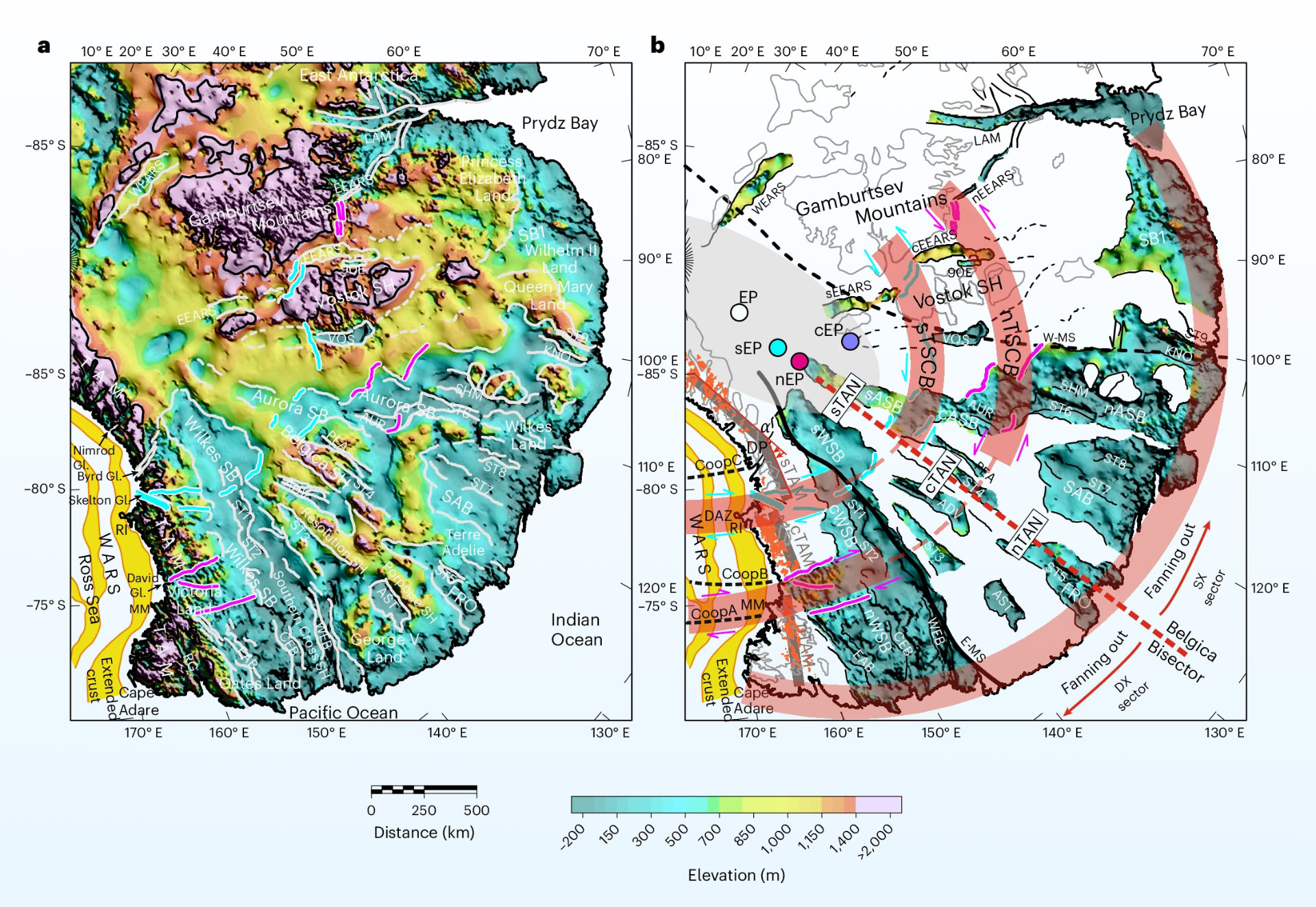
Fault-controlled basins and interpreted structural frame in the newly-identified East Antarctic Fan-Shaped Basin Province. Image credit: Armadillo et al., doi: 10.1038/s41561-026-01991-6.
“Antarctic bedrock is largely obscured by the Antarctic Ice Sheet, which covers more than 99% of the continent,” said first author University of Genoa’s Dr. Egidio Armadillo and colleagues.
“Recently, international compilations of radio-echo sounding data have resolved large-scale subglacial topographic features in increasing detail, revealing a wide and low-elevation sector of East Antarctica extending from Prydz Bay to the Transantarctic Mountains and from the coast inland to 85° S.”
“In this region, most of the large subglacial basins are V-shaped and aligned along the north-south direction.”
“Moreover, the 2,000-km-long Antarctic coastline and continent-ocean boundary margin, delimiting the sector to the north, has a distinct semi-circular arc geometry.”
“At a semi-continental scale, the topography resembles a handheld fan, converging to a point located close to the South Pole.”
“We propose that the entire region is a single physiographic unit and name it the East Antarctic Fan-Shaped Basin Province (EAFBP).”
The EAFBP structure includes some of Antarctica’s best-known subglacial features, such as the Wilkes and Aurora basins and the basin hosting Lake Vostok, the largest known subglacial lake on Earth.
Analysis suggests the structure was formed by a process known as distributed rotational extension.
This is where the continental crust has spread out from a central point.
The pattern is similar to a hand, with the base of the thumb as the fixed point, and fingers spreading out showing the stretching.
The gaps between the fingers are like the triangular basins that form as it opens.
According to the scientists, EAFBP could be one of the largest examples of rotational extension ever seen in continental crust.
It may have developed through multiple tectonic phases linked to the evolution of the supercontinent Gondwana and the later separation between Antarctica and Australia and could even have influenced this break-up.
The discovery also raises fresh questions — particularly around the precise age of the structure and the geodynamic mechanisms that generated it.
However, the significance of the discovery extends beyond historical insight.
“The shape of the bedrock hidden beneath the ice sheet continues to influence ice flow today, controlling the distribution of subglacial basins and lakes,” the authors said.
“This could potentially affect the stability of parts of the Antarctic Ice Sheet that are particularly sensitive to climate change.”
The study was published June 3 in the journal Nature Geoscience.
_____
E. Armadillo et al. A fan-shaped subglacial basin province in East Antarctica formed by rotational extension. Nat. Geosci, published online June 3, 2026; doi: 10.1038/s41561-026-01991-6