Zircon crystals and impact-altered minerals show that a massive asteroid slammed into what is now the Pilbara region of Western Australia about 3 billion years ago.
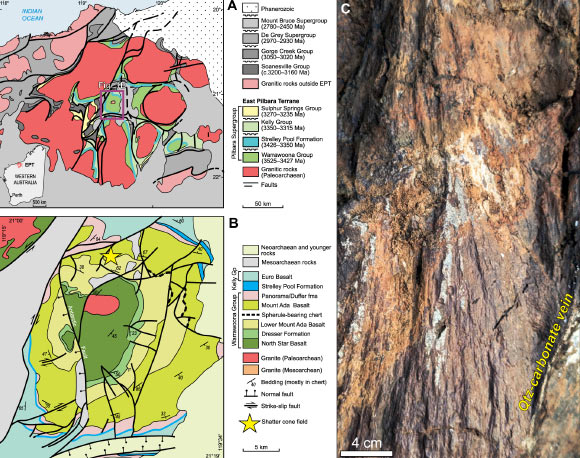
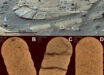
The North Pole Dome crater: (A) simplified map of the East Pilbara Terrane (EPT, Western Australia), showing Paleoarchean granite domes (pink) and greenstone belts (greens and blues); the North Pole Dome (NPD) lies near the terrane center; (B) geological map of the NPD and the shatter-cone field (yellow star); (C) A quartz (Qtz)-carbonate vein cutting shatter-cone lineation. Image credit: Kirkland et al., doi: 10.1130/G54866.1.
“Although the Moon preserves clear evidence for intense bombardment during the Hadean to early Archean eons, the impact history on the early Earth remains elusive,” said Curtin University’s Professor Chris Kirkland and colleagues.
“Meteorite impact structures are notoriously challenging to date, an issue exacerbated for impacts into Archean upper crustal rocks where mafic protoliths dominate.”
“Such rocks generally lack primary quartz and zircon that may preserve shock indicators and, in the case of zircon, be amenable to dating.”
“A dense shatter cone field discovered recently at the North Pole Dome, in the center of the East Pilbara Terrane of Western Australia, provides macroscopic evidence of impact into weakly metamorphosed mafic rocks.”
“The shatter cones were originally considered to have formed at ca. 3.47 billion years ago.”
“However, scientists reported two shatter cones within rocks they interpreted to belong to the Neoarchean Mount Roe Basalt, implying that the impact occurred at some time between 2.7 and 0.4 billion years ago.”
In the new study, the authors examined two samples of shatter-cone-bearing rocks — a zircon-bearing metadolerite and an apatite-bearing metabasalt — along with a shocked quartz vein from the North Pole Dome.
Using advanced mineral dating techniques, they identified the clearest evidence yet that the impact occurred around 3 billion years ago.
“The findings help resolve a longstanding question about the timing of the impact,” Professor Kirkland said.
“While the site had previously been identified as an ancient impact structure, its exact age remained uncertain.”
“The impact left a ‘mineral clock’ behind. By dating minerals that were remade or newly grown in the damaged rocks, we can now pin down when this extraordinary event happened.”
“The key evidence comes from zircon, a tiny but extraordinarily resilient mineral that can keep geological time for billions of years.”
“Some zircons at North Pole Dome have unusual branching, skeletal shapes.”
“We interpret these as impact-modified crystals, formed when older zircon was disrupted, partly recrystallised, and in places regrown during the intense heating caused by the impact.”
“These zircon crystals record an event at about 3 billion years ago, which we believe is the best estimate for the impact.”
“To confirm the result, we analyzed a second mineral, apatite, which formed as hot fluids moved through the shock-damaged rocks.”
“This independent dating method produced the same age.”
“The agreement between two different mineral systems gives us confidence that we are seeing the signature of a single major event — a meteorite impact.”
The new age places the North Pole Dome structure as Earth’s oldest known impact crater and the only recognized example from the Archean Eon, a time when the planet’s earliest continents were forming.
“Ancient impact craters are incredibly difficult to date because over billions of years, rocks are altered by heat, pressure and fluids, which can obscure or reset the original impact signals,” Professor Kirkland said.
“What we’ve been able to do here is separate the moment of impact from its long geological history.”
“This discovery pushes Earth’s impact record deeper into geological time than any previously well-dated crater, offering a rare glimpse of the violent processes that shaped the early Earth.”
The team’s paper was published June 23 in the journal Geology.
_____
C.L. Kirkland et al. How old is the North Pole Dome impact, Western Australia? Geology, published online June 23, 2026; doi: 10.1130/G54866.1