Paleontologists from the Field Museum of Natural History have described the fossilized remains of baby embolomeres, crocodile-like predators that prowled ancient rivers and swamps between 350 and 280 million years ago. These creatures were among the earliest land-dwelling vertebrates, and their babies, scientists had assumed, would look like tadpoles — but they don’t.
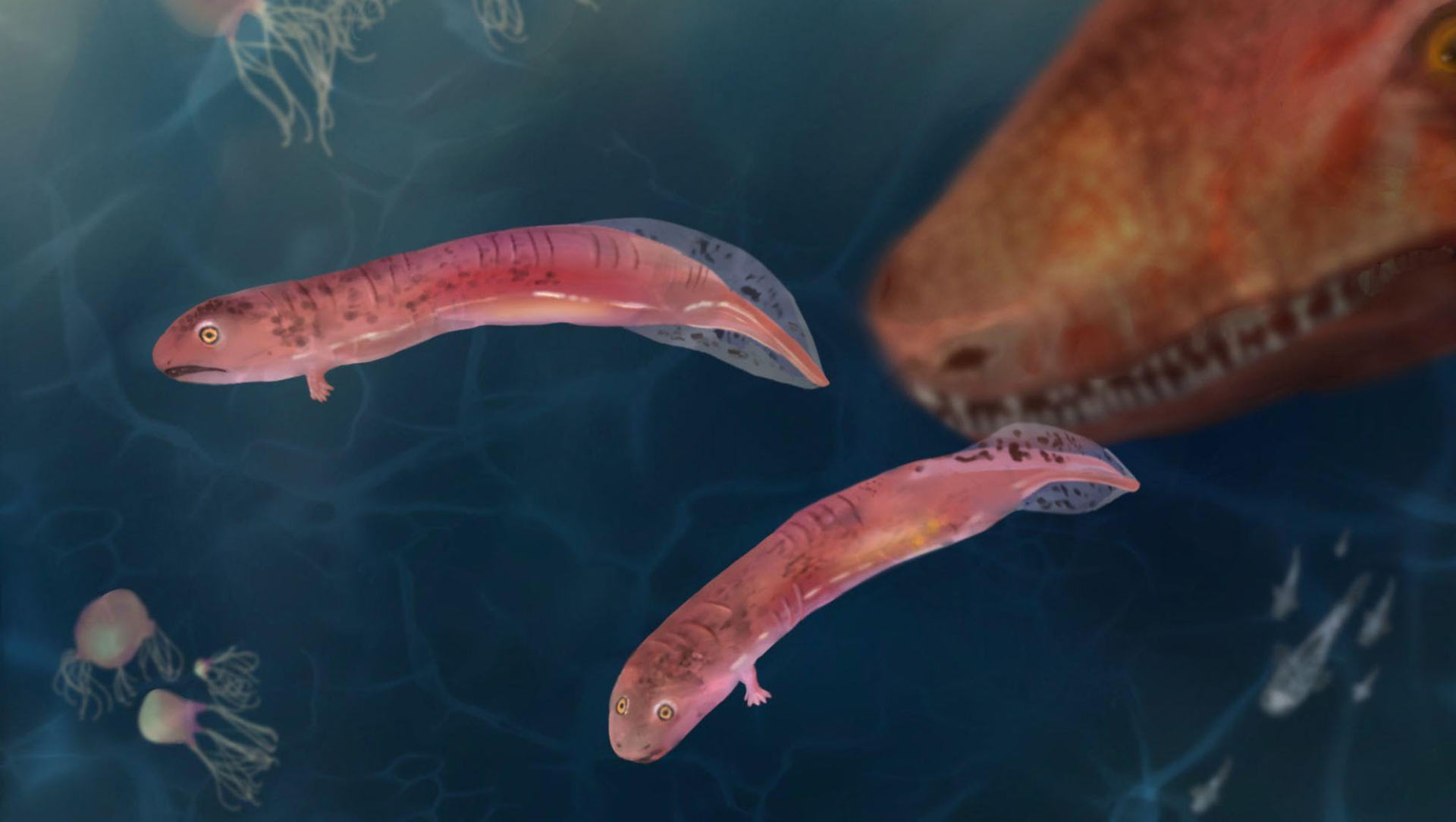
New fossil evidence suggests that embolomeres did not undergo a metamorphosis the way that modern amphibians do when growing up, which challenges a long-standing scientific belief that amphibians, reptiles, and mammals evolved from animals that had a tadpole stage. Image credit: Berit Godring.
“When a lot of us were in high school, we were taught this simplified story of evolution: that some fish evolved into amphibians, and some of those amphibians evolved into reptiles, and some of those reptiles evolved into mammals,” said Field Museum paleontologist Jason Pardo.
“And our study shows that this basic underlying premise, that the first four-legged vertebrates grew up like amphibians, is wrong.”
In their new research, Dr. Pardo and his colleague, Dr. Arjan Mann, looked at tetrapod fossils, many with well-preserved soft tissues, from the Mazon Creek Lagerstatte in Illinois.
“It’s one of the best fossil sites in the world, especially for soft tissues and delicate little fossils,” Dr. Mann said.
“Mazon Creek fossils are time capsules that capture the impossible.”
As adults, embolomeres could stretch over 3 m (10 feet) — fearsome apex predators that lived in rivers, lakes, and swamps from 350 (Carboniferous period) to 280 million years ago (Permian period).
The Mazon Creek specimens are a humbling contrast: babies just a few cm long, yet carrying enough information to overturn a century of scientific assumption.
According to the authors, the baby embolomeres were missing key amphibian tadpole traits like frilly external gills.
Even when larval stages underwent big changes on their way to adulthood, they showed no signs of true amphibian metamorphosis.
Instead, these early tetrapods’ life cycles appear to be more like ours — or like those of fish — than like amphibians.
“We looked at a number of different species that represent different lineages in the transition from fish to tetrapods, and what we found is that none of them have anything that looks remotely like a tadpole,” Dr. Pardo said.
“And if you don’t have a tadpole, then you don’t have a metamorphosis.”
“And if animals like embolomere didn’t have a tadpole form or a true amphibian metamorphosis, that means that the widely-accepted hypothesis that reptiles and mammals evolved from amphibian-like animals is incorrect.”
“The story was that metamorphosis is the tool by which animals made the transition from fossil to land. That story doesn’t work anymore, it’s dust in the wind.”
The findings appear in the journal Science.
_____
Jason D. Pardo & Arjan Mann. 2026. Direct development of stem tetrapods across the fin-to-limb transition. Science 392 (6804): 1292-1296; doi: 10.1126/science.aeb7635