A 113-million-year-old pterosaur fossil from northeastern Brazil has yielded rare evidence of soft tissues, organic molecules and chemical traces of a diet heavy in fish and cephalopods such as squid or nautilus relatives.
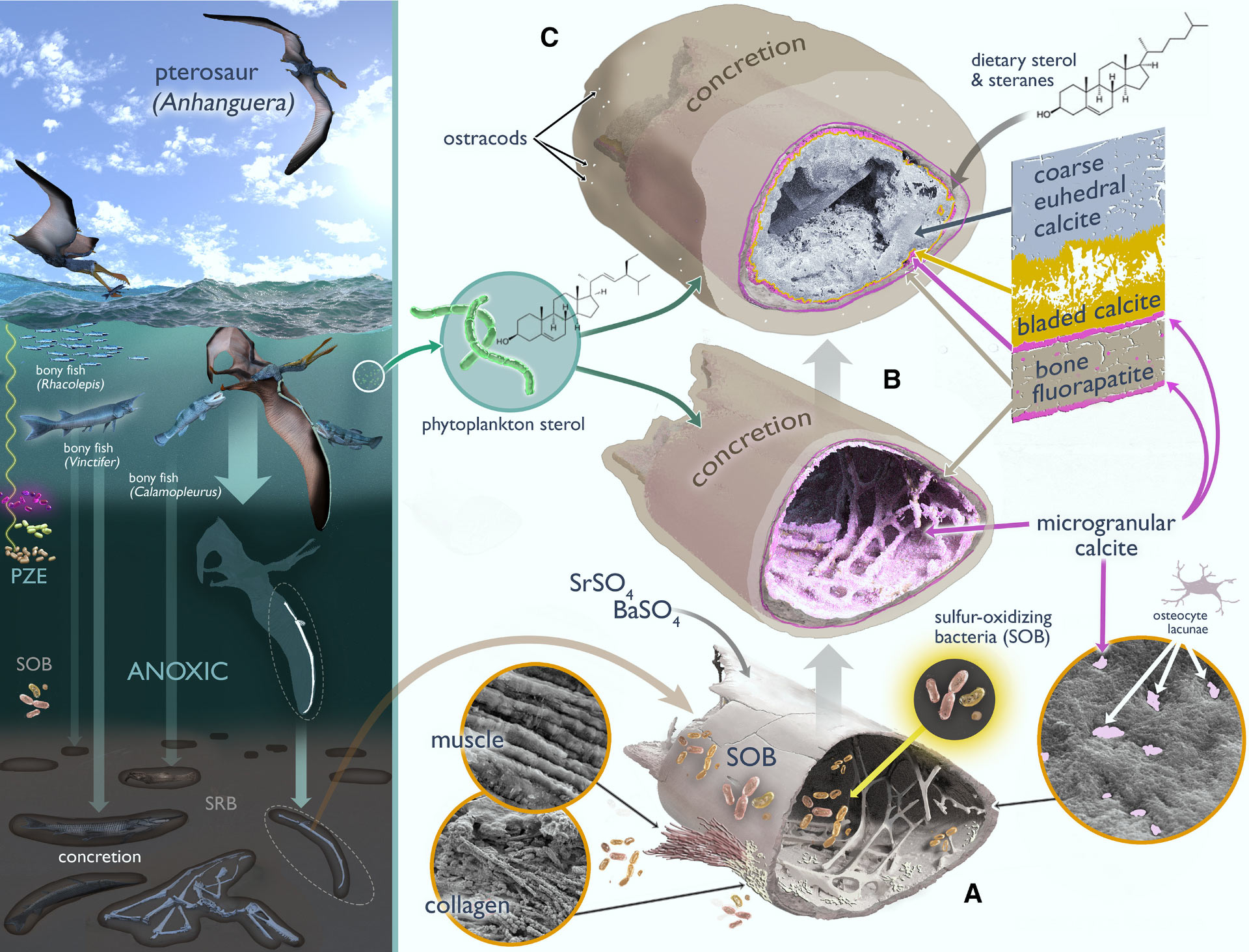
Grice et al. integrate organic geochemical analyses with high-resolution micro-mineral imaging of a three-dimensionally preserved Cretaceous pterosaur wing phalanx from Brazil to reveal steroid biomarkers and multi-stage mineralization pathways underlying its preservation. Image credit: Grice et al., doi: 10.1016/j.isci.2026.116199.
“Our findings open a new window into fossil formation,” said Curtin University Professor Kliti Grice, lead author of the study.
In the study, Professor Grice and colleagues examined a partial left wing of an Early Cretaceous anhanguerid pterosaur found at the Sítio Baixa Grande locality in the northwestern region of the Araripe Basin, Brazil.
The site is part of the Romualdo Formation, which is world-renowned for its exceptionally preserved vertebrate fossils, notably its panoply of pterosaurs.
The pterosaur wing was encased in a limestone concretion that protected it in remarkable detail.
The paleontologists found microscopic structures within the specimen, including preserved collagen-like fibers, mineralized soft tissues and steroid biomarkers.
Carbon-isotope measurements of cholesterol-derived compounds suggest this pterosaur was an aerial predator hunting above Cretaceous seas.
The reptile likely fed on fish and cephalopods and occupied a relatively high position in the food web.
“This fossil is a true time capsule — not only is it beautifully preserved, but for the first time we’ve detected traces of steroids in a pterosaur, providing further evidence that these creatures likely fed on fish or squid,” Professor Grice said.
“It also marks the first time molecules have been recovered from a pterosaur fossil, revealing new clues about its diet and highlighting the growing potential of molecular paleontology to unlock secrets from deep time.”
“Steroid preservation in fossils is exceptionally rare but what’s even more fascinating is that our findings challenge long-held ideas about fossil preservation itself.”
Using a combination of chemical, isotopic and high-resolution imaging techniques, they reconstructed the fossilization process.
They concluded that the carcass created a localized chemical environment as it decayed.
Acidity generated by microbial activity triggered the formation of phosphate minerals that stabilized tissues, while later waves of carbonate mineralization sealed the remains and shielded organic compounds from further degradation.
The study challenges the common assumption that exceptional fossil preservation requires only oxygen-poor conditions.
Instead, the researchers argue that localized shifts between oxidizing and reducing conditions around the decaying animal played a critical role in preserving the fossil.
“Our research reveals a new pathway for remarkable fossil preservation, offering fresh insights into ancient life and the unique environmental conditions that enable such remarkable fossilization,” Professor Grice said.
“It adds to the growing evidence that tiny microbes played a big role in this process — something we are now identifying at other fossil sites — presenting a new global Lagerstätten mechanism, the special conditions that make exceptional preservation possible.”
The team’s findings were published this week in the journal iScience.
_____
Kliti Grice et al. Multi-staged mineralization and biomarker preservation in a 113-million-year-old pterosaur bone via redox shifts in diagenesis. iScience, published online June 18, 2026; doi: 10.1016/j.isci.2026.116199