Paleontology News

May 3, 2021 by News Staff

Bicellum brasieri, a freshwater protist that lived nearly one billion years ago, had two distinct cell types and could be the earliest multicellular animal ever recorded. Found in the Scottish Highlands, the microfossil reveals a new insight into the transition of single-celled holozoans into more complex multicellular animals. Bicellum brasieri in mature form; all specimens were preserved in petrographic thin sections from the Diabaig Formation stratotype,...

Apr 28, 2021 by Enrico de Lazaro

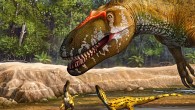
Yamatosaurus izanagii roamed our planet 71.8 million years ago during the Late Cretaceous epoch. This artist’s illustration of Yamatosaurus izanagii...

Apr 27, 2021 by News Staff

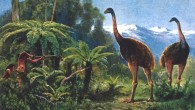
An international team of scientists has recovered and analyzed partial mitochondrial genomes from 1,300-1,400-year-old specimens of Voay robustus, a recently...

Apr 26, 2021 by Enrico de Lazaro

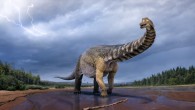
A new genus and species of lithostrotian titanosaur has been identified from a partial skeleton found in northern Chile. Life reconstruction of Arackar...

Apr 23, 2021 by News Staff

Paleontologists have unearthed the 67,000-year-old fossilized remains from three extinct species of giant cloud rats in several caves on the Philippine...

Apr 23, 2021 by News Staff

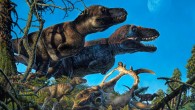
An international team of paleontologists has examined a collection of 72.5-million-year-old tyrannosaur — probably Albertosaurus — footprints...

Apr 21, 2021 by News Staff

Animals display a variety of gaits and walking speeds. It is commonly assumed that they minimize locomotor energy expenditure by selecting gait kinematics...

Apr 21, 2021 by News Staff

Tyrannosaurs — theropod dinosaurs that lived in what is now North America and Asia between 100 and 66 million years ago (Cretaceous period) —...

Apr 20, 2021 by Enrico de Lazaro

Scientists have reconstructed the genomes of the extinct giant short-faced bear (Arctodus simus) and the American black bear (Ursus americanus) using environmental...

Apr 16, 2021 by News Staff

Paleontologists estimate that the abundance of one of the best-known dinosaurs, Tyrannosaurus rex, at any one time was about 20,000 individuals, that the...

Apr 16, 2021 by News Staff

An international team of paleontologists has discovered a 5.7-cm-long stegosaur footprint in Xinjiang province, China. A life reconstruction of the stegosaur...

Apr 15, 2021 by News Staff

Paleontologists have found that the thin neck vertebrae of the azhdarchid pterosaurs got their strength from an intricate internal structure. An artist’s...

Apr 14, 2021 by News Staff

Paleontologists have found an exceptionally preserved short-winged flower beetle and associated pollen aggregations and coprolites in a piece of mid-Cretaceous...

Apr 13, 2021 by Enrico de Lazaro

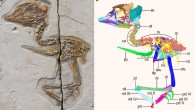
Opposed thumbs are adaptations to arboreal life and rare for non-mammal vertebrates; Kunpengopterus antipollicatus, a newly-discovered species of arboreal...

Apr 12, 2021 by Enrico de Lazaro

Paleontologists have announced the discovery of a new genus and species of hadrosaurid (duck-billed) dinosaur, based on the skeletal remains found in New...

Apr 12, 2021 by News Staff

Gray wolves (Canis lupus) from the Yukon Territory, Canada, survived the extinction at the end of the last Ice Age by adapting their diet over thousands...

Apr 8, 2021 by News Staff

Fossiomanus sinensis and Jueconodon cheni, two distantly related species of mammaliamorphs that lived some 120 million years ago (Early Cretaceous epoch),...

Apr 2, 2021 by News Staff

Trilobites had well-developed gill-like structures in their upper leg branches, according to a new imaging study led by the University of California, Riverside. Trilobite...

Apr 2, 2021 by News Staff

About 66 million years ago (the end of the Cretaceous period), a 10-km-wide asteroid crashed into Earth near the site of the small town of Chicxulub in...

Mar 31, 2021 by News Staff

A new genus and species of furileusaurian (stiff-backed lizard) abelisaurid dinosaur being named Llukalkan aliocranianus has been discovered by a team...