Paleontology News

Jan 12, 2017 by News Staff

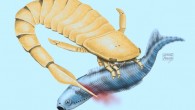
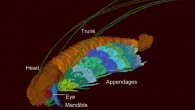
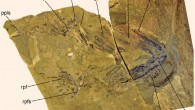
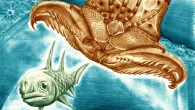
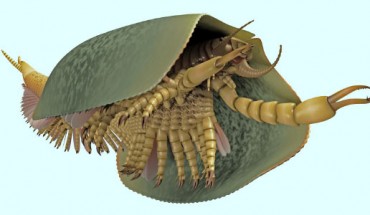
Paleontologists have finally determined what hyoliths — a group of extinct marine creatures — actually are. Reconstruction of the hyolith Haplophrentis on the Cambrian sea floor. Image credit: D. Dufault / Royal Ontario Museum. Hyoliths evolved over 530 million years ago during the Cambrian period and are among the first animals known to have produced mineralized external skeletons. Long believed to belong to the same family as snails,...

Jan 4, 2017 by News Staff

CT scans of the fossilized skull of Dwykaselachus oosthuizeni — a shark-like fish that lived during the Permian period, around 280 million years...

Jan 3, 2017 by News Staff

Non-avian dinosaur eggs took a long time to hatch — between 3 and 6 months, according to new research on the teeth of fossilized dinosaur embryos. Herds...

Dec 23, 2016 by News Staff

An international team of paleontologists has discovered that Limusaurus inextricabilis, a species of Jurassic dinosaur, lost its teeth in adolescence and...

Dec 20, 2016 by News Staff

A team of paleontologists has found the remains of a prehistoric bird that lived 90 million years ago (Cretaceous period) in the Canadian Arctic. An artist’s...

Dec 9, 2016 by News Staff

An international team of paleontologists from China, Canada and the United Kingdom has discovered the tail of a non-avian theropod dinosaur (likely a coelurosaur)...

Dec 5, 2016 by News Staff

Fossilized forewings (elytra) from two individuals, discovered at the Oliver Bluffs on the Beardmore Glacier, revealed the first ground beetle species...

Nov 25, 2016 by News Staff

An international team of paleontologists has found evidence of beta-keratin and melanosome preservation in a 130-million-year-old specimen of the Early...

Nov 16, 2016 by Enrico de Lazaro

A group of paleontologists led by University of Akron researcher Jennifer Peteya has discovered a new bohaiornithid bird specimen from the Cretaceous period...

Nov 10, 2016 by Enrico de Lazaro

A new species of oviraptorid dinosaur has been discovered in southern China dating back approximately 69 million years to the latest Cretaceous period,...

Nov 2, 2016 by Enrico de Lazaro

The sabertooth salmon (Oncorhynchus rastrosus), a giant species of salmon that swam in Pacific Northwest waters from the mid-Miocene to early Pliocene,...

Oct 27, 2016 by News Staff

A strange brown pebble found near Bexhill in Sussex, UK, has been identified as the first known example of fossilized brain tissue from a dinosaur. Brain...

Oct 25, 2016 by Enrico de Lazaro

Dozens of fossils from a bird-like theropod dinosaur known as Avimimus have been unearthed in a single bonebed in Mongolia, providing strong evidence that...

Oct 24, 2016 by News Staff

A new genus and species of sauropod dinosaur from the mid-Cretaceous has been discovered in western Queensland, Australia. Savannasaurus elliottorum. Image...

Oct 21, 2016 by News Staff

The discovery of a 423-million-year-old fossil in China has shed light on the evolution of the tripartite (three-part) jaw, revealing a previously unknown...

Oct 14, 2016 by News Staff

An enigmatic wingless parasitic wasp has been found preserved in mid-Cretaceous Burmese amber, a new study says. Aptenoperissus burmanicus lived at the...

Oct 13, 2016 by News Staff

The oldest known syrinx (vocal organ) of a bird has been found, preserved in three dimensions in a 66-million-year-old specimen from Antarctica, according...

Oct 6, 2016 by News Staff

A fossilized biting midge found in India preserved in amber dates back some 54 million years, says an international team of paleontologists. Camptopterohelea...

Oct 3, 2016 by News Staff

Fossilized teeth from a newly identified species of extinct shark that lived 20 million years ago (early Miocene) were found in the mid-latitudinal zones...

Sep 30, 2016 by News Staff

212-million-year-old fossils discovered in New Mexico confirm that Drepanosaurus, a Late Triassic tree-dwelling reptile, was a small-bodied creature with...