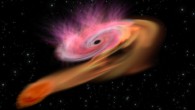
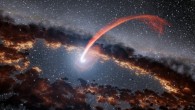
Astronomers have detected radio echoes of a supermassive black hole feeding on a star, suggesting the black hole emits a jet of energy proportional to...
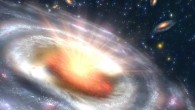
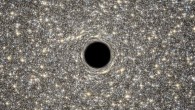
Using NASA’s Chandra X-ray Observatory, astronomers have found evidence for what is likely the most massive black holes ever detected.
A massive black...
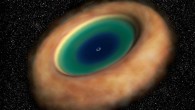
High resolution observations using the Atacama Large Millimeter/submillimeter Array (ALMA) have revealed the presence of a rotating dusty gaseous torus...
A team of astronomers led by University of Colorado Boulder scientists has discovered a mechanism that explains the persistence of asymmetrical star clusters...
An international team of physicists has created the first small-scale replica of gamma ray bursts in a laboratory, opening up a whole new way to investigate...
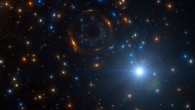
An international team of astronomers led by Georg-August-Universität Göttingen researcher Benjamin Giesers has discovered a star in the globular cluster...
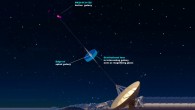
Using the Arecibo Observatory in Puerto Rico and the Green Bank Telescope in West Virginia, astronomers have gained new insight into the extreme home of...
Supermassive black holes, with masses more than a million times that of the Sun, reside at the centers of all massive galaxies. A new study published in...
A sudden flare from a low-mass black hole in the binary system V404 Cygni has offered astrophysicists a unique opportunity to make precise measurements...
An international group of astronomers has discovered and measured the distance to the most distant supermassive black hole ever found.
Artist’s conception...
Using X-ray data from NASA’s Chandra X-ray Observatory and optical data from ground-based telescopes, astronomers have spotted what could be the most...
In a paper published in the journal New Astronomy, theoretical physicist Ovidiu Racorean suggests that X-ray photons emitted by accretion disks around...
Conditions favorable for mergers of massive black holes exist in the outer gas disks of massive spiral galaxies, according to a study led by Rochester...
The LIGO Scientific Collaboration and the Virgo Collaboration report the first joint detection of gravitational waves, ripples in the fabric of space and...
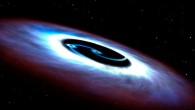
Astronomers have discovered what may be the most compact binary supermassive black hole ever known in a galaxy about 400 million light years from Earth.
An...
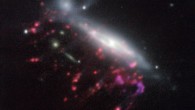
An international research team, led by Dr. Bianca Poggianti of the INAF-Astronomical Observatory of Padova, has used the MUSE instrument on ESO’s Very...
An international team of astronomers has found evidence for a unique gravitational lensing system, in which a massive star cluster is magnifying an extremely...
A trio of astronomers at the University of California, Irvine, claims that stellar-remnant black holes, which result from the collapse of massive stars...
In a paper to be published in the journal Physical Review Letters (arXiv.org preprint), Professor George Fuller of the University of California, San Diego,...