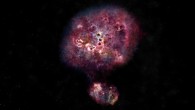
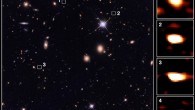
Using the Atacama Large Millimeter/submillimeter Array (ALMA), an international team of astronomers has spotted an unlensed, dusty star-forming galaxy...
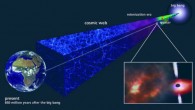
An international team of astronomers has discovered a massive cloud of gas that formed just 850 million years after the Big Bang. The chemical composition...
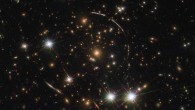
An effect called strong gravitational lensing has allowed the NASA/ESA Hubble Space Telescope to see the same remote galaxy twelve times. Called PSZ1 G311.65-18.48,...
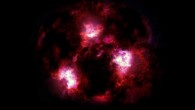
Astronomers using the Atacama Large Millimeter Array (ALMA) have discovered faint traces of a huge dust-obscured star-forming galaxy never seen before,...
Using the Subaru, Keck, and Gemini telescopes, astronomers have discovered a young cluster of galaxies in the early Universe. Named z66OD, the protocluster...
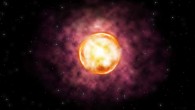
Astronomers have announced the discovery of the most massive star ever known to be destroyed by a supernova explosion. Dubbed SN 2016iet, the explosive...
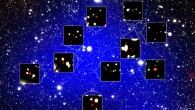
Using data from multiple space- and ground-based telescopes, an international team of astronomers has discovered 39 massive star-forming galaxies at a...
New data from Spitzer and Hubble space telescopes show that in a few specific wavelengths of infrared light, some of the first galaxies to form in the...
A team of astronomers from MIT has observed evidence that the Universe’s first stars exploded as asymmetric supernovae, strong enough to scatter heavy...
A spectacular new image from the NASA/ESA Hubble Space Telescope shows SPT-CL J0615-5746, a very massive group of galaxies located approximately 7.7 billion...
Measurements of today’s expansion rate do not match the rate that was expected based on how the Universe appeared shortly after the Big Bang over 13...
When the Universe was still very young, only a few kinds of atoms existed. Astrophysicists believe that around 100,000 years after the Big Bang, ionized...
Astronomers using the Subaru Telescope have discovered 83 quasars in the distant Universe, from a time when the Universe was less than 10% of its present...
A duo of astronomers has spotted three new globular clusters in the Milky Way’s bulge, a 10,000-light-year-wide central structure made primarily of old...
Astronomers using data from NASA’s Chandra X-ray Observatory and ESA’s XMM-Newton spacecraft have found evidence that an invisible force called dark...
When the Universe was less than 1 billion years old, some of its stars turned into supermassive black holes. A key mystery in astronomy has been: why are...
Astronomers using the NASA/ESA Hubble Space Telescope have spotted the brightest quasar ever seen in the early Universe.
Less than a billion years after...
According to a Swinburne University of Technology-led study, the newly-discovered relic cloud of gas is unpolluted by stars even 1.5 billion years after...
Physicists from the PHENIX Collaboration have created droplets of a liquid-like state of matter called quark-gluon plasma, forming three distinct shapes...