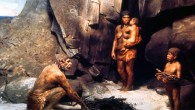
Adrie and Alfons Kennis, two paleo-artists from the Kennis & Kennis Reconstructions, have used facial approximation techniques and the latest findings...
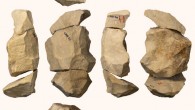
Archaeologists have examined a large assemblage of 45,000-year-old stone tools and by-products of tool-making process from the site of Heidenschmiede in...
An analysis of the high-quality nuclear genomes previously published from three Neanderthals and one Denisovan shows that these extinct hominins were polymorphic...
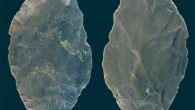
Archaeologists say they have found a 65,000-year-old leaf point in a cave in the Swabian Jura, Germany.
The 65,000-year-old leaf point from Hohle Fels...
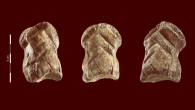
Archaeologists have uncovered a 51,000-year-old engraved giant deer phalanx in a cave in the Harz Mountains, Germany. The find, which came from an apparent...
Homo longi is phylogenetically closer to Homo sapiens than to Neanderthals or other archaic humans, according to new research described in The Innovation.
A...
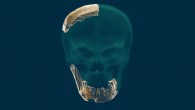
The Nesher Ramla hominins lived between 420,000 and 120,000 years ago in the Middle East and had a distinctive combination of Neanderthal (especially the...
In a new study published this week in the journal Nature, an international team of researchers analyzed DNA from more than 700 sediment samples that were...
The oral microbiome plays key roles in human biology, health, and disease, but little is known about the global diversity, variation, or evolution of this...
An international team of scientists has developed new methods for the enrichment and analysis of nuclear DNA from sediments, and applied them to cave deposits...
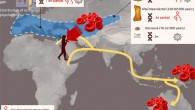
Scientists have extracted and analyzed DNA from three individuals of anatomically modern humans who lived between 45,930 and 42,580 years ago in what is...
Neanderthals, our evolutionary cousins, used toothpicks nearly 46,000 years ago, a new study of their teeth has revealed.
A reconstruction of a Neanderthal...
Neanderthals evolved the auditory capacities to support a vocal communication system as efficient as modern human speech, according to new research led...
Several hominin teeth found the Paleolithic site of La Cotte de St Brelade in Jersey may belong to Neanderthal-Homo sapiens hybrids, according to new research...
A new genetic study conducted by researchers from Leiden University and Wageningen University thoroughly debunks previous claims that a genetic mutation...
Neanderthals may have found precision grips (where objects are held between the tip of the finger and thumb) more challenging than power squeeze grips...
A new study published in the Proceedings of the National Academy of Sciences reveals that the modern human nursing strategy, with onset of weaning at 5...
An international team of researchers has virtually reconstructed the ribcages of four Neanderthal individuals from birth to around 3 years old and found...