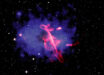
Astronomers discovered an enormous galaxy cluster called RM J130558.9+263048.4 on December 31, 2020; the date, combined with the bubble-like appearance of the galaxies and the superheated gas, inspired the astronomers to nickname the object the Champagne Cluster. The new composite image of the cluster contains X-rays from NASA’s Chandra X-ray Observatory and optical data from the Legacy Surveys.
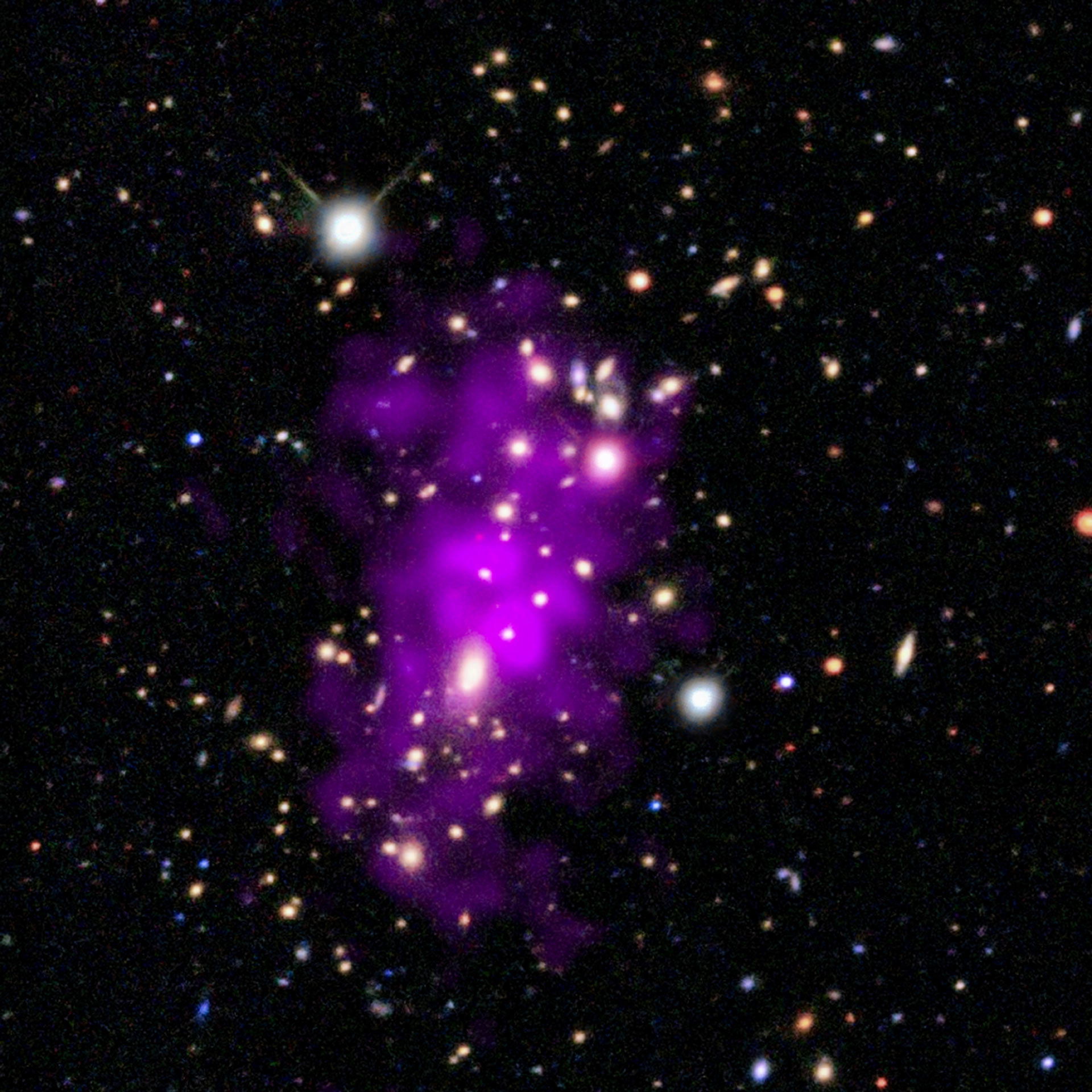
The Champagne Cluster appears here as a large collection of brilliant white lights, each a distinct galaxy. A neon purple cloud stretches across the cluster’s crowded core. Many of the hundred-plus galaxies in the cluster are in two clumps of galaxies towards the top and bottom of center. Some are encircled by a faint glowing haze, while a few foreground stars gleam with diffraction spikes. Some of the smaller galaxies are tinted blue, orange, or red, and some appear more oblong than round, suggesting spiral shapes viewed edge-on. The neon purple cloud sits at the heart of the image, surrounding the most densely-packed part of the cluster. This cloud, which spreads vertically across the cluster, is multimillion-degree gas observed by Chandra. The two clumps of observable galaxies, and the spread of superheated gas, reveal that the Champagne Cluster is in fact two clusters in the process of colliding. Image credit: NASA / CXC / UCDavis / Bouhrik et al. / Legacy Survey / DECaLS / BASS / MzLS / SAO / P. Edmonds / L. Frattare.
In a new study, University of California Davis astronomer Faik Bouhrik and colleagues used NASA’s Chandra X-ray Observatory and ESA’s XMM-Newton observatory to observe the Champagne Cluster.
They also analyzed data collected with the DEIMOS multiobject spectrograph at the W.M. Keck Observatory.
“The new composite image shows that the Champagne Cluster is actually two galaxy clusters in the process of merging to form an even larger cluster,” the astronomers said in a statement.
“Multimillion-degree gas in galaxy clusters usually takes on an approximately circular or moderately oval shape in images, but in the Champagne Cluster it is more widely spread from top to bottom, revealing the presence of the two colliding clusters.”
“Two clumps of individual galaxies making up the colliding clusters can be seen toward the top and bottom of center.”
“The hot gas outweighs the combined mass in all of the hundred-plus individual galaxies in the newly forming cluster.”
“The clusters also contain even larger amounts of unseen dark matter, the mysterious substance that pervades the Universe.”
The Champagne Cluster is a member of a rare class of merging clusters, which includes the well-known Bullet Cluster, where the hot gas in each cluster has collided and slowed down, and there is a clear separation between the hot gas and the most massive galaxy in each cluster.
By comparing the data with computer simulations, the researchers came up with two possibilities for the history of the Champagne Cluster.
One is that the two clusters already collided with each other over two billion years ago.
After the collision the two clusters traveled outward and then were pulled back toward each other by gravity, and are now heading into a second collision.
The other idea is that a single collision occurred about 400 million years ago, and the two clusters are now traveling away from each other after that collision.
“Further studies of the Champagne Cluster can potentially teach us how dark matter reacts to a high-speed collision,” the scientists said.
Their paper was published in July 2025 in the Astrophysical Journal.
_____
Faik Bouhrik et al. 2025. Discovery and Multiwavelength Analysis of a New Dissociative Galaxy Cluster Merger: The Champagne Cluster. ApJ 988, 166; doi: 10.3847/1538-4357/ade67c