Astronomers have released the new results from the CAFFEINE survey, shedding new light on a long-standing mystery: what controls the efficiency of star formation in the densest parts of galaxies?
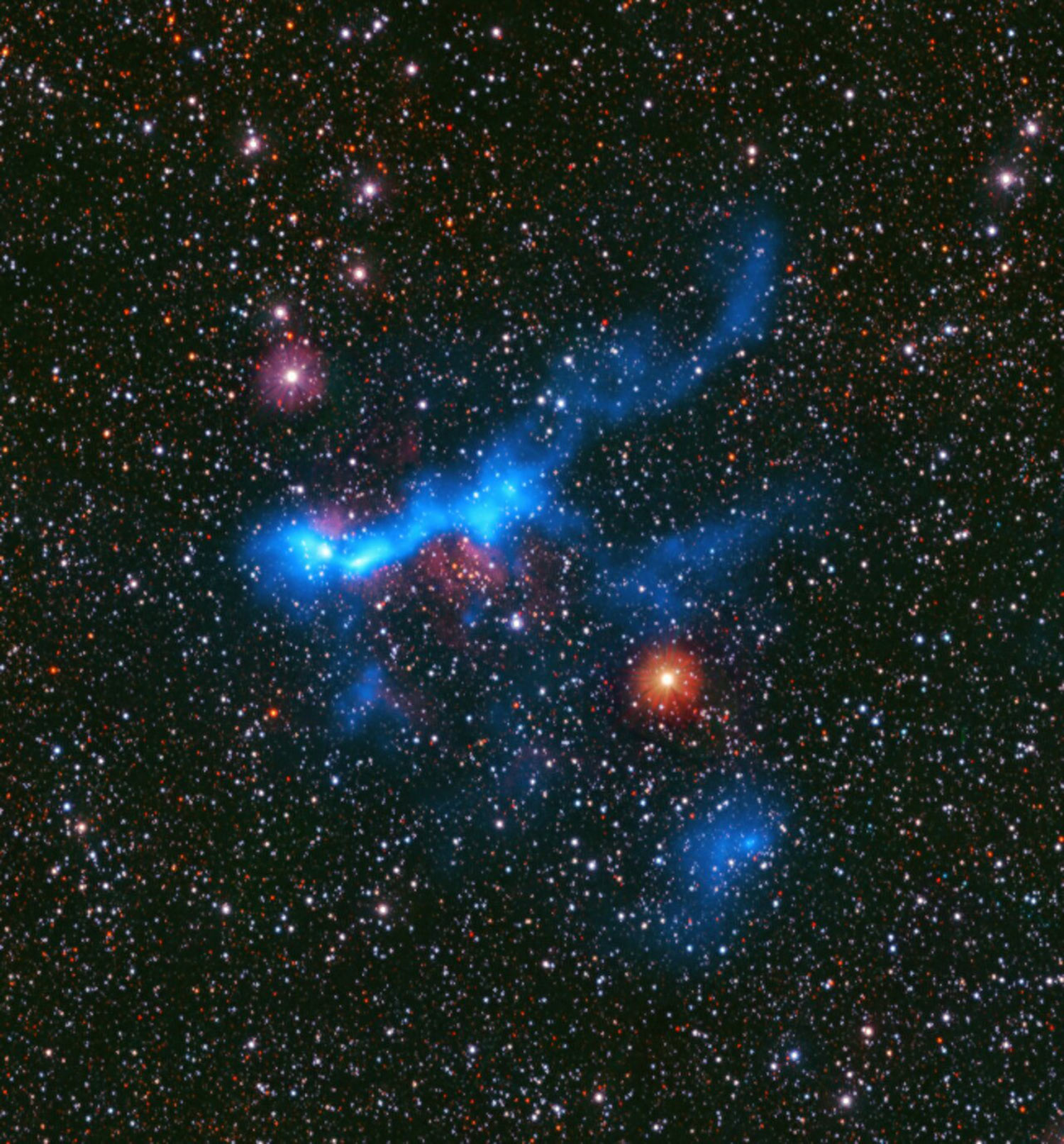
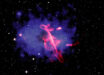
This image shows the massive star-forming region GAL316. Image credit: ESO / M. Mattern / André et al. / VVV.
In the study, Université Paris-Saclay astronomer Michael Mattern and colleagues mapped the dense gas in a sample of 49 nearby massive star-forming complexes out to a distance of 3,000 parsecs in the Galactic disk.
“Creating a star is hard work, and the process is not very efficient,” the astronomers said in a statement.
“Current knowledge suggests that a stellar nursery must have a minimum density of gas and dust for a star to form.”
“Only 1-2% of all the gas and dust in these clouds is utilized to ignite a star.”
“But could even denser regions be more efficient at forming stars?”
“We’re looking at GAL316, one of the many stellar nurseries we observed to answer this question,” they added.
The CAFFEINE survey is carried out using the ArTéMiS camera at the Atacama Pathfinder Experiment (APEX), a radio-telescope in the Chajnantor plateau.
“Now operated by the Max Planck Institute for Radio Astronomy, APEX captures the faint glow of cold gas clouds, seen in the image of GAL316 as a blue glow,” the researchers said.
“This glow has been overlaid on a starry background captured with ESO’s VISTA telescope.”
They found that star formation efficiency — how quickly gas is turned into stars — does not continue to rise as gas becomes denser beyond a certain threshold.
This goes against models that predict a steady increase of star formation with density.
Instead, the efficiency appears to stay nearly constant in very dense gas, supporting a picture where stars form primarily in filamentary structures within clouds, and the process is governed by how those filaments fragment into protostellar cores.
The results also point to a possible threshold in gas density around which star formation becomes efficient, lending weight to theories that star formation is regulated by the physics of dense filaments rather than solely by turbulence or feedback from young stars.
The study represents one of the most comprehensive efforts to date to link the physical structure of dense gas with the efficiency of star formation, providing a clearer framework for future observations and simulations aimed at unraveling how stars like our Sun emerge from interstellar clouds.
“Our results show that the densest regions observed with this CAFFEINE survey seemed no more efficient at producing stars than any other stellar nursery above the minimum density,” the scientists said.
Their paper was published in the journal Astronomy & Astrophysics.
_____
M. Mattern et al. 2024. Understanding the star formation efficiency in dense gas: Initial results from the CAFFEINE survey with ArTéMiS. A&A 688, A163; doi: 10.1051/0004-6361/202449908