A population of free-floating planets is known from gravitational microlensing surveys. None have a directly measured mass, owing to a degeneracy with the distance, but the population statistics indicate that many are less massive than Jupiter. Now, astronomers have discovered a microlensing event that breaks the mass-distance degeneracy. Designated KMT-2024-BLG-0792/OGLE-2024-BLG-0516, the event was caused by an exoplanet about 21.9% the mass of Jupiter at a distance of 9,785 light-years (3,000 parsecs) from the center of our Milky Way Galaxy.
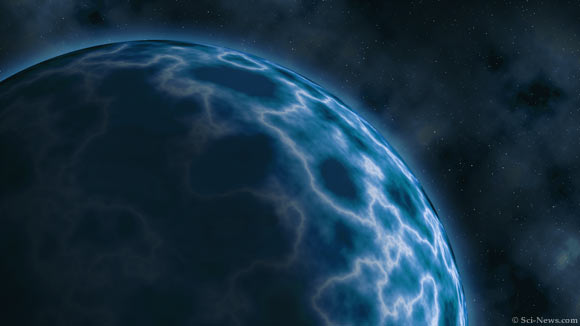
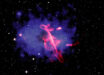
An artist’s impression of a free-floating exoplanet. Image credit: Sci.News.
Planets are most often found bound to one or more stars, yet a growing body of evidence shows that some wander the galaxy alone.
These objects, called free-floating or rogue planets, lack any known stellar companion.
And, since they don’t emit very much light, they reveal themselves only through their subtle gravitational effects — a phenomenon called microlensing.
One of the main limitations of this discovery method is that it cannot determine the distance to these planets, making independent measurement of their mass difficult.
As a result, much about this elusive population of solitary worlds remains speculative.
In new research, Dr. Subo Dong, an astronomer at Peking University and the National Astronomical Observatories, and colleagues detected a new free-floating planet via a fleeting microlensing event: KMT-2024-BLG-0792/OGLE-2024-BLG-0516.
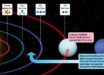
However, unlike previous detections, they uniquely observed this microlensing event simultaneously from both Earth and space, using several ground-based surveys alongside ESA’s Gaia space telescope.
Tiny differences in the timing of the light reaching these distantly separated vantage points enabled measurement of the microlensing parallax, which, when combined with finite-source point-lens modeling, allowed the authors to determine the planet’s mass and location.
“Through comparison with the statistical properties of other observed microlensing events and predictions from simulations, we infer that this object likely formed in a protoplanetary disk (like a planet), not in isolation (like a brown dwarf),” the astronomers said.
“Dynamical processes then ejected it from its birthplace, producing a free-floating object.”
The results are described in a paper published this month in the journal Science.
_____
Subo Dong et al. 2026. A free-floating-planet microlensing event caused by a Saturn-mass object. Science 391 (6780): 96-99; doi: 10.1126/science.adv9266