Astronomers using the NASA/ESA Hubble Space Telescope have confirmed the existence of starless, hydrogen-rich objects dominated by dark matter. Named Reionization-Limited H I Clouds (RELHICs), these objects are relics from the early Universe that challenge traditional views of galaxy formation and could hint at hidden populations of similar structures.
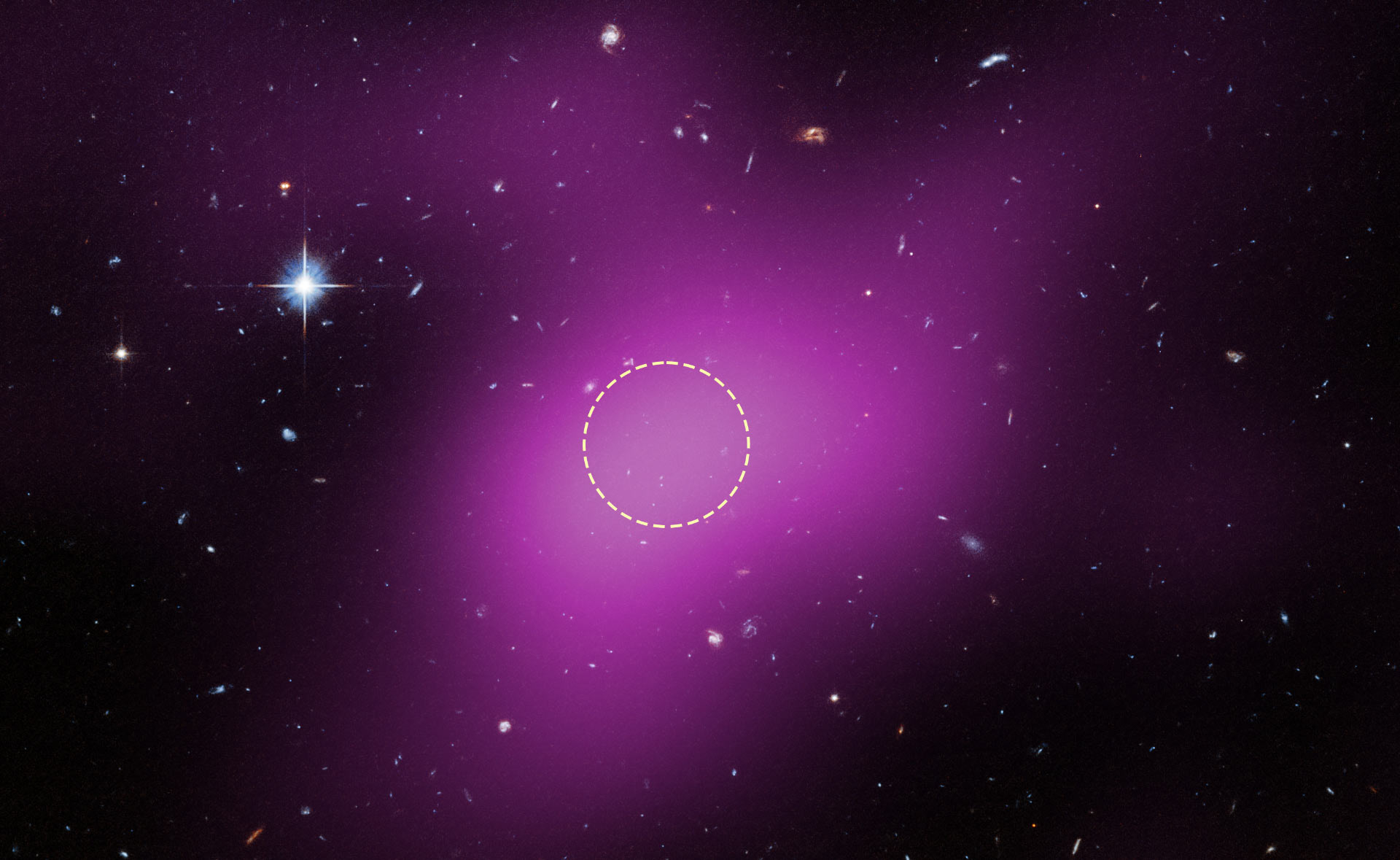
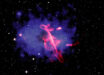
This image shows the location of the RELHIC object Cloud-9. Image credit: NASA / ESA / VLA / Gagandeep Anand, STScI / Alejandro Benitez-Llambay, University of Milano-Bicocca / Joseph DePasquale, STScI.
Designated Cloud-9, this RELHIC object was identified through observations with the Five-hundred-meter Aperture Spherical Telescope (FAST) and confirmed independently with the Very Large Array (VLA) and Green Bank Telescope (GBT).
“This is a tale of a failed galaxy,” said Dr. Alejandro Benitez-Llambay, an astronomer at the Milano-Bicocca University.
“In science, we usually learn more from the failures than from the successes. In this case, seeing no stars is what proves the theory right.”
“It tells us that we have found in the local Universe a primordial building block of a galaxy that hasn’t formed.”
Cloud-9’s core is composed of neutral hydrogen and is about 4,900 light-years in diameter.
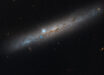
Located in the vicinity of the spiral galaxy Messier 94, the object shares the same recession velocity as the galaxy, placing it at an approximate distance of 14.3 million light-years from Earth.
“This cloud is a window into the dark Universe,” said Dr. Andrew Fox, an astronomer at the Association of Universities for Research in Astronomy/Space Telescope Science Institute (AURA/STScI) for ESA.
“We know from theory that most of the mass in the Universe is expected to be dark matter, but it’s difficult to detect this dark material because it doesn’t emit light.”
“Cloud-9 gives us a rare look at a dark-matter-dominated cloud.”
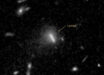
The astronomers used Hubble’s Advanced Camera for Surveys (ACS) to search for any luminous, stellar component in Cloud-9.
Their analysis rules out the presence of any dwarf galaxy with detectable stellar mass.
“The absence of detectable stars reinforces the interpretation that this system is a RELHIC; i.e., a starless dark matter halo filled with hydrostatic gas in thermal equilibrium with the cosmic ultraviolet background,” they said.
Cloud-9 would be the leading candidate of any known compact HI cloud — and offer empirical support for a cornerstone prediction of the prevailing cosmological framework, the ΛCDM (Lambda Cold Dark Matter) model.
That model anticipates the existence of gas-filled starless dark matter halos on sub-galactic mass scales that never formed stars.
“The discovery of Cloud-9 also helps constrain the present-day threshold halo mass for galaxy formation, pushing us closer to understanding why some dark matter halos host galaxies while others remain devoid of stars,” the researchers said.
The detailed findings appear this week in the Astrophysical Journal Letters.
_____
Gagandeep S. Anand et al. 2025. The First RELHIC? Cloud-9 is a Starless Gas Cloud. ApJL 993, L55; doi: 10.3847/2041-8213/ae1584