JCMT0402-0424, a dusty starburst galaxy around 11 billion light-years away, is the strongest candidate yet for the source of the high-energy neutrino event IC 210922A, according to a team of astronomer led by Yuji Urata of MITOS Science Co.
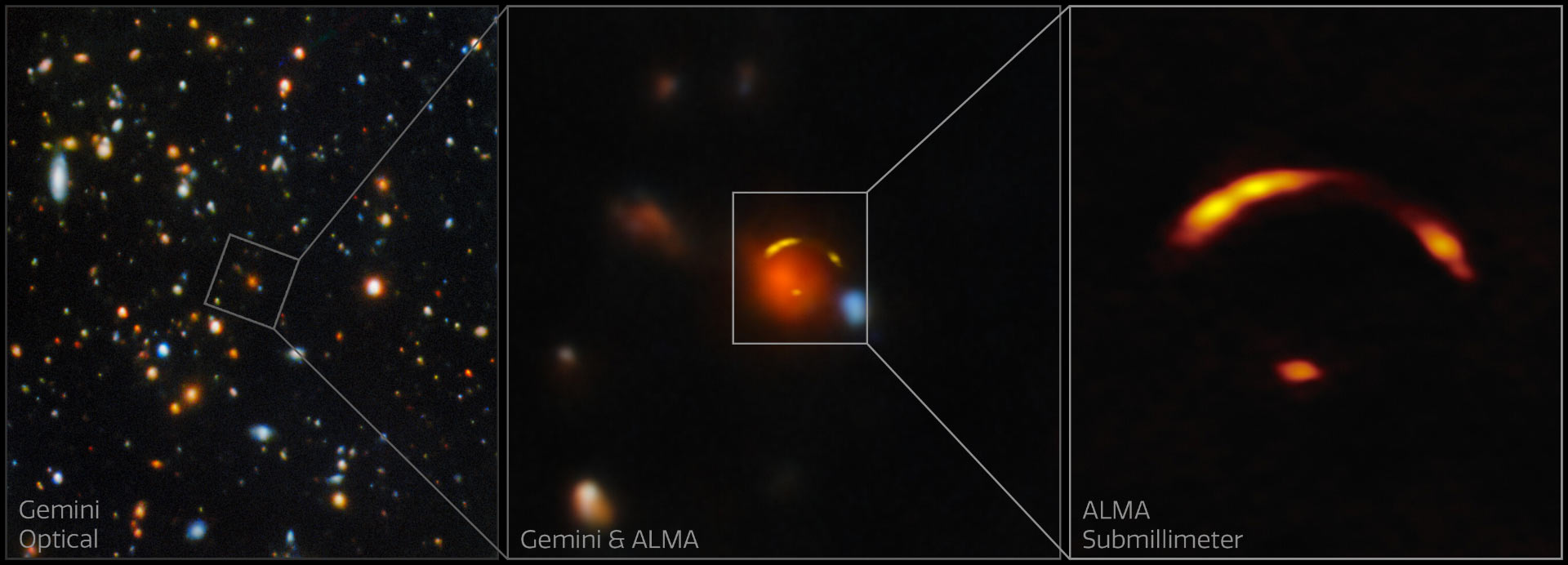
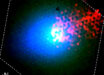
The origin of high-energy astrophysical neutrinos remains unresolved, and secure electromagnetic counterparts to individual events are rare despite rapid follow-up. Dusty star-forming galaxies at cosmic noon (redshift of z ≈ 1-4) are natural cosmic-ray calorimeters, yet observational links between these galaxies and neutrinos have remained unknown. Urata et al. report a compact-core, dusty star-forming galaxy within an IceCube localization, JCMT0402-0424, a quadruply lensed galaxy at z = 2.988 located inside the 90% containment region of the IceCube event IC 210922A. Image credit: International Gemini Observatory / NOIRLab / NSF / AURA / ALMA / ESO / NAOJ / NRAO / T.A. Rector, University of Alaska Anchorage & NSF’s NOIRLab / D. de Martin & M. Zamani, NSF’s NOIRLab / Yuji Urata. MITOS Science Co., LTD.
In 2021, NSF’s IceCube Neutrino Observatory in Antarctica alerted the scientific community to a high-energy neutrino event, IC 210922A, coming from a region of space in the direction of the constellation Eridanus.
This alert triggered rapid follow-up observations across the electromagnetic spectrum to search for a counterpart signal that, if detected, could help identify the neutrino’s source.
Multiple teams of scientists conducted follow-up observations using a variety of telescopes and instruments.
However, they all reported no convincing gamma-ray, X-ray, or optical counterpart, nor any gamma-ray burst, supernova, or tidal disruption event that could be associated with the alert.
Then, a couple of days after the initial alert, Dr. Urata and colleagues initiated observations with the James Clerk Maxwell Telescope (JCMT) and the Submillimeter Array (SMA) and discovered the star-forming galaxy JCMT0402-0424, whose location and brightness made it a promising candidate for the source of the signal.
To investigate this galaxy further, they organized follow-up observations with the Atacama Large Millimeter/submillimeter Array (ALMA) and discovered that the galaxy, nicknamed the Shadow Blaster, is located behind a strong gravitational lens.
Thanks to this lensing effect, they would be able to study the galaxy’s internal structure, which would otherwise be too distant and too faint to resolve in such detail.
However, to use the lensing effect correctly and to understand how much the lens amplified the neutrino signal, they first needed to know the distance, nature, and mass distribution of the foreground galaxy.
To decipher these details, the astronomers used two powerful instruments on Gemini North telescope: the Gemini Multi-Object Spectrograph (GMOS) and the Gemini Near-InfraRed Spectrograph (GNIRS).
“The combined GMOS and GNIRS data helped us measure the distance to the lensing galaxy and determine that it is a massive elliptical galaxy,” Dr. Urata said.
“This information was crucial for estimating the lens mass distribution and constructing a model of the gravitational lens.”
Around 10 billion years ago, the Universe was populated with galaxies like JCMT0402-0424 that were actively forming stars.
During this epoch, galaxies were theoretically producing large numbers of cosmic rays, which are high-energy streams of particles that can generate neutrinos.
Yet obtaining observational evidence that links an individual neutrino event to such a distant galaxy has been extremely difficult since these galaxies are very far away and often deeply hidden behind thick layers of dust.
JCMT0402-0424’s serendipitous location behind a gravitational lens makes finding this observational evidence much easier.
“Shadow Blaster possesses the kind of dense, gas-rich environment that theoretical models have long suggested could efficiently produce high-energy neutrinos,” Dr. Urata said.
“Combined with the absence of any more compelling counterpart despite extensive follow-up searches, Shadow Blaster is the most plausible candidate for the source of IC 210922A.”
“If confirmed, Shadow Blaster would be the first-ever individual dusty star-forming galaxy directly linked to a high-energy neutrino event.”
Compact star-forming galaxies like Shadow Blaster may be numerous throughout the Universe.
As a population, they may therefore contribute a significant fraction of the high-energy neutrino background that fills the cosmos.
“Our analysis suggests that this population could contribute up to roughly 20% of the observed diffuse neutrino background measured by IceCube,” Dr. Urata concluded.
The study appears today in the journal Nature Astronomy.
_____
Y. Urata et al. Compact dusty starbursts at cosmic noon linked to high-energy neutrinos. Nat Astron, published online June 17, 2026; doi: 10.1038/s41550-026-02884-9