A globular cluster typically has only one ancient star population. New data from the NASA/ESA/CSA James Webb Space Telescope and the NASA/ESA Hubble Space Telescope not only confirm the existence of two distinct populations of stars in the ancient stellar system Terzan 5, once classified as a globular cluster, but also provides evidence for two more recent rounds of star formation.
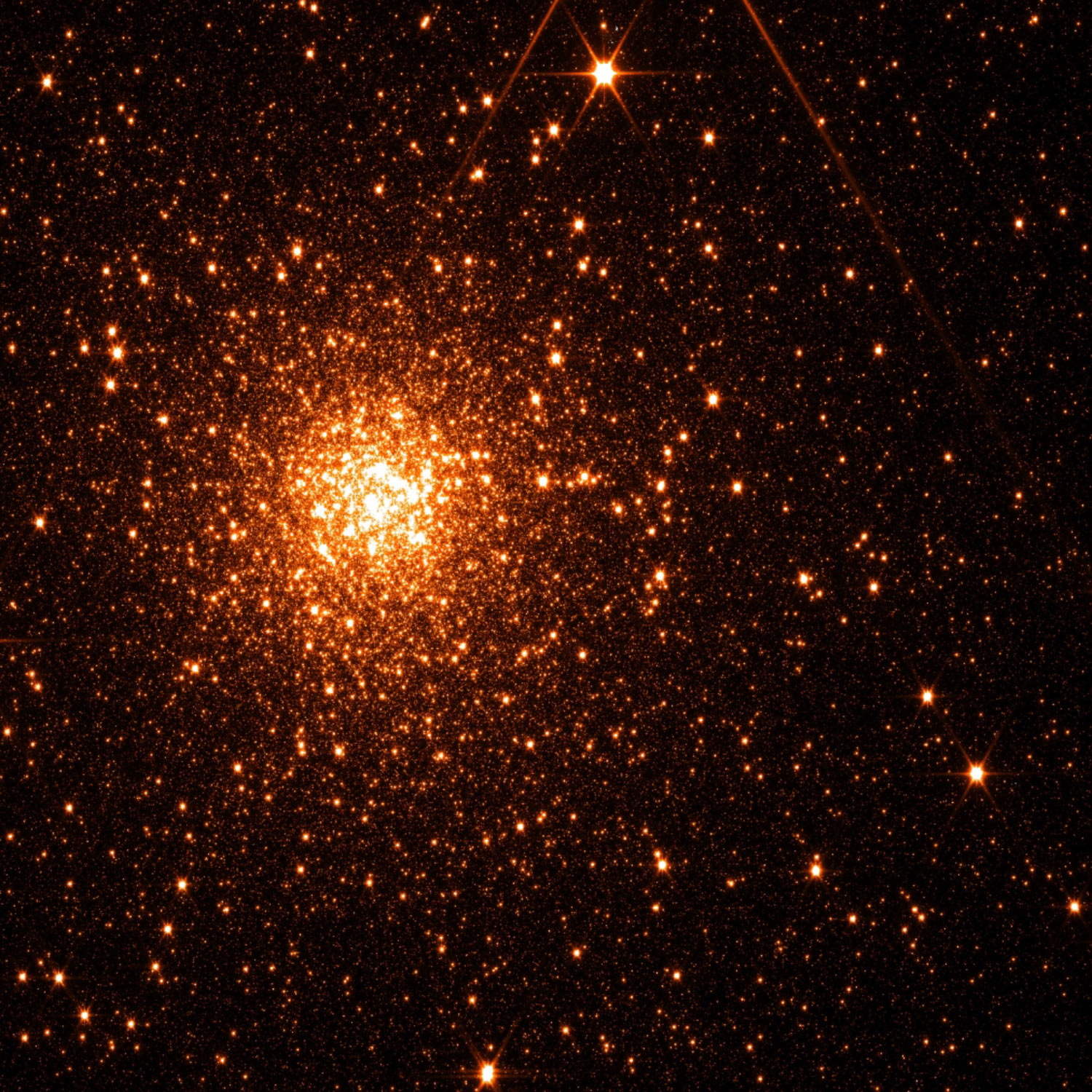
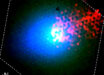
This Webb/NIRCam image shows the star cluster Terzan 5. Image credit: NASA / ESA / CSA / Webb.
Terzan 5 was discovered in 1968 by Agop Terzan, a Turkish-French astronomer of Armenian descent.
The object is located approximately 19,000 light-years away in the constellation of Sagittarius.
Also known as ESO 520-27 and 2MASX J17480455-2446441, it is home for hundreds of thousands of different types of stars.
Located in the inner bulge of the Milky Way, Terzan 5 resembles a globular cluster in many ways.
However, in 2009, this system was discovered to harbor two distinct populations of stars.
In 2016, Hubble provided the first estimate of their ages, showing that one formed roughly 12 billion years ago, as the Milky Way itself was assembling, and the other about 5 billion years ago, just before Earth started forming. This pointed to a more complex history than a typical globular cluster.
“Webb’s new near-infrared observations, cross-referenced with Hubble’s archival observations, have given us a much clearer picture of the history of Terzan 5,” said Giorgia Zullo, a Ph.D. student at the University of Bologna.
Studying Terzan 5 is complicated by its location in a region of our galaxy crowded with stars and heavily obscured by dust.
Webb’s infrared view allowed the astronomers to peer through the dust and catalog many more stars, and fainter stars, than previous work.
By measuring star colors and brightnesses, they can classify them into populations of different ages and chemistries.
Webb was able to measure these key properties for every star within the field of view in the sky — both stars within Terzan 5 and unrelated foreground stars.
To isolate the stars of Terzan 5, the researchers relied on the power and longevity of Hubble.
The 12-year separation of Hubble’s exposures allowed the team to measure very small movements of individual stars, known as proper motions, to determine which stars belong to Terzan 5 and which are part of the Milky Way bulge.
By combining data from both Webb and Hubble, the researchers found strong evidence for two more stellar populations, one that formed 3.8 billion years ago and another only 2.5 billion years ago.
They also were able to determine the ages of the previously known stellar populations with unprecedented precision, finding that they formed 12.5 billion and 4.7 billion years ago.
With the previously known two generations of stars, they could not rule out the possibility that Terzan 5 interacted with another object, like a globular cluster or a giant molecular cloud, becoming enriched with new gas and dust that set off a second round of star formation. With four stellar generations, those explanations are ruled out.
Measurements of the stellar composition of Terzan 5 populations made at the W. M. Keck Observatory and ESO’s Very Large Telescope also point toward very distinct populations.
“Along with the ages of these populations, the cluster preserves a fossil record of progressive enrichment of heavy elements by supernovae,” said Dr. R. Michael Rich, an astronomer at the University of California, Los Angeles.
Terzan 5 formed multiple generations of stars because it was able to retain the necessary raw materials.
There is evidence of powerful supernova explosions in Terzan 5 that forged heavier elements that were swept up by subsequent generations of stars.
In lighter weight systems, the force of the explosions themselves could have ejected the resulting elements as well as sweeping out leftover gas and dust.
The progenitor of Terzan 5 had enough mass to retain those stars’ ejections, allowing new generations of stars to form over billions of years.
The results show that Terzan 5 is most likely the remnant of a much more massive stellar system that initially formed 12.5 billion years ago.
The object is extraordinary because it survived — and never merged or fully ‘mixed in’ with the Milky Way’s bulge.
“For some reason, this peculiar clump of stars formed separately from the bulge and was not destroyed as the bulge itself formed,” said Professor Francesco Ferraro, an astronomer at the University of Bologna.
“Terzan 5 is what we now call a bulge fossil fragment because it resembles the primordial clumps that contributed to the formation of the bulge.”
A paper on the findings was published in the journal Astronomy & Astrophysics.
_____
G. Zullo et al. 2026. The multi-age stellar populations of Terzan 5 as revealed by JWST. A&A 709, A212; doi: 10.1051/0004-6361/202659349