SETI@home, the pioneering distributed-computing project launched in 1999 that enlisted millions of volunteers to analyze radio signals from space, produced some 12 billion detections — brief bursts of energy that stood out from background noise — as it combed through observations recorded at the now-defunct Arecibo Observatory in Puerto Rico. Astronomers at the University of California, Berkeley have now narrowed the dataset to about 100 signals that merit follow-up with powerful radio telescopes.
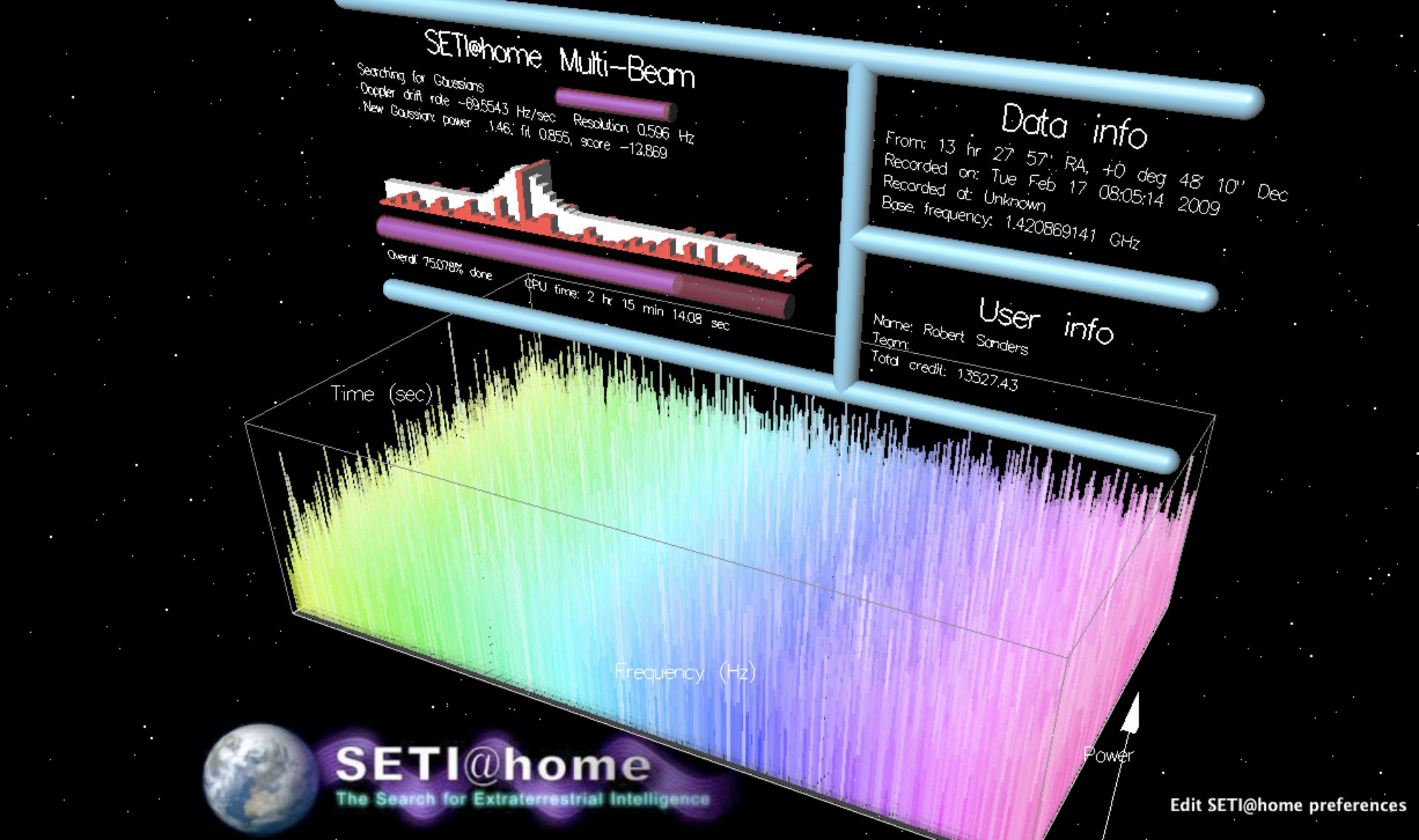
A screenshot of the SETI@home user interface on a desktop computer in 2009. Image credit: Robert Sanders / UC Berkeley.
Between 1999 and 2020, millions of people worldwide loaned the SETI@home project their home computers to search for signs of advanced civilizations in our Milky Way Galaxy.
They downloaded the SETI@home software to their computers and allowed it to analyze data recorded at the Arecibo Observatory to find unusual radio signals from space.
All told, these computations produced 12 billion detections.
After 10 years of work, the SETI@home team has now finished analyzing those detections, winnowing them down to about a million candidate signals and then to 100 that are worth a second look.
“SETI@home is a radio SETI (Search for Extraterrestrial Intelligence) project, which searched for several types of signals in recorded data,” said SETI@home project co-founder Dr. David Anderson, a computer scientist at the University of California, Berkeley.
“Most of this data was recorded commensally at the Arecibo Observatory over a 22-year period.”
“Other data from the Parkes and Green Bank observatories was provided by Breakthrough Listen initiative.”
“Most radio SETI projects process data in near real-time using special purpose analyzers at the telescope.”
“SETI@home takes a different approach: it records digital time-domain (also called baseband) data, and distributes it over the Internet to large numbers of computers that process the data, using both CPUs and GPUs.”
The promising SETI@home signals are currently being re-observed with China’s Five-hundred-meter Aperture Spherical Telescope (FAST) to see whether any repeat or exhibit characteristics inconsistent with noise.
“I’m not expecting to find a genuine extraterrestrial signal,” Dr. Anderson said.
“If there were a signal above a certain power, we would have found it.”
SETI@home’s multistage analysis, described in two papers in the Astronomical Journal, offers both a technical roadmap and a cautionary tale for future technosignature hunts.
The first of these papers detailed how the project’s distributed network of home computers applied advanced signal processing to raw time-domain radio data, using techniques such as discrete Fourier transforms to search for frequency patterns that might betray a persistent extraterrestrial beacon.
A follow-up paper focused on the complex task of distinguishing potential signals from the overwhelming background of terrestrial interference — from satellites, broadcast stations and even microwave ovens — by identifying clusters of detections consistent with origin from a single sky location over multiple observations.
Future efforts could expand on the SETI@home model by distributing new telescope datasets through platforms like BOINC — the volunteer computing infrastructure that SETI@home helped pioneer — to enlist public processing power again, this time with more sophisticated tools and faster networks.
“I think it still captures people’s imagination to look for extraterrestrial intelligence,” said SETI@home project director Dr. Eric Korpela, an astronomer at the University of California, Berkeley.
“I think that you could still get significantly more processing power than we used for SETI@home and process more data because of a wider internet bandwidth.”
“The biggest issue with such a project is that it requires personnel, and personnel means salaries. It’s not the cheapest way to do SETI.”
_____
David P. Anderson et al. 2025. SETI@home: Data Analysis and Findings. AJ 170, 111; doi: 10.3847/1538-3881/ade5ab
E.J. Korpela et al. 2025. SETI@home: Data Acquisition and Front-end Processing. AJ 170, 112; doi: 10.3847/1538-3881/ade5a7