Astronomers using NASA’s James Webb Space Telescope have captured the most detailed infrared view yet into the center of the Circinus Galaxy, one of the closest known active galaxies to the Milky Way. The Webb observations suggest that much of the hot dust near the galaxy’s supermassive black hole is feeding the black hole itself, rather than being expelled outward in powerful flows as previous models had predicted.
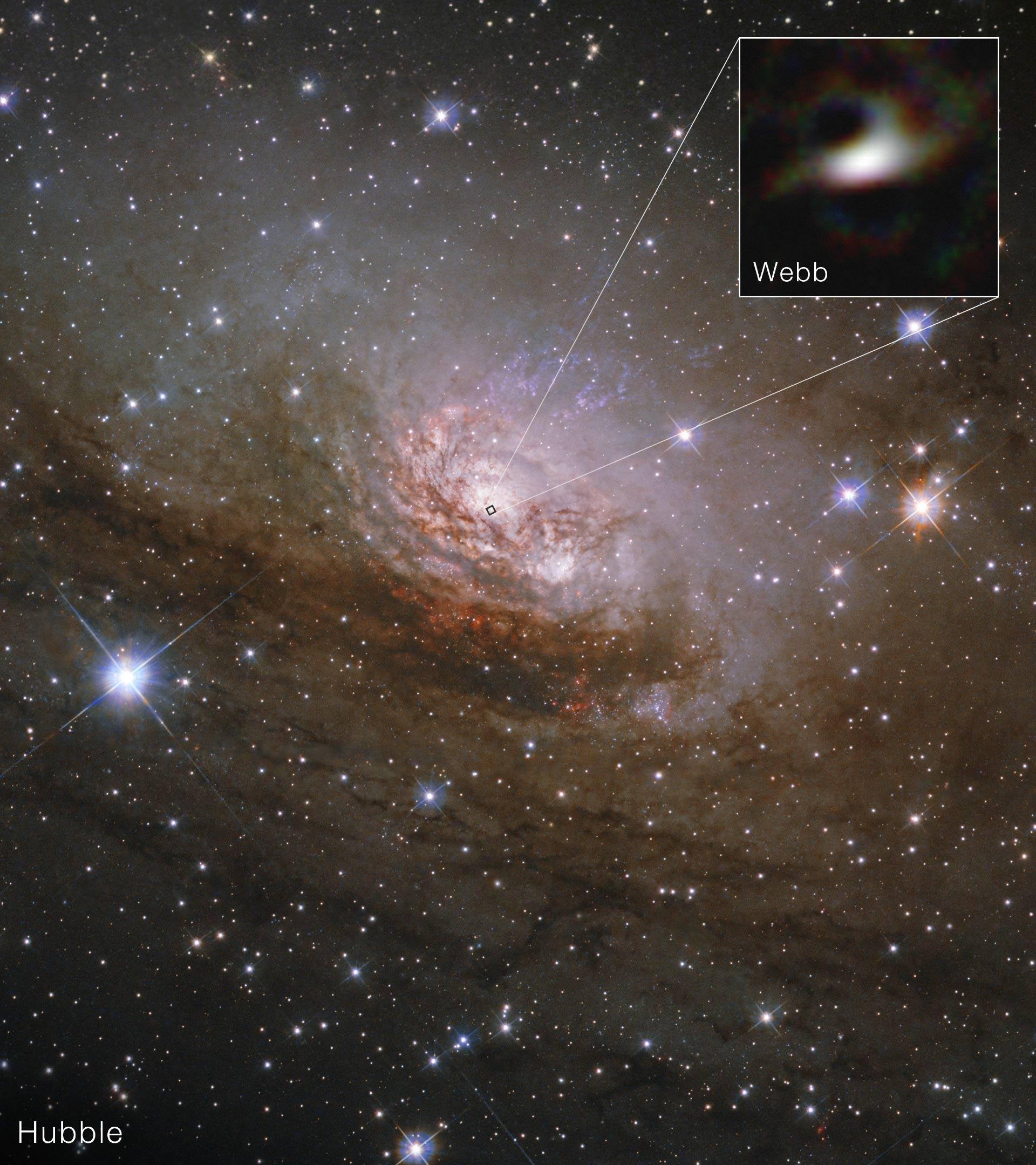
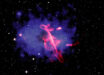
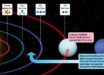
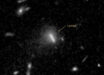
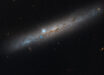
The Hubble image shows the Circinus Galaxy, a spiral galaxy about 13 million light-years away in the southern constellation of Circinus; a close-up of its core from Webb shows the inner face of the hole of the donut-shaped disk of gas disk glowing in infrared light; the outer ring appears as dark spots. Image credit: NASA / ESA / CSA / Webb / Hubble / Enrique Lopez-Rodriguez, University of South Carolina / Deepashri Thatte, STScI / Alyssa Pagan, STScI / NSF’s NOIRLab / CTIO.
The Circinus Galaxy is a spiral galaxy about 13 million light-years away in the southern constellation of Circinus.
Also known as ESO 97-G13 or LEDA 50779, this galaxy has long intrigued astronomers because its core is obscured by thick clouds of gas and dust.
Ground-based telescopes have struggled to isolate the region close to the central black hole, where matter spirals inward and radiates intense infrared light.
Webb’s advanced capabilities allowed Dr. Julien Girard of the Space Telescope Science Institute and colleagues to penetrate that veil of dust with unprecedented clarity.
The breakthrough came from using Webb’s Near-Infrared Imager and Slitless Spectrograph (NIRISS) in a specialized high-contrast mode called the Aperture Masking Interferometer.
This method effectively turns the instrument into a miniature interferometer, combining light through a set of small apertures to create detailed interference patterns.
By analyzing those patterns, the astronomers reconstructed a sharply focused picture of the Circinus Galaxy’s central engine, revealing that most of the infrared emission originates from the donut-shaped torus of dust feeding the black hole, rather than from outflowing material.
“It is the first time a high-contrast mode of Webb has been used to look at an extragalactic source,” Dr. Girard said.
“We hope our work inspires other astronomers to use the Aperture Masking Interferometer mode to study faint, but relatively small, dusty structures in the vicinity of any bright object.”
Supermassive black holes remain active by drawing in surrounding matter.
Gas and dust accumulate into a torus around the black hole, and as material spirals into the black hole, it forms a rotating accretion disk that heats up through friction, becoming luminous across many wavelengths — including infrared.
The new Webb data indicate that the bulk of the infrared glow near the Circinus Galaxy’s core is produced by the innermost regions of this dusty torus, overturning earlier assumptions that outflows dominated the emission.
This technique paves the way for deeper investigations of black holes in other galaxies.
By applying Webb’s high-contrast imaging to additional targets, the researchers hope to build a broader catalog of emission patterns that could reveal whether Circinus Galaxy’s behavior is typical among active galactic nuclei or an outlier.
Their findings not only provide a sharper look at the mechanics of black hole feeding but also underscore the growing power of interferometric methods in space astronomy.
With further observations planned, Webb continues to push the boundaries of what is visible from the most hidden corners of the Universe.
“We need a statistical sample of black holes, perhaps a dozen or two dozen, to understand how mass in their accretion disks and their outflows relate to their power,” said Dr. Enrique Lopez-Rodriguez, an astronomer at the University of South Carolina.
The results were published today in the journal Nature Communications.
_____
E. Lopez-Rodriguez et al. 2026. JWST interferometric imaging reveals the dusty torus obscuring the supermassive black hole of Circinus galaxy. Nat Commun 17, 42; doi: 10.1038/s41467-025-66010-5