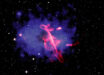
Using ultra-sharp imaging from the NASA/ESA/CSA James Webb Space Telescope, astronomers have produced an extremely detailed, wide-area map of mass in the Universe, showing how dark and ordinary matter weave together from galactic filaments to dense clusters. Created as part of the COSMOS-Web survey, the new map has more than twice the resolution of its predecessor and extends to earlier periods in the Universe’s evolution.
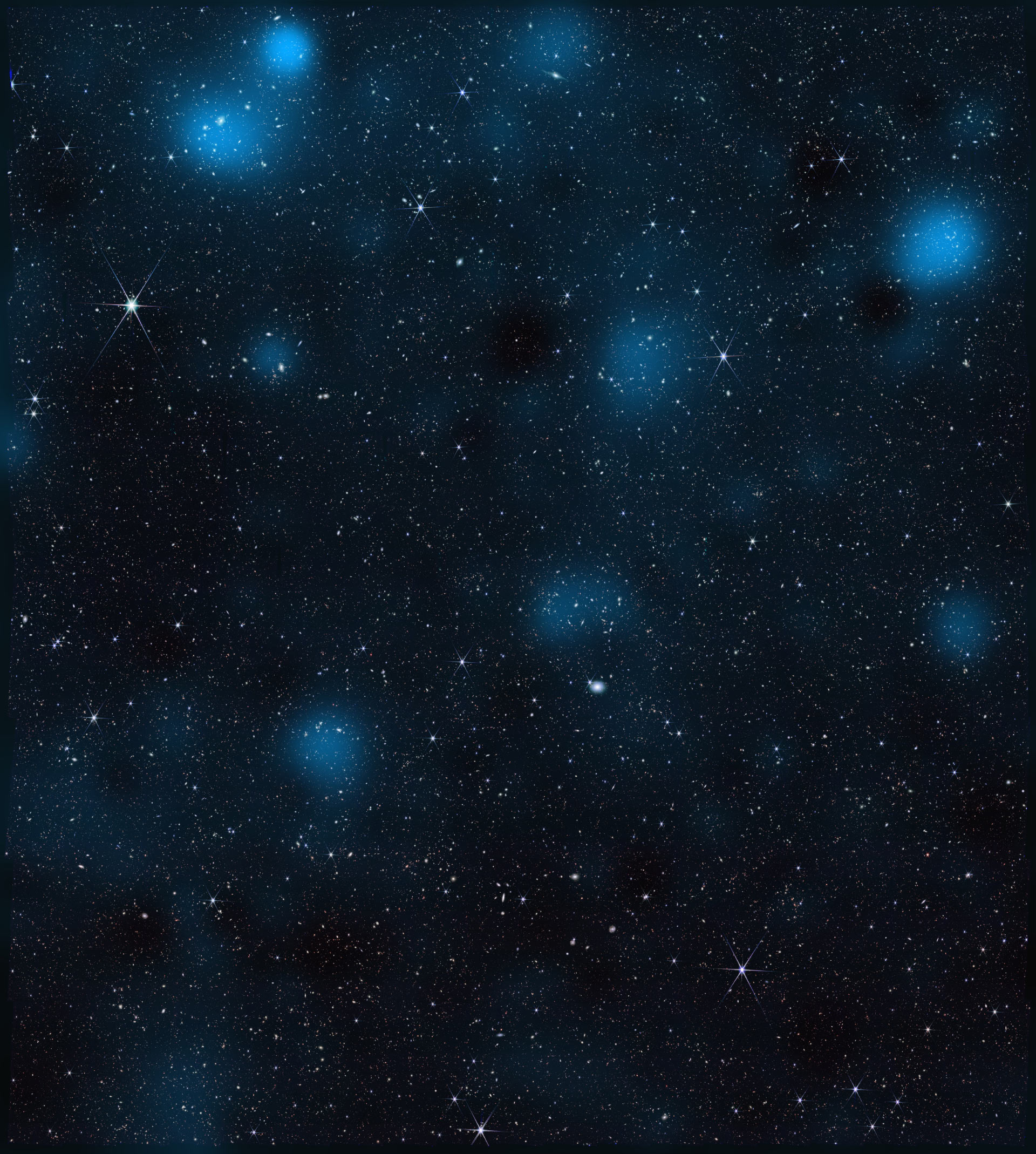
Containing nearly 800,000 galaxies, this Webb image is overlaid with a map of dark matter, represented in blue. Image credit: NASA / STScI / J. DePasquale / A. Pagan.
Dark matter, which makes up around 85% of the Universe’s matter, is difficult to detect because it does not emit or absorb light and is therefore invisible to conventional telescopes.
Its gravity, however, affects the paths of light from distant galaxies.
By measuring the slight distortions in the shapes of a very large number of distant galaxies, scientists can trace how the intervening mass is distributed, regardless of its nature.
Comparison with known luminous structures then reveals where the dark matter must lie.
Previous maps, based on the NASA/ESA Hubble Space Telescope and other facilities, have lacked either resolution, sensitivity or area, limiting the view to only the largest and most massive structures in the cosmic web.
Dr. Diana Scognamiglio of NASA’s Jet Propulsion Laboratory and colleagues used Webb imaging to measure the shapes of around 250,000 galaxies and reconstruct the most detailed mass map to date of any contiguous region of the Universe.
“This is the largest dark matter map we’ve made with Webb, and it’s twice as sharp as any dark matter map made by other observatories,” Dr. Scognamiglio said.
“Previously, we were looking at a blurry picture of dark matter.”
“Now we’re seeing the invisible scaffolding of the Universe in stunning detail, thanks to Webb’s incredible resolution.”
The map reveals massive galaxy clusters as well as networks of dark filamentary bridges and low-mass galaxy groups that are otherwise too faint or too distant to be seen with conventional telescopes.
These structures appear consistent with the leading cosmological model, which predicts that galaxies form at dense nodes between the dark matter filaments that thread or span the Universe.
“By revealing dark matter with unprecedented precision, our map shows how an invisible component of the Universe has structured visible matter to the point of enabling the emergence of galaxies, stars, and ultimately life itself,” said Dr. Gavin Leroy, an astronomer at Durham University.
“This map reveals the invisible but essential role of dark matter, the true architect of the Universe, which gradually organises the structures we observe through our telescopes.”
“Wherever you find normal matter in the Universe today, you also find dark matter,” said Durham University’s Professor Richard Massey.
“Billions of dark matter particles pass through your body every second. There’s no harm, they don’t notice us and just keep going.”
“But the whole swirling cloud of dark matter around the Milky Way has enough gravity to hold our entire galaxy together. Without dark matter, the Milky Way would spin itself apart.”
The results were published this week in the journal Nature Astronomy.
_____
D. Scognamiglio et al. An ultra-high-resolution map of (dark) matter. Nat Astron, published online January 26, 2026; doi: 10.1038/s41550-025-02763-9