A new genus and species of titanosaur sauropod dinosaur that lived during the Cretaceous period has been identified from the fossilized remains found in northern Patagonia, Argentina.
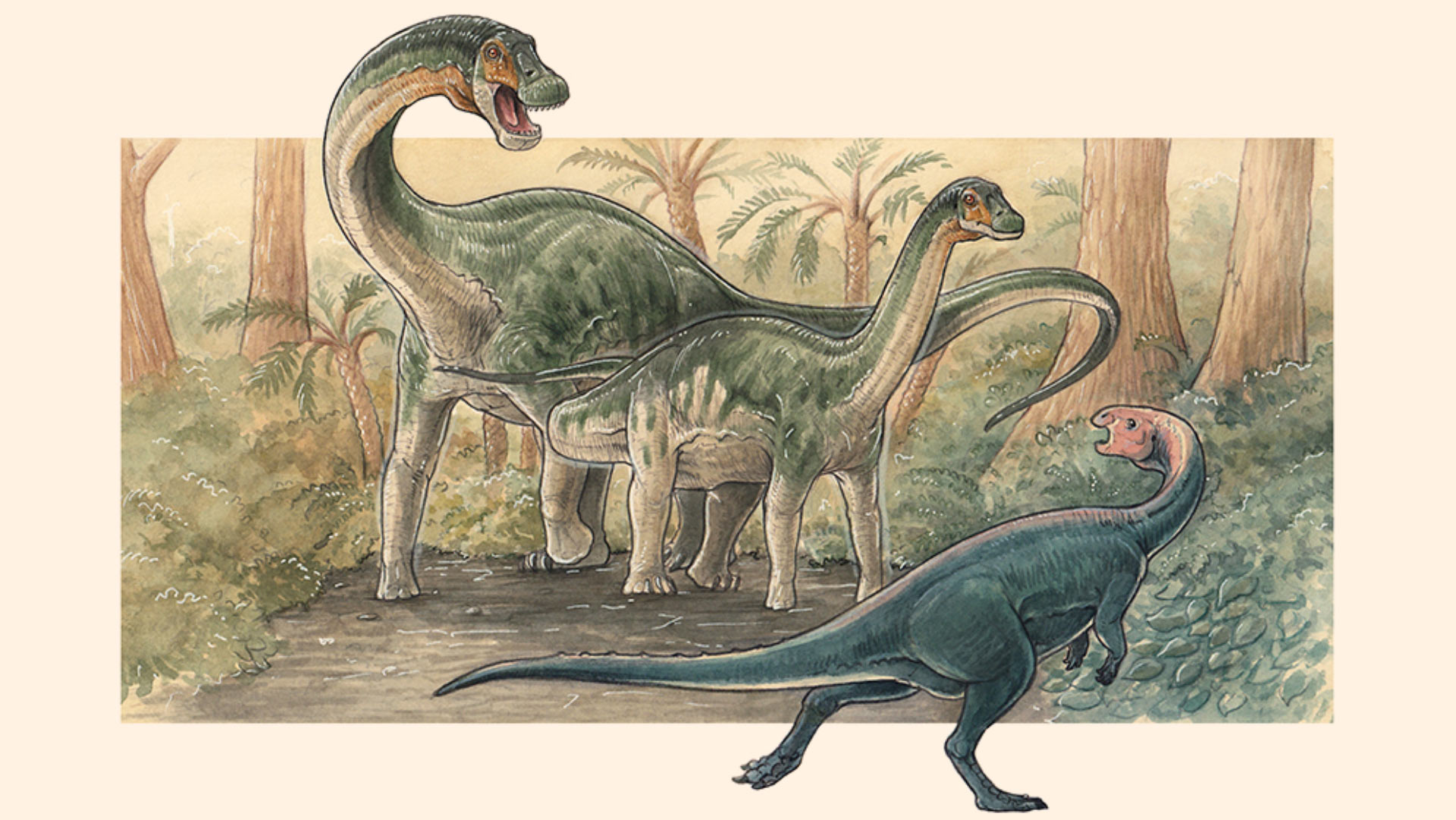
Life reconstruction of Yeneen houssayi. Image credit: Gabriel Lío.
Named Yeneen houssayi, the new species roamed our planet approximately 83 million years ago (Late Cretaceous epoch).
The ancient creature belongs to Titanosauria, a group of large, long-necked, plant-eating dinosaurs that were widespread across the supercontinent Gondwana.
“Yeneen houssayi had a small head relative to the rest of its body,” said Dr. Leonardo Filippi, a paleontologist at CONICET and the Museo Municipal Argentino Urquiza.
“It measured between 10 and 12 m (33-39 feet) in length and weighed approximately 8 to 10 tons.”
The fossil remains of Yeneen houssayi were recovered from the Bajo de la Carpa Formation at a locality known as Cerro Overo-La Invernada in the Neuquén province, Patagonia, Argentina.
The material represents one of the most complete skeletons of a titanosaur from this region, preserving six cervical vertebrae, ten dorsal vertebrae with associated ribs, the sacrum, and the first caudal vertebra.
In addition to the holotype individual, the paleontologists identified remains of at least two other sauropods at the site, including a juvenile specimen and another adult titanosaur that appears to belong to a different, as yet undescribed species.
“Phylogenetic analysis indicates that Yeneen houssayi is closely related to Narambuenatitan and Overosaurus, as a basal member of an unnominated clade of derived non-lithostrotian saltasauroids,” they said.
“The evidence provided by the Cerro Overo-La Invernada sauropod titanosaur fauna suggests that, during the Santonian, species diversity was relatively high and that at least two lineages coexisted: Collossosauria and Saltasauroidea.”
“This finding makes the Cerro Overo-La Invernada area the one with the greatest diversity of titanosaurs for the Santonian of the Neuquén Basin, which makes it an exceptional area to understand the evolution of dinosaur faunas for this period.”
The discovery is reported in a paper published on January 12, 2026 in the journal Historical Biology.
_____
L.S. Filippi et al. Yeneen houssayi gen. et sp. nov. and an overview of the sauropod titanosaurian diversity from Cerro Overo – La Invernada area (Bajo de la Carpa Formation, Santonian), North Patagonia, Argentina. Historical Biology, published online January 12, 2026; doi: 10.1080/08912963.2025.2584707